Affiliate income does not sit outside the tax system simply because it arrives from an online programme, in more than one currency, from advertisers you have never met. For publishers based in the EU, affiliate marketing tax is really three questions stacked on top of each other: what your own country treats as taxable income, whether VAT applies to what you supply, and what platforms may report about you under DAC7.
The third question causes the most confusion. DAC7 is a reporting framework, not a new tax, and it does not automatically apply to every business that pays commissions. Plenty of publishers have read otherwise.
What follows covers how affiliate income is generally treated, what DAC7 does and does not reach, when VAT becomes relevant, why tax residency drives the outcome, and which records are worth keeping.
Tax and legal disclaimer: This article is provided for general informational purposes only and does not constitute tax, legal or financial advice. Affiliate income, VAT and reporting obligations vary by country and individual circumstances. Always consult a qualified tax adviser or the relevant tax authority before making decisions about your tax obligations.
What Counts as Affiliate Income
Affiliate income is money a publisher earns for driving a measurable action for an advertiser: a qualifying registration, an application, a funded account, a completed purchase. It is commercial income earned for a marketing service.
In European fintech programmes it usually arrives through one of three commission structures:
- CPA (cost per action) pays a fixed amount when a defined conversion happens. It suits broad acquisition with a clean conversion point.
- CPL (cost per lead) pays for a qualified lead and is standard in lending, insurance and brokerage, where the advertiser converts the lead itself.
- The hybrid model combines CPL and CPS: a lead fee paid upfront, plus a share earned on the referred user’s transaction volume in the first 90 to 180 days after registration, usually with a fixed fee for content production. It fits P2P lending, investment platforms and brokers, where a user’s real value only appears once they fund an account.
Referral bonuses, tenancy fees and content fees sit alongside these, and the affiliate marketing glossary breaks down the models behind them.
For tax purposes the label matters less than the substance. Whether a payment is CPL, CPA or hybrid rarely changes how a national tax authority views it. What changes the answer is who you are, where you are resident, and whether the activity is occasional or run as a business.
Do You Have to Pay Tax on Affiliate Income in the Eu?
Affiliate income may be taxable, reportable, or both, depending on the publisher’s country of tax residence, their status as an individual or company, the scale of the activity and their circumstances. There is no single EU-wide answer, because income tax is set at national level.
The EU coordinates VAT rules, administrative cooperation and the automatic exchange of information. It does not run one income tax system. Twenty-seven Member States each set their own rates, allowances, registration duties, filing deadlines and social contribution rules.
What usually decides the treatment:
- Your tax residency
- Whether the activity is occasional or ongoing
- Whether national law treats it as a business or professional activity
- Whether registration as a self-employed person or company is required
- Social contribution obligations, which in some countries bite earlier than income tax
- Your VAT position
One question comes up constantly: what is the threshold before affiliate income becomes taxable? In many Member States the more useful question is whether the activity is organised and repeated. A single commission from an old blog post is a different fact pattern from a comparison site publishing weekly and invoicing four networks. Settle your status first, then look at thresholds.
DAC7 Explained for Affiliate Publishers
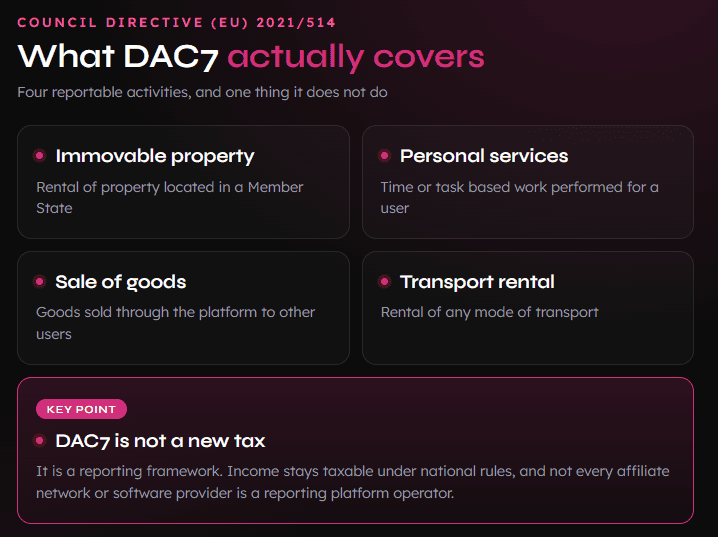
DAC7 requires certain digital platform operators to collect, verify and report information about sellers earning money through their platforms, and it allows tax authorities to exchange that information across borders. The legal text is Council Directive (EU) 2021/514, in force since 1 January 2023, with the first exchange of information covering calendar year 2023 taking place at the end of February 2024.
Two points deserve emphasis, because both are widely misreported.
First, DAC7 creates no new tax. The European Commission says so plainly: income earned by sellers on digital platforms continues to be taxed under existing national rules. What changed is visibility, not liability.
Second, the scope is narrower than most summaries suggest. The activities covered are the rental of immovable property, personal services, the sale of goods, and the rental of any mode of transport. Everything else sits outside those four categories.
Where the rules do apply, the operator files with one Member State, which passes the information to the seller’s country of residence. Reports are due no later than 31 January following the calendar year concerned, and platform operators outside the EU with reportable EU sellers must register in a single Member State and report through it.
What Information Can Be Reported Under Dac7
Reportable information falls into two groups: who the seller is, and what they earned. Depending on status and platform relationship, that can include:
- Name for individuals, or legal name for entities
- Primary address
- Tax identification number and the Member State that issued it, or place of birth for an individual with no TIN
- VAT identification number, where available
- Date of birth for individuals, business registration number for entities
- Financial account identifier, and the account holder’s name where it differs from the seller’s
- Total consideration paid or credited in each quarter of the period
- Number of relevant activities the consideration relates to
- Fees, commissions or taxes the platform withheld or charged in each quarter
Not every seller has the same set reported, and a publisher who is not a reportable seller has nothing reported at all.
Where a platform does report, it is generally required to give the reported information to the seller too. Treat that statement as a reconciliation document: check it against your own records before you file. One footnote worth knowing is that the small seller exclusion, fewer than 30 activities and consideration of no more than EUR 2,000 in the period, is written for sellers of goods. It is not a general small earner exemption, and it says nothing about whether income is taxable.
Not Every Affiliate Platform Is a Reporting Platform Operator
DAC7 attaches to platform operators that allow sellers to be connected with other users to carry out one of the covered activities for consideration. An affiliate network paying a publisher a commission for referring customers to an advertiser is not obviously doing what a goods marketplace or a gig platform does. That difference matters, which is why blanket claims about affiliate networks and DAC7 should be read sceptically.
Four business models get conflated in this discussion:
- Affiliate networks and partnership platforms that connect publishers with advertisers and settle commissions
- Affiliate software providers that license tracking technology to a brand running its own programme
- Marketplaces that intermediate sales of goods or services between users
- Payment providers and payout intermediaries that move the money
Whether a specific business is a reporting platform operator is a legal assessment based on its model and its Member State’s implementation, not a label applied from the outside. Publishers should also separate two things that look alike: a request for tax information and a DAC7 report. Networks collect tax details for onboarding, invoicing, VAT validation and sanctions screening. A request for your TIN is not proof that a report will follow, and the absence of a report is not evidence that your income is untaxed.
Affiliate marketing VAT: Where It Starts to Matter
VAT is a tax on supplies, charged through the chain and ultimately borne by the final consumer. Income tax looks at your profit. VAT looks at your transactions. Different rules, different timing, and a common blind spot for publishers who otherwise have income tax under control.
When a publisher acts as a business supplying marketing or advertising services to an advertiser or network, that supply can fall within the scope of VAT.
Place of Supply and the Reverse Charge
For services supplied to a taxable person, the general rule places the supply where the customer is established, under Article 44 of the VAT Directive. Where the supplier is not established in the customer’s country, the customer is generally the person liable for the VAT under Article 196. In practice the publisher invoices without VAT and the business customer accounts for it locally. Cross-border B2B supplies of this kind normally also have to appear on a recapitulative statement, commonly called the EC Sales List.
The consequence people miss is that the reverse charge does not mean no VAT administration. It usually means holding a VAT identification number, validating the customer’s number, using the correct invoice wording and filing a periodic listing.
Thresholds, Registration and the Sme Scheme
Registration thresholds are national and differ considerably. Since 1 January 2025, the reformed SME scheme also lets a small business established in one Member State apply a VAT exemption to supplies in other Member States, provided neither the Union annual threshold of EUR 100,000 nor the national threshold in each Member State concerned is exceeded. Businesses using it register once at home and work with a single quarterly report and simplified invoices, and the conditions are set out by the European Commission.
Do not read a domestic exemption as a complete answer. Sitting below a national registration threshold does not always settle the treatment of intra-EU B2B services, and several Member States expect a trader supplying or receiving such services to hold a VAT identification number regardless.
Affiliate Marketing Vat vs Income Tax

| Area | Income tax | VAT |
| What it concerns | Income and profit | Tax on qualifying supplies |
| Who determines the rules | Primarily national authorities | EU framework with national implementation |
| Registration | Depends on national rules and your status | Depends on VAT rules, thresholds and circumstances |
| Cross-border considerations | Tax residency and local rules | Place of supply and customer status |
| Reporting | Tax returns and supporting records | VAT returns and related listings where applicable |
This is a high-level educational comparison, not a determination of your position.
Tax Residency, and When Affiliate Activity Becomes a Business
Where you are paid from is not the same as where you are taxed. A publisher resident in Portugal, invoicing a network established in Estonia, paid into an account in Lithuania, will usually be looking at their country of residence first. Payment routing is an operational detail. Residency is the anchor.
National law defines residency, typically through days of presence, a permanent home, or the centre of a person’s personal and economic interests. Where two countries both claim you, double tax treaties exist to resolve it. Moving mid-year or keeping ties in two countries turns this into a professional question rather than a self-serve one.
The related question is when ongoing affiliate activity becomes a business under national law. Factors that commonly matter include frequency and continuity, profit motive, degree of organisation such as sites, contracts and paid media, scale of revenue, and whether you present yourself commercially to advertisers. There is no universal EU threshold, and anyone quoting one is describing a single country. In practice the trigger is often administrative rather than financial: when a network asks for a VAT number or a business invoice, that is the moment to check your registration status.
Tax Identification Numbers And W-8BEN
What Is a Tax Identification Number?
A tax identification number is the identifier a national tax authority uses to link a taxpayer to their record. TIN specifications are set by national authorities, so structures differ by country, and some countries use different formats for different categories of taxpayer. The Commission’s TIN portal can check whether a number’s structure looks valid, but it does not confirm that the number exists or belongs to a particular person.
Networks may request it for onboarding, invoicing, VAT validation, payout compliance, or reporting where reporting applies. Give the correct number and make sure the legal name and address match your tax record. Mismatched details are one of the most ordinary reasons payouts get held.
W-8BEN And European Publishers
W-8BEN is a US tax form, Certificate of Foreign Status of Beneficial Owner for United States Tax Withholding and Reporting, used by foreign individuals. Entities use a different form, W-8BEN-E. Where relevant, it supports a claim to a reduced rate of, or exemption from, US withholding under an income tax treaty.
It becomes relevant when a payment arrangement involves US-source income and a US withholding agent. Many European publishers working with European networks and advertisers never see one. Others working with US programmes are asked for it at onboarding.
Two things it does not do. It does not replace local obligations, since the income remains reportable at home under national rules. And it is not a universal requirement for European publishers. If you are unsure whether it applies, or which form fits a company rather than an individual, ask a tax adviser rather than your affiliate manager.
Records Affiliate Publishers Should Keep
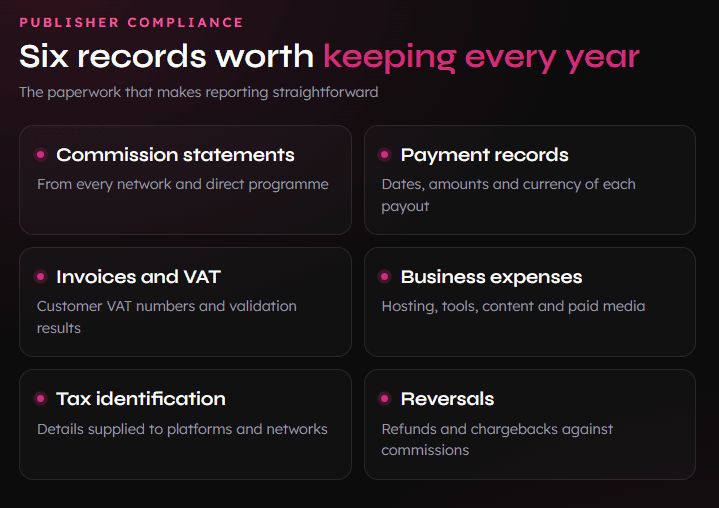
Good records are the cheapest form of affiliate tax compliance. Keep:
- Affiliate statements and commission reports from every network and direct programme
- Invoices issued and received, where applicable
- Payment records and bank statements, with the date and currency of each payout
- Platform fees, payment processing fees and any amounts withheld
- Business expenses: hosting, tools, content, paid media, subscriptions
- VAT documentation, including customer VAT numbers and validation results
- Tax identification information provided to platforms
- Programme agreements and commission terms
- Refund, chargeback and reversal records
- Correspondence about payouts, adjustments and reporting
Retention periods are national and vary, so check the requirement that applies to you rather than assuming a common standard.
Publishers working across several networks and direct advertisers should keep one central income log rather than relying on dashboards that change or disappear. Track the advertiser or network, dates earned and paid, gross amount, fees, currency, payment status and reversals. Reversals are the usual cause of mismatched year-end figures: a commission approved in December and reversed in February appears differently in two systems.
It also helps to understand how those numbers are produced. Our guide to affiliate links and tracking explains where attribution data comes from, and how much affiliate marketers actually earn covers how income builds across programmes.
Affiliate Marketing Tax Across Europe: National Rules Decide the Outcome
Affiliate marketing tax looks like a European topic and behaves like a national one. Across Member States you will find differences in income tax rates and allowances, whether and when registration as a sole trader or company is required, social contribution obligations, VAT thresholds and duties, which expenses are deductible and how they must be evidenced, record retention periods, and filing deadlines and formats.
A publisher in Finland and a publisher in Poland can run identical sites, earn identical commissions, and still face different registration and contribution requirements. That is why advice picked up from a publisher in another country is unreliable, however confidently it is given.
Start from the official source in your own country. Most national tax authorities publish guidance on income earned through digital platforms, and the European Commission maintains a directory of national DAC7 pages by Member State.
Publisher Compliance Checklist
- Determine your tax residency
- Check whether your affiliate activity has to be registered locally
- Understand your national income tax obligations and filing deadlines
- Check whether VAT applies to what you supply, and to whom
- Provide accurate tax identification information to platforms where required
- Keep income records for every programme, not just the largest
- Keep expense records with evidence
- Review any DAC7-related information request or statement you receive
- Retain programme statements and payment records for the period your country requires
- Take professional advice where circumstances are complex or changing
Common Affiliate Tax Mistakes
- Assuming affiliate income is tax free because it is small, foreign or paid online
- Confusing DAC7 reporting with taxation, and assuming a report means tax is due
- Assuming the reverse: no report does not mean no obligation
- Ignoring VAT until an advertiser asks for a VAT number
- Tracking one network carefully and the other four loosely
- Keeping no expense records, then losing legitimate deductions
- Supplying a tax identification number that does not match the legal name on the account
- Applying another country’s rules picked up from a forum or a video
- Overlooking tax residency after a move
- Relying on tax content that has quietly gone out of date
When Should a Publisher Speak to a Tax Adviser?
- Income becomes substantial or grows quickly
- You operate through a company rather than as an individual
- You work across more than one country, or have recently moved
- You have international advertisers and cross-border invoicing
- VAT registration may be required, or you are unsure whether it already is
- You have several income sources beyond affiliate commissions
- Your tax residency is unclear or contested
- You receive US-source payments, or are asked to complete a W-8 form
- You are simply not confident how to report what you have earned
How Circlewise Supports Publishers
Circlewise works with fintech advertisers across Europe and gives publishers access to those programmes, with tracking, reporting and payout records that make income easier to reconcile at year end. Clean statements save time when you or your adviser need to reconstruct a year.
To be direct about the boundary: Circlewise is not a tax adviser and does not provide tax advice. Platform documentation supports your reporting, it does not replace a qualified adviser or your national tax authority. Terms and policies are set out in our legal information.
Key Takeaways
- Affiliate marketing tax is decided nationally. The EU coordinates VAT rules and information exchange, not a single income tax system.
- DAC7 is a reporting framework under Council Directive (EU) 2021/514. It imposes no new tax and covers four defined activity types.
- Not every affiliate network or software provider is a reporting platform operator.
- VAT follows separate rules. For B2B services the place of supply is generally the customer’s country, and the reverse charge often applies.
- Tax residency usually matters more than where a payment originates, and W-8BEN does not replace local obligations.
The publishers who find this straightforward are rarely the ones with the simplest earnings. They are the ones who settled their status early, kept one reliable income log, and asked an adviser the awkward questions before the filing deadline rather than after it.
This information is not tax advice. Tax rules can change, so publishers should verify current requirements with a qualified professional or relevant tax authority.
Frequently Asked Questions
Do I have to pay tax on affiliate income in the EU?
Possibly, and it depends on your country of tax residence, your status and your circumstances. Income tax is set nationally, so there is no single EU-wide answer.
Is affiliate income taxable?
Affiliate income is commercial income earned for a service, and most tax systems treat it as reportable in some form. How it is taxed, and whether social contributions or VAT also apply, depends on national rules and on whether the activity is occasional or ongoing.
What is DAC7 for affiliate publishers?
DAC7 is Council Directive (EU) 2021/514. It requires certain digital platform operators to collect, verify and report information about sellers earning through their platforms, and allows tax authorities to exchange it. It covers four defined activity types, so many affiliate arrangements sit outside it.
Does DAC7 mean I automatically owe tax?
No. DAC7 is a reporting mechanism and creates no new tax. Whether tax is due depends on the national rules that apply to you, exactly as before.
What information can platforms report under DAC7?
Where a platform is a reporting platform operator, reportable data can include name, address, tax identification number, VAT number where available, date of birth for individuals, business registration number for entities, financial account identifier, quarterly consideration, the number of relevant activities, and fees or amounts withheld.
Do affiliate publishers need to register for VAT?
It depends on status, turnover, customers and country. Thresholds and duties are national, and cross-border B2B services follow place of supply rules that can create obligations even for small businesses.
What is a tax identification number?
It is the identifier a national tax authority uses to link a taxpayer to their record. Formats are set nationally and differ between countries, and some countries use different structures for different taxpayer categories.
Do European affiliate publishers need a W-8BEN?
Not automatically. It is a US form for foreign individuals, relevant where a payment arrangement involves US-source income and a US withholding agent. Entities use W-8BEN-E. Many European publishers never need either.
What records should affiliate publishers keep?
Commission statements, payment records, invoices where applicable, fee and expense documentation, VAT records, programme agreements, reversal records, and the tax identification details you have supplied. Retention periods vary by country.
How is affiliate income reported in different EU countries?
Reporting formats, deadlines, registration duties and social contribution rules differ across Member States, so start from your own national tax authority’s guidance.
Sources and further reading
- European Commission, DAC7: taxation-customs.ec.europa.eu
- European Commission, Persons liable for VAT: taxation-customs.ec.europa.eu
- European Commission, VAT special schemes: taxation-customs.ec.europa.eu
- European Commission, Cross-border SME scheme: sme-vat-rules.ec.europa.eu
- European Commission, Taxpayer Identification Number: taxation-customs.ec.europa.eu
- IRS, About Form W-8 BEN: irs.gov