An influencer partnership is a structured, ongoing commercial relationship between a brand and a content creator. It is not a one-off sponsored post or a quick product mention. Both sides agree on terms, deliverables, timelines and compensation, and the arrangement runs long enough for the creator to become a genuine representative of the brand rather than a passing voice.

That distinction matters more than it might seem. A single paid post is a transaction. A brand ambassador program or a structured influencer partnership is a business relationship, with contracts, payment models, and obligations that need to be set up properly from the start.
This post covers five partnership structures, how to pay creators, what your contract should contain, and how to handle disclosure across European markets. If you are looking for the mechanics of affiliate link tracking, attribution and performance measurement for creator affiliates,
Five Influencer Partnership Structures
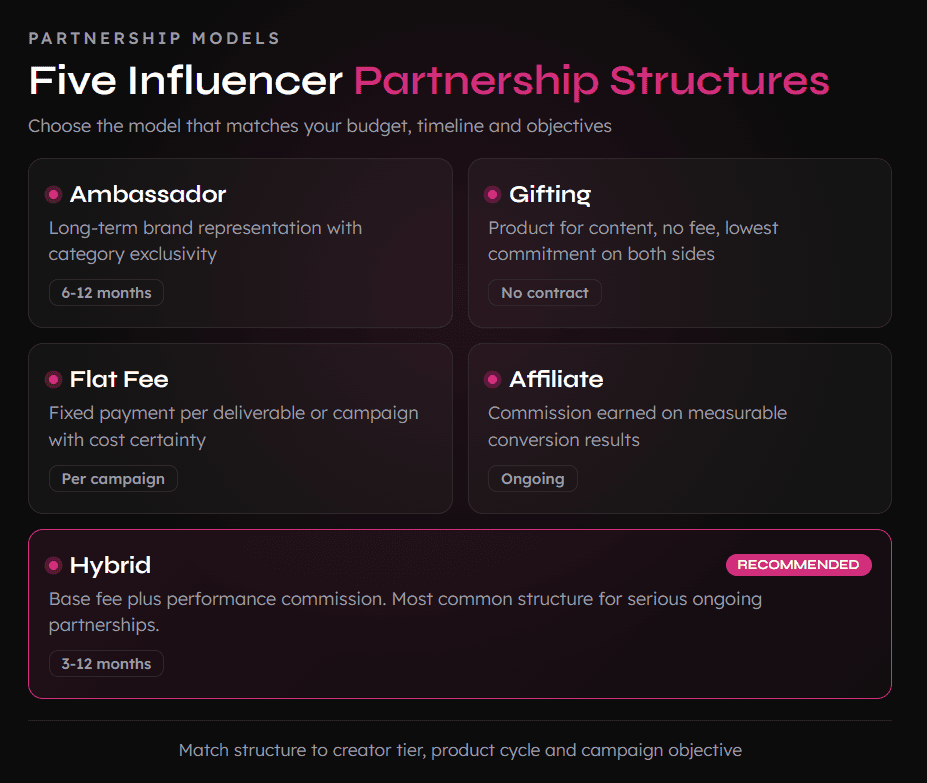
Not every creator relationship needs the same commercial framework. The right structure depends on your budget, your product, how much creative control you want, and how long you plan to work with someone. Here are the five models most brands end up using, and where each tends to go wrong.
Ambassador Programme
A brand ambassador program is a long-term arrangement where a creator represents your brand over months or years. Ambassadors are typically semi-exclusive or fully exclusive within their product category. They appear in campaigns, attend events, and are expected to integrate the brand into their regular content.
Who it suits: Brands with a clear identity and budget to sustain a relationship for six months or more. Common in fintech and financial services, where trust and consistent messaging carry regulatory weight.
What the brand commits to: Regular payment (usually a monthly retainer), product access, early releases, and often a degree of creative collaboration.
What the creator commits to: Agreed content volume, exclusivity within the category, availability for campaigns, and consistent brand representation.
Where it goes wrong: Brands sign ambassadors and then fail to brief them properly, or lock them into exclusivity without providing enough work to justify the restriction. Creators lose enthusiasm when they feel underused. The other common mistake is treating an ambassador like an employee rather than a partner. Prescriptive briefs and heavy-handed approval processes defeat the purpose.
Gifting
The simplest structure. You send a product, the creator may or may not post about it, and no money changes hands. There is no obligation on either side, which makes gifting low risk but also low control.
Who it suits: E-commerce brands with a physical product and a wide pool of potential creators. Also useful for testing whether a creator is a good fit before committing to a paid structure.
What the brand commits to: Product and shipping costs. Sometimes a personalised note or briefing, but nothing contractual.
What the creator commits to: Nothing, technically. Some brands send a brief with suggested talking points, but without a contract there is no enforceable obligation. Worth noting: even gifted products trigger disclosure obligations in every EU market. Free does not mean undisclosed.
Where it goes wrong: Brands send products to hundreds of creators, track nothing, and then wonder why the results are inconsistent. Gifting works best as a relationship opener, not a strategy in itself.
Flat Fee
A straightforward paid arrangement. The brand pays a fixed amount per deliverable (a video, a post, a series of stories) or per campaign. The scope, price and timeline are agreed before work begins.
Who it suits: Brands running time-bound campaigns with specific deliverables. Also practical when you need content for a product launch or seasonal push and want certainty on cost.
What the brand commits to: Payment within agreed terms, a clear brief, timely feedback on drafts.
What the creator commits to: Deliverables to specification, by deadline, with an agreed number of revision rounds.
Where it goes wrong: Two common problems. First, brands underbrief and then request extensive revisions, which creates friction. Second, flat-fee deals do not incentivise the creator to optimise performance. If the content underperforms, the brand still pays the same amount.
Affiliate
In an affiliate structure, the creator earns a commission based on results. This is a commercial arrangement, and one of several partnership types rather than a separate discipline. For how affiliate tracking and attribution actually work in creator partnerships
Who it suits: Brands with a strong conversion funnel and products that creators can promote with clear calls to action. Particularly effective in fintech and e-commerce where the purchase or sign-up action is straightforward.
What the brand commits to: Commission structure, reporting, timely payouts.
What the creator commits to: Ongoing promotion, typically with more flexibility on format and timing than a flat-fee arrangement.
Where it goes wrong: Smaller creators struggle with purely commission-based arrangements because the income is uncertain. If your product has a long consideration cycle, or if the creator’s audience is top-of-funnel, commission-only will not attract the people you want.
Hybrid
A combination of a base fee (retainer or per-deliverable payment) plus a performance component (commission on conversions). This is the most common structure for serious, ongoing partnerships.
Who it suits: Most brands working with mid-tier creators and above. The base fee shows commitment and attracts better talent. The performance component keeps incentives aligned.
What the brand commits to: Regular base payment plus commission, clear reporting, and enough support for the creator to actually perform.
What the creator commits to: Agreed content output plus active promotion beyond the minimum.
Where it goes wrong: Getting the split wrong. If the base fee is too low, it feels like a commission-only deal with a token gesture. If it is too high relative to the performance component, you lose the alignment benefit. A common starting point is 60-70% base, 30-40% performance, adjusting as the relationship matures and both sides have data.
Partnership Structures Compared
| Structure | Typical commitment | How paid | Brand risk | Creator appeal | Best for |
| Ambassador programme | 6-12 months | Monthly retainer | High (long commitment) | High (stable income, status) | Brand building, fintech, financial services |
| Gifting | One-off or ongoing | Product only | Low | Low (no income) | Product seeding, relationship testing |
| Flat fee | Per campaign | Fixed per deliverable | Medium (pay regardless of result) | Medium (certain income, no upside) | Launches, seasonal campaigns |
| Affiliate | Ongoing | Commission on results | Low (pay on performance) | Variable (uncertain income) | E-commerce, strong conversion funnels |
| Hybrid | 3-12 months | Base fee + commission | Medium | High (security + upside) | Most ongoing partnerships |
Payment Models in Detail
Payment structure is one of the areas where brands most often rely on guesswork. Getting it right affects who you can attract, how motivated they are, and whether the economics actually work.
Flat Fee Per Deliverable
The simplest model. You agree a price for each piece of content: a YouTube video, an Instagram Reel, a TikTok post, a blog review. Rates vary enormously depending on platform, audience size, engagement rate, and niche.
Rough benchmarks for European markets (these shift constantly, so treat them as orientation rather than gospel):
- Micro-influencers (10,000-50,000 followers): EUR 200-1,500 per Instagram post; EUR 500-3,000 per YouTube video
- Mid-tier (50,000-250,000): EUR 1,500-5,000 per Instagram post; EUR 3,000-10,000 per YouTube video
- Macro (250,000+): EUR 5,000+ per post, with significant variation by market and vertical
For fintech brands, expect to pay a premium. Financial content requires more research, carries compliance obligations (creators talking about investment products must follow MiFID II marketing rules in the EU), and limits the creator’s other commercial opportunities through category exclusivity.
Monthly Retainer
A fixed monthly payment in exchange for an agreed content volume and availability. Retainers typically run from EUR 1,000 per month for micro-influencers to EUR 10,000+ for established creators with large, engaged audiences.
Retainers suit ambassador programmes and longer hybrid arrangements. They provide creators with income stability, which generally results in better, more consistent content. But they also mean you are paying regardless of output quality or performance, so pair them with clear deliverable expectations.
CPM-Based Payment
Some brands pay against guaranteed impressions or views, using a cost-per-thousand (CPM) model. The creator guarantees a minimum reach, and the payment scales accordingly. Typical CPM rates for sponsored content in European markets range from EUR 10 to EUR 50, depending on the platform and audience quality.
This model can work well for awareness campaigns where reach is the primary objective. It shifts some risk to the creator, who has to deliver the audience. But CPM-based deals require reliable analytics, and you should verify the creator’s historical reach data before agreeing to guaranteed numbers.
Commission-Based Payment
Under a commission arrangement, the creator earns a percentage of sales or a fixed amount per conversion. The commercial terms, such as commission rates and payout thresholds, vary by industry. For more on how affiliate programmes structure these payments
Commission-only works best with creators who already have experience monetising their audience and are comfortable with variable income. For newer creators or those with audiences earlier in the purchase funnel, combining commission with a base fee is usually necessary to secure the partnership.
Hybrid: Retainer Plus Commission
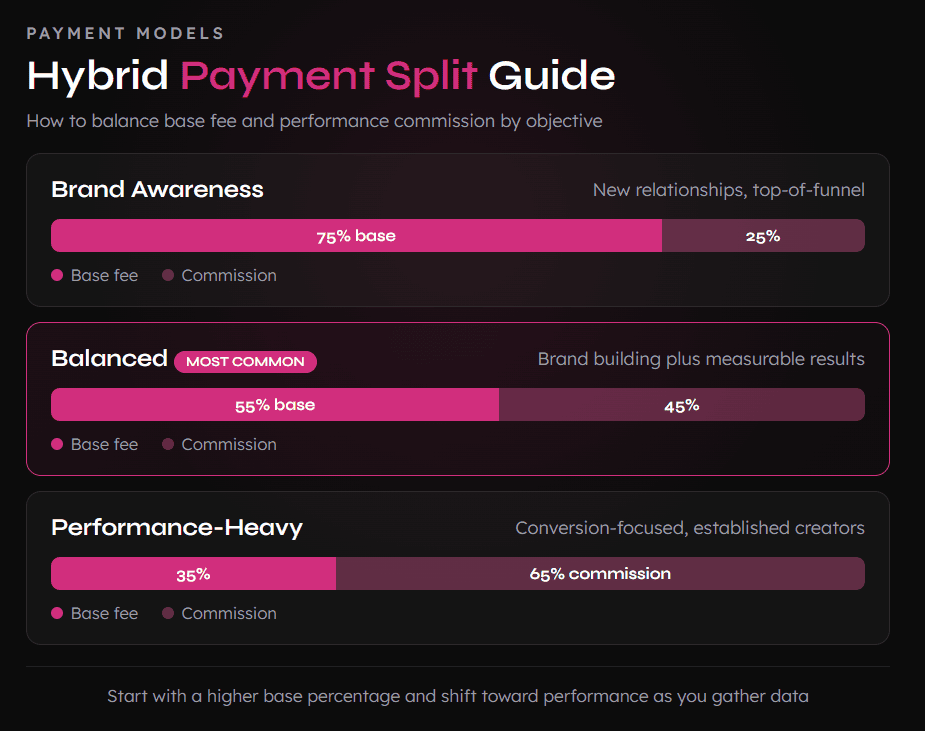
The hybrid model combines a fixed base with a performance layer. The base payment compensates for the creator’s time and content production. The commission rewards results beyond the baseline.
How to set the split depends on your objectives:
- Brand awareness focus: 70-80% base, 20-30% commission
- Balanced brand and performance: 50-60% base, 40-50% commission
- Performance-heavy: 30-40% base, 60-70% commission
Start with a higher base percentage for new relationships and shift toward performance as you both gather data. Renegotiating the split after the first quarter is standard practice, not a sign that the deal was wrong to begin with.
Product-Only and Equity Arrangements
Product-only compensation works for gifting and early-stage relationships with micro-influencers. It is not a sustainable model for ongoing partnerships with established creators.
Equity arrangements (offering shares or options instead of, or alongside, cash) occasionally appear in startup partnerships. These can be powerful for long-term alignment but introduce complexity around valuation, vesting, and tax. They suit fintech startups working with a small number of high-profile creators who genuinely believe in the product. For everyone else, stick to cash and commission.
Payment Timing
How you pay matters as much as how much. Standard terms in the European market:
- Net 30: Most common for flat-fee and retainer arrangements
- Milestone payments: Split payment across deliverable milestones (e.g. 50% on brief acceptance, 50% on publication)
- Upfront percentages: 25-50% upfront is standard for larger campaigns, particularly with creators who have the leverage to demand it
- Commission payouts: Monthly or bi-monthly, with a validation period to account for returns and chargebacks
Cross-Border Payments: VAT and Invoicing
When working with creators in different EU countries, VAT on services becomes relevant. Under the EU’s B2B reverse charge mechanism, the brand (as the recipient) accounts for VAT in most cases, but the creator still needs to issue a compliant invoice. Creators outside the EU have different withholding requirements depending on bilateral tax treaties.
What Goes in the Contract

This is the section that separates professional partnerships from informal arrangements that cause problems later. Every influencer contract should cover these areas:
Deliverables and specification. Be precise about format, platform, quantity and timeline. “Three Instagram posts” is not enough. Specify feed posts versus Reels, minimum length for video content, and whether Stories are included.
Exclusivity and category restrictions. Define the product category where exclusivity applies and how long it extends beyond the contract term. A fintech brand might restrict a creator from promoting competing neobanks for the contract duration plus 90 days. Be reasonable: overly broad exclusivity clauses deter good creators and may not be enforceable in some jurisdictions.
Usage and licensing rights. This is the clause brands get wrong most often. Specify exactly how the brand can use the creator’s content: on which channels, for how long, and whether you can modify it or use it in paid media. Usage rights for paid amplification (running creator content as ads) should be negotiated and compensated separately. Assuming you own the content because you paid for it is a reliable way to end up in a dispute.
Term and renewal. Fixed term with an option to renew, or rolling with a notice period. Include what happens to content after the term ends. Does the creator remove it? Can the brand continue using it?
Approval process and turnaround. Set a clear workflow: creator submits draft, brand provides feedback within X business days, creator revises, brand approves. Define how many revision rounds are included. Endless revision cycles are one of the top complaints creators have about brand partnerships.
Termination and morality clauses. Both sides should be able to exit with notice. Include grounds for immediate termination (material breach, reputational harm). Morality clauses are standard but should be drafted carefully. Overly broad morality clauses can be challenged, and they create a chilling effect that makes creators cautious about your brand.
Disclosure obligations. Make compliance the creator’s contractual responsibility, but specify the standard. Do not assume the creator knows the rules in your target markets.
Payment terms. Method, currency, timing, invoicing requirements, and what happens if the brand pays late. Include any applicable VAT terms.
Ownership of content after the term. Clarify whether the brand retains a licence to use content created during the partnership, or whether rights revert to the creator.
How to Write the Brief
A good brief gives the creator enough direction to produce relevant content while leaving enough space for their voice and style to come through.
Overly prescriptive briefs produce content that sounds like an advert. The creator’s audience can tell, engagement drops, and you end up paying more for worse results. The brief should communicate what you need, not how to say it.
What a usable creator brief contains:
- Campaign objective (awareness, consideration, conversion)
- Product or service to feature, with key details and any compliance language that must be included
- Target audience description
- Key messages (two or three maximum)
- Required disclosures and compliance language
- Deliverable specifications (format, platform, length)
- Timeline with draft and publication dates
- What is off-limits (competitor mentions, specific claims, regulated language)
- Approval process and contact person
What the brief deliberately leaves open:
- Creative concept and execution
- Tone and style (the creator’s audience follows them for their voice, not yours)
- Exact script or wording (unless regulatory requirements demand specific language, as they do for some financial products under MiFID II)
Disclosure Requirements Across Circlewise’s Six Markets
Disclosure obligations across Europe share a common foundation: the EU Unfair Commercial Practices Directive (2005/29/EC) classifies influencers engaged in commercial promotion as traders and requires that commercial intent is never hidden from consumers. The European Commission’s Influencer Legal Hub, developed with academic experts, sets out five key principles for disclosure in social media marketing.
Beyond that EU baseline, each market has its own regulatory body, enforcement approach and practical expectations. The table below covers the six markets where Circlewise operates.
| Market | Governing body / framework | Disclosure requirement | Notes |
| Germany | Landesmedienanstalten (state media authorities); Medienstaatsvertrag (MStV); UWG (Act against Unfair Competition) | Commercial content must be labelled as advertising (“Werbung” or “Anzeige”). Label must be visible at the start of the content. | Germany has some of the strictest enforcement in Europe. Several court rulings have established that even unpaid brand mentions may require labelling if there is any commercial relationship. The BGH ruled in 2021 that promoting your own company does not require separate disclosure if commercial intent is already obvious. |
| Netherlands | Stichting Reclame Code (SRC); Commissariaat voor de Media (Dutch Media Authority); Dutch Media Act | Relevant relationships must be disclosed clearly and unambiguously. Major video creators must register with the Dutch Media Authority. | The Advertising Code for Social Media and Influencer Marketing was updated in July 2026 to cover UGC creators, virtual influencers and AI-generated content. Discount codes alone are not sufficient disclosure. |
| Poland | UOKiK (Office of Competition and Consumer Protection); general consumer protection and unfair competition law | Commercial intent must not be hidden. Advertising must be clearly labelled. | No specific influencer law, but UOKiK has actively enforced existing rules. Fines can reach up to 10% of annual turnover. UOKiK published guidance on influencer advertising labelling in 2022. |
| Sweden | Konsumentverket (Swedish Consumer Agency); Marketing Act (Marknadsforingslagen) | Marketing must be clearly identifiable as such. The label must appear where consumers see it immediately. | Konsumentverket published a major enforcement report in early 2026 documenting persistent non-compliance. Fines up to SEK 1.5 million. The self-regulatory programme “Reko content” offers creator certification. |
| Norway | Forbrukertilsynet (Norwegian Consumer Authority); Marketing Control Act | Commercial content must be clearly marked. Influencers may be classified as AVMS providers. | Norway has imposed financial penalties on creators for disclosure failures. The Consumer Authority actively monitors social media. |
| Finland | Kuluttaja-asiamies (Consumer Ombudsman); Consumer Protection Act | Commercial influencer content must be clearly identified as advertising and the advertiser/brand must be disclosed. The label should be immediately visible, placed at the beginning of the post/content, and remain visible throughout the commercial content. | The Consumer Ombudsman’s “Influencer marketing in social media” guidance was updated in 2025, with further clarifications incorporated in November 2025. Recommended labels include “Advertisement [Company/Brand]” and, where products were received for advertising purposes without an agreement, “Advertisement / Gifted [Company/Brand].” Labels such as “PR” or “Gifted” alone are not considered sufficiently clear. Both the company and influencer have responsibilities for ensuring advertising is recognizable. |
For fintech brands specifically, additional rules apply. Creators promoting investment products, credit services or payment products in the EU must comply with the financial promotion requirements under MiFID II (for investment products) and the Consumer Credit Directive (for lending). This means that beyond standard advertising disclosure, the content itself may need to include risk warnings, representative APR examples, or other mandated information. These obligations fall on the brand, not the creator, but the contract should make clear who provides the compliance language and who is responsible for ensuring it appears correctly.
Measuring a Partnership That Is Not Purely Performance-Based
When a partnership includes a retainer or flat-fee component, you cannot rely solely on conversion data to evaluate it. You need a broader measurement framework.
Reach and quality of reach. Raw impressions matter less than who saw the content. Check audience demographics and geographic fit against your target market. A creator with 200,000 followers in the wrong country is worth less than one with 30,000 in your core market.
Engagement quality. Look beyond likes and comments to the substance of engagement. Are people asking questions about the product? Saving the post? Sharing it to their stories? Surface-level engagement metrics reward controversy and entertainment, not purchase intent.
Content output value. What would it cost to produce equivalent content in-house or through an agency? Many brands find that creator content, once they have the usage rights, performs better than studio-produced assets in paid channels and costs less to create.
Branded search lift. Monitor branded search volume during and after a campaign. If a creator partnership is genuinely reaching new audiences, you should see a measurable increase in people searching for your brand name.
Discount code redemption. Unique discount codes assigned to each creator provide a simple directional measure of purchase intent, even when the full conversion path is harder to track.
Survey attribution. Post-purchase surveys asking “how did you hear about us?” remain one of the most reliable ways to attribute conversions to creator partnerships, especially for products with long consideration cycles.
Frequently Asked Questions
What Is a Brand Ambassador Programme?
A brand ambassador programme is a long-term influencer partnership where a creator represents your brand over months or years, typically with some degree of category exclusivity. Unlike one-off sponsored posts, ambassador arrangements involve regular content commitments, brand representation at events, and ongoing collaboration. They work best for brands that want consistent messaging and are willing to invest in a sustained relationship.
How Much Should You Pay an Influencer?
Rates depend on the creator’s audience size, engagement rate, platform, content format, and your industry. European micro-influencers typically charge between EUR 200 and EUR 1,500 per Instagram post, while mid-tier creators charge EUR 1,500 to EUR 5,000. Fintech and financial services brands generally pay higher rates because the content requires specialist knowledge and compliance with financial promotion rules. The best approach is to agree on a structure (flat fee, retainer, or hybrid) that matches your campaign objectives rather than haggling over individual post prices.
What Is the Difference Between Gifting and a Paid Partnership?
Gifting involves sending a product to a creator with no contractual obligation and no financial compensation. A paid partnership involves an agreed fee, a contract, defined deliverables, and typically a timeline. Both require disclosure under EU consumer protection law. Even a gifted product creates a commercial relationship that must be transparent to the audience.
What Should an Influencer Contract Include?
At minimum: deliverables with specifications, exclusivity terms, usage and licensing rights, contract duration, approval process, payment terms, termination clauses, and disclosure obligations. The clause most often neglected or poorly drafted is usage rights. Specify exactly how the brand can repurpose creator content, on which channels, and for how long.
Do Influencers Have to Disclose Gifted Products?
Yes. Under the EU Unfair Commercial Practices Directive, any commercial relationship between a brand and a creator must be disclosed, regardless of whether money changes hands. Gifted products, free services, affiliate commissions, and any other form of compensation all trigger disclosure obligations. This applies across all EU member states, and enforcement has increased significantly since 2024.
Building influencer partnerships that work
Setting up creator partnerships properly from the start, with the right structure, a clear contract, and a payment model that suits both sides, saves considerable time and budget down the line. Most of the problems brands run into with influencer marketing come from informal arrangements that were never designed to scale.