
Your commission model is not a line item on a contract. It is the single decision that shapes which publishers will work with you, how much margin you keep on every conversion, and where the financial risk sits between you and your partners.
Get it wrong and the programme stalls quietly. You either overpay for low quality traffic, underpay and watch strong publishers ignore your offer, or build a structure that looked efficient in a spreadsheet but attracts nobody worth recruiting.
This post is about making that choice. It assumes you already know what CPA, CPL, CPS and revenue share mean. If you need definitions, the Circlewise affiliate marketing glossary covers all four models. What it does not cover, and what the rest of this article addresses, is the economics behind each model and how to decide which one fits your product, your margin, and the publishers you actually want in your programme.
The Decision Framework: Match The Model To Your Economics

Before getting into the detail of any single model, here is the decision laid out against the inputs that actually matter. This table is designed to be read top to bottom. Find the row that best describes your business, and start there.
| Your situation | Recommended model | Why |
| High gross margin (above 60%), recurring revenue, long customer lifetime | Revenue share | You can afford to pay over time, and the model attracts publishers who care about quality |
| Moderate margin (30-60%), clear single conversion event, short sales cycle | CPA | Clean, predictable cost per acquisition; publishers get paid fast |
| Long or complex sales cycle, conversion happens offline or requires approval | CPL | You pay for the lead, you own the conversion process |
| E-commerce, immediate transaction, variable basket size | CPS | Commission scales with order value; natural fit for product catalogues |
| High LTV product, new programme, need to recruit strong publishers quickly | Hybrid (reduced CPA or CPL + revenue share) | The upfront payment gets publishers started; the recurring element rewards quality |
| Mature programme, proven publishers, looking to optimise margins | Tiered escalators on any base model | Rewards volume and quality; reduces blended commission cost from underperformers |
That table is a starting point, not a formula. The rest of this article explains the economics behind each column.
Revenue Share: Why It Deserves The Most Attention
Revenue share is the model with the most complex economics, the highest potential upside for both parties, and the one most fintech advertisers should seriously evaluate before defaulting to a flat CPA.
How Revenue Share Works In Practice
The publisher earns a percentage of the net revenue that each referred customer generates, either for a fixed period (commonly 12 to 24 months) or for the customer’s lifetime. “Net revenue” typically means gross revenue minus processing fees, refunds, and chargebacks. The exact deduction methodology belongs in the affiliate agreement before any traffic flows, because ambiguity here is where trust breaks down.
Most fintech programmes in Europe set revenue share percentages between 20% and 40% of net revenue, according to a 2026 Tapfiliate analysis of over 2,600 programmes. The range is wide because margins vary enormously between a payments processor and a wealth management platform.
Lifetime Versus Fixed-window: One Choice, Two Completely Different Programmes
A lifetime revenue share has no end date. The publisher earns for as long as the customer remains active. A fixed-window revenue share, say 12 or 18 months, caps the obligation.
This single distinction changes everything about publisher recruitment. Strong content publishers and comparison sites with organic traffic prefer lifetime models because the compounding is what makes the economics work for them. They are building long-term assets and want long-term returns. A 12-month cap tells them you are borrowing the language of revenue share without committing to the principle behind it.
On the other hand, lifetime revenue share creates an open-ended liability on your balance sheet. Finance teams push back hard on this, and with reason. Forecasting quarterly commission costs when your obligation on a two-year-old cohort is still growing requires solid cohort tracking and a decent retention model.
The practical middle ground: start with an 18 or 24-month window. It is long enough to attract quality publishers and short enough to model. Once you have 12 months of cohort data, you will know whether extending to lifetime makes financial sense.
A Worked Calculation: Revenue Share Versus Flat Cpa Over 24 Months

Suppose you run a European investment platform. A referred customer generates an average of EUR 15 per month in net revenue after platform fees and costs. Your average customer lifetime is 30 months.
Scenario A: Flat CPA of EUR 120
The publisher earns EUR 120 at conversion. That is the end of the relationship. Your total revenue from that customer over 24 months is EUR 360. Commission as a share of 24-month revenue: 33%.
Scenario B: 25% Revenue Share Over 24 Months
Month 1: publisher earns EUR 3.75. Month 12: cumulative earnings reach EUR 45. Month 24: cumulative earnings reach EUR 90.
Total publisher payout over 24 months: EUR 90. Your total revenue from that customer over the same period: EUR 360. Commission as a share of 24-month revenue: 25%.
| Flat CPA | 25% revenue share (24 months) | |
| Publisher total payout | EUR 120 | EUR 90 |
| Advertiser 24-month revenue | EUR 360 | EUR 360 |
| Effective commission rate | 33% | 25% |
| Publisher break-even vs CPA | Immediate | Never (CPA pays more in total) |
So why would any publisher accept revenue share in this scenario? Because the calculation above assumes a single customer. A publisher referring 50 customers per month builds a revenue stream that compounds. By month 12, that publisher is earning from 600 active customers simultaneously, producing monthly income far exceeding what 50 one-off CPA payments would deliver, assuming reasonable retention. That compounding effect is the entire point.
Why Revenue Share Frightens New Programmes
Three reasons, all legitimate:
- Cash flow timing. With CPA, you pay at conversion and you know the cost immediately. With revenue share, you recognise commission costs over months or years, which complicates cash flow forecasting, especially in the first year when referred cohorts are small and the per-customer monthly payout feels disproportionate to the effort of tracking it.
- Finance team resistance. Open-ended or long-window revenue share creates what looks like an unbounded liability. Finance directors want to see a cap, a worst-case number, and a clear exit clause. If you cannot produce those, expect pushback.
- Operational overhead. Monthly reconciliation across dozens of publishers, each with their own cohort of referred customers, requires tooling. Manual spreadsheets break down quickly. You need reliable attribution and revenue tracking per referred user, ideally automated through your affiliate platform.
What Strong Publishers Will Ask For
Experienced publishers negotiating a revenue share deal will want to know:
- The exact definition of “net revenue” and what deductions apply
- Whether negative months carry over (negative carryover is a deal-breaker for most serious publishers)
- The minimum reporting frequency (monthly, with transaction-level detail)
- Whether the percentage is fixed or subject to change with notice
- What happens to accrued revenue share if the programme closes
If you cannot answer these questions clearly, you are not ready for revenue share. Stick with CPA until your tracking and reporting infrastructure supports it.
Where Revenue Share Is A Bad Idea
Low-margin products where the customer generates minimal recurring revenue. Single-purchase e-commerce. Products with very short average lifetimes (under 6 months), where the publisher never earns enough to justify the delayed payout. And programmes that lack the technical infrastructure to track per-user revenue accurately over time.
Cpa: Predictable, But It Shapes Your Publisher Mix
CPA means you pay a fixed amount per completed action, typically a signup, a funded account, or an approved application. The full economics of CPA in affiliate marketing are covered in the Circlewise CPA guide, so there is no need to repeat them here.
What matters for the commission model decision: CPA puts all the conversion risk on the publisher and all the quality risk on you. The publisher delivers traffic and earns at the point of conversion. Whether that customer stays for three months or three years is your problem.
This creates a specific publisher mix. CPA attracts media buyers, email marketers, and incentivised traffic sources because the payout is immediate and the economics are straightforward. It tends to underperform at recruiting long-form content publishers and high-authority comparison sites, who prefer models that reward them for sending customers who actually stick around.
For fintech programmes with customer acquisition costs averaging well above EUR 100, a CPA that is high enough to attract quality publishers can strain margins quickly if retention disappoints.
CPL: The Model Where The Scrub Rate Is Everything
With cost per lead, you pay for a qualified lead, typically a form submission, a registration, or an application. You own the conversion from lead to customer.
The economic question with CPL is not the headline rate. It is the scrub rate: the percentage of leads you reject as invalid, duplicate, or unqualified. A CPL of EUR 30 with a 40% scrub rate is really a CPL of EUR 50 per valid lead. Publishers know this, and they will ask about your validation criteria and rejection turnaround time before they commit traffic.
CPL works best for products with long or complex sales cycles: lending, insurance, brokerage accounts. The advertiser needs to control the sales process, and paying at the lead stage reflects that reality.
The risk to watch: CPL attracts publishers who optimise for lead volume rather than lead quality. Without tight validation criteria and transparent clawback terms, you end up paying for leads that never convert. Define your acceptance criteria clearly in the publisher agreement, and report scrub rates weekly so publishers can optimise their traffic sources.
CPS: Margin Arithmetic For E-commerce
CPS ties the commission directly to the sale value. The publisher earns a percentage of each transaction. E-commerce defaults to this model because it scales naturally with basket size.
The mistake most programmes make is setting a flat CPS across the entire catalogue. A 10% commission on a product with 50% gross margin is very different from 10% on a product with 15% gross margin. Category-level commission rates, where high-margin categories pay more and low-margin categories pay less, prevent the programme from bleeding money on its thinnest products.
According to ReferralCandy’s 2026 analysis, most direct-to-consumer brands start affiliates at 10 to 15% per sale and tier upward for top performers. That baseline holds for general e-commerce, but specialist or luxury categories often run lower percentages on higher average order values
For businesses evaluating return on ad spend from their affiliate channel, CPS makes the ROAS calculation straightforward: commission is a direct percentage of revenue. No lifetime modelling required.
Hybrid And Tiered Structures: When A Blend Beats A Single Model
A single model rarely fits every publisher in a programme. Hybrid structures solve this by combining elements:
- Reduced CPA plus revenue share. The publisher gets a smaller upfront payment at conversion (enough to cover their immediate costs) and then earns a percentage of the customer’s revenue over 12 to 18 months. This is common in fintech and P2P lending, where customer lifetime value is high but the advertiser wants to cap initial outlay.
- CPL plus CPS. The publisher earns a cost per lead upfront, and then a commission on the lead’s transaction volume in the first 90 to 180 days after registration. Some programmes also include a fixed fee for content production, which helps recruit editorial publishers who would otherwise not consider a pure performance model.
- Volume-based escalators. The base commission rate increases once the publisher hits monthly volume thresholds. This rewards consistency and discourages publishers from spreading effort across too many programmes.
What tiering does to publisher behaviour is worth understanding: it concentrates effort among your top partners. Publishers below the first tier threshold often stop optimising because the incremental reward does not justify the work. Design your tiers so the first threshold is achievable for mid-tier publishers, not just your top three.
Two Worked Examples
Example A: European Fintech (Investment Platform)
Product: Mobile investment app with EUR 9.99/month subscription Average customer lifetime: 28 months Gross margin: 72% Average LTV: EUR 280 Target acquisition cost: under EUR 90
A flat CPA of EUR 85 would hit the target, but it attracts mainly media buyers running paid social. The programme needs content publishers and comparison sites to build sustainable organic acquisition.
A hybrid structure works better: EUR 25 CPL at registration, plus 20% revenue share on the customer’s subscription payments for 18 months. If the customer stays the full 18 months, total publisher payout is approximately EUR 25 + EUR 36 = EUR 61. That is well under the EUR 90 target, and the revenue share component attracts publishers who care about sending customers that retain.
Example B: European E-commerce (Outdoor Equipment)
Product: Online retailer, average order value EUR 95 Gross margin: 38% Repeat purchase rate: 22% within 12 months Gross profit per first order: EUR 36
Revenue share makes no sense here. The customer relationship is transactional, repeat purchases are uncertain, and there is no recurring revenue to share.
A CPS of 12% on the first order (EUR 11.40) keeps commission well within margin. For top publishers driving more than 100 orders per month, a tiered rate of 14% rewards volume without threatening profitability. With the gross profit per order at EUR 36, even the higher tier leaves EUR 22.70 in gross profit after commission.
Both examples use the same logic: start with gross margin and LTV, set a maximum acquisition cost, then choose the model that fits the revenue pattern and attracts the right publishers.
What The Commission Model Does To Publisher Recruitment
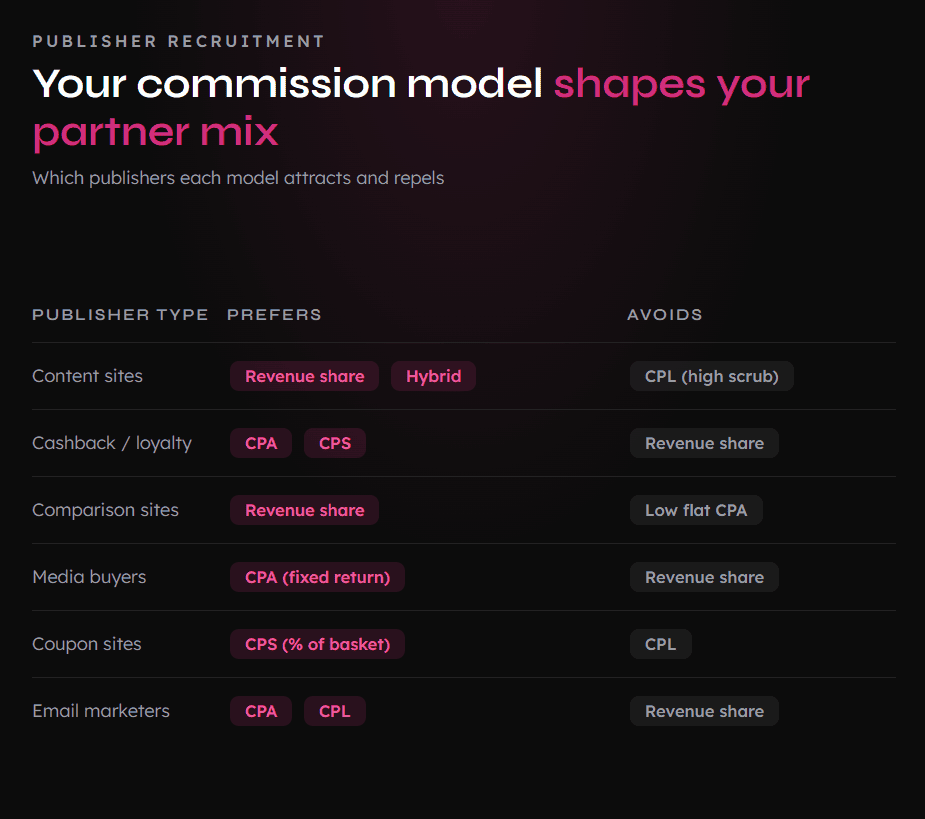
This is the part most programme managers overlook. The commission model is not just a cost structure. It is a recruitment tool. Different models attract fundamentally different types of publishers.
| Publisher type | Preferred model | Will usually avoid |
| Content sites and editorial publishers | Revenue share or hybrid with content fee | Pure CPL with high scrub rates |
| Cashback and loyalty platforms | CPA or CPS (fixed, immediate payout) | Revenue share (their users expect instant rewards) |
| Coupon and voucher sites | CPS (percentage of basket) | CPL (no transaction to discount) |
| Comparison and review sites | Revenue share or hybrid | Low CPA with no performance upside |
| Email marketers | CPA or CPL (fast payout cycle) | Revenue share (too slow to compound) |
| Media buyers (paid traffic) | CPA (fixed, predictable return) | Revenue share (cash flow mismatch with ad spend) |
A programme that offers only a flat CPA of EUR 60 will fill its pipeline with media buyers and incentivised traffic. That is not necessarily bad, but if the programme strategy depends on content-driven organic acquisition, the commission model is working against the strategy.
Before finalising your model, ask: which publisher types does the programme need most? Then check whether the proposed commission structure actually appeals to those publishers. If there is a mismatch, adjust the model, not the recruitment targets.
How To Choose, And How To Change Later
A simple method for the initial decision:
- Calculate your gross margin per customer and your maximum acceptable acquisition cost.
- Determine whether your revenue is one-off or recurring.
- Identify which publisher types you need most for the programme strategy.
- Match those inputs against the decision framework table at the top of this article.
- Start with the simplest model that fits. You can add complexity later.
Changing commission models on a live programme is operationally tricky. Publishers have built their traffic strategies around your current payout. A sudden switch from CPA to revenue share, or a rate reduction, will cause your best publishers to pause or leave.
The practical approach: grandfather existing publishers on their current terms for 90 days, introduce the new model for new publishers immediately, and offer existing publishers the option to switch voluntarily with a small incentive (a temporary rate bump, for instance). Communicate the change 30 days in advance with clear reasoning, not just a notice.
Frequently Asked Questions
What Is The Most Common Affiliate Commission Model?
CPA remains the most widely used model across affiliate marketing. Its popularity comes from simplicity: both advertiser and publisher know the exact payout at the point of conversion. That said, revenue share and hybrid models are growing quickly in fintech and SaaS, where recurring revenue makes them economically superior for both parties.
Is Revenue Share Better Than CPA?
Neither model is universally better. Revenue share suits businesses with recurring revenue, high margins, and long customer lifetimes, because it typically produces a lower effective commission rate over time while attracting quality-focused publishers. CPA suits businesses with one-off transactions or short sales cycles where immediate, predictable cost control matters more.
What Is A Typical Affiliate Commission Rate?
Rates vary significantly by vertical. In fintech, CPA rates commonly fall between EUR 50 and EUR 200 per verified signup, according to Tapfiliate’s 2026 benchmark data. For e-commerce, 10 to 15% CPS is a standard starting point. Revenue share programmes in SaaS and fintech typically offer 20 to 30% of net revenue.
Can You Combine Commission Models?
Yes, and many mature programmes do. Common hybrids include a reduced CPA or CPL combined with a revenue share component, or a base CPS with volume-based tiered escalators. The key is ensuring the combined structure remains simple enough for publishers to understand and profitable enough at your target acquisition cost.
What Is A Scrub Rate?
The scrub rate is the percentage of submitted leads that an advertiser rejects as invalid, duplicate, or below quality thresholds. It is the number that determines the true cost per valid lead in a CPL programme. A CPL of EUR 30 with a 35% scrub rate means the advertiser effectively pays EUR 46 per accepted lead. Publishers watch scrub rates closely, and programmes with scrub rates above 40% struggle to retain quality traffic sources.
How Do You Change Commission Model Without Losing Publishers?
Grandfather existing publishers on their current terms for at least 90 days. Introduce the new model to new publishers immediately. Offer existing publishers a voluntary migration with a temporary incentive. Communicate the rationale clearly and give at least 30 days’ notice. Most importantly, provide data showing how the new model benefits publishers who send quality traffic, not just how it benefits the advertiser.