Most brands start with affiliate marketing. It makes sense: performance based, low risk, and fast to scale. But somewhere around month six or nine, a pattern emerges. A fintech company wants to co-market with a complementary platform. A fashion retailer wants to build an integration with a loyalty app. A SaaS vendor’s consulting partners are asking for a formal referral structure. None of these fit neatly into the affiliate programme.

That gap is where partnership marketing begins. Partnership marketing is the broader channel that covers every type of commercial relationship a brand builds to grow through third parties. Affiliate marketing is one model inside it, arguably the most efficient one, but far from the only one. This post maps out the difference at channel level: what sits outside the affiliate model, why those partner types need different commercial structures, and how to decide what to build first.
What Partnership Marketing Actually Covers
Partnership marketing is not a trend or a rebrand of affiliate. It is the umbrella category for any structured commercial relationship where a third party helps a brand acquire customers, enter a new market, or expand product reach.
Under that umbrella sit several distinct models:
- Affiliate marketing (performance based, tracked via links and pixels)
- Strategic and co-marketing partnerships
- Technology and integration partnerships
- Reseller and channel partnerships
- Referral programmes
- Brand ambassador agreements
- Agency and consultancy partnerships
- Publisher relationships that run on flat fees or licensing, not performance
The confusion between “partnership marketing” and “affiliate marketing” usually comes from two sources. First, affiliate networks have started calling themselves “partnership platforms” because it sounds broader and more strategic. Second, many brands genuinely discover partnership marketing only after they have already built an affiliate programme and start encountering partner types that do not fit it.
A Forrester report on the partner economy estimated that partnerships generate roughly a quarter of total revenue for mature organisations. Most of that value comes from partner types that sit well outside the affiliate tracking model.
The Partner Types Affiliate Marketing Excludes

This is the core of the distinction. Each of the following partner types requires a different commercial model, relationship structure, or measurement approach than the standard affiliate setup offers.
Strategic and Co-Marketing Partners
Two brands collaborate on a joint campaign, product bundle, or market entry. Think of a digital bank and an insurance platform running a co-branded campaign across both customer bases. Neither party is an “affiliate” of the other. The relationship is mutual, often involves shared costs, and the value is measured in pipeline contribution or brand lift, not last-click conversions.
Why affiliate does not fit: there is no tracking link. The commercial model is shared investment, not commission on conversion. The relationship is peer to peer, not advertiser to publisher.
Technology and Integration Partners
A payment processor integrates with an accounting platform. A lending API appears inside a property marketplace. These partnerships create product value through technical integration, and the commercial arrangement is usually a licensing fee, an API call fee, or a mutual referral mechanic built into the product itself.
Why affiliate does not fit: the value is product-level, not marketing-level. Tracking happens through API calls and product analytics, not through affiliate pixels.
Resellers and Channel Partners
A fintech company sells its white label compliance solution through consulting firms. A SaaS platform distributes through regional IT partners. The reseller owns the customer relationship, sets the pricing (within agreed bounds), and takes a margin. This is a distribution model, not a marketing channel.
Why affiliate does not fit: the reseller buys or licenses the product and resells it. Commission structures, cookie windows, and last-click attribution have no role here.
Referral Partners
A mortgage broker refers clients to an insurance provider. An accountancy firm recommends a specific business banking platform. Referral partners introduce qualified leads from their own client base, usually on a CPA or CPL basis. That sounds close to affiliate marketing, but the key difference is relationship depth. Referral partners are typically managed individually, expect personal account management, and often negotiate custom terms.
Why affiliate does not fit: the commercial terms might overlap, but the relationship management model is completely different. You cannot manage a referral partner through a self-serve affiliate dashboard. They expect a named contact, quarterly reviews, and bespoke reporting.
Brand Ambassadors
A well-known financial commentator agrees to represent a neobank across events, media appearances, and their own channels. This is a retained relationship, usually paid as a retainer plus performance bonus, and it covers far more than trackable link clicks.
Why affiliate does not fit: the value is in credibility, reach, and repeated association, none of which map to standard affiliate attribution. For a deeper look at structuring these relationships,
Publishers on Non-Performance Deals
A personal finance comparison site runs a sponsored content placement. A fintech media outlet publishes a branded editorial series. These publishers are often also affiliates, but the specific deal is a flat-fee or licensed content arrangement, not a CPA.
Why affiliate does not fit: the payment is not triggered by a conversion event. The publisher expects a fixed fee, editorial control, and measurement based on reach or engagement.
Agency and Consultancy Partners
A management consultancy recommends specific fintech platforms to its banking clients. A marketing agency builds affiliate programmes and brings its own network of contacts. These partners influence buying decisions at the advisory level.
Why affiliate does not fit: the value is influence and recommendation within a trusted advisory relationship. Tracking a consulting partner through an affiliate link misses the point of the relationship entirely.
Comparison Table

| Partner type | Commercial model | Who owns the customer relationship | How it is measured | Typical time to value |
| Affiliate | CPA, CPL, or hybrid (CPL + CPS) | The advertiser | Conversions, revenue, ROAS | 1-3 months |
| Strategic / co-marketing | Shared investment, co-funded campaigns | Both brands | Pipeline contribution, brand lift, shared KPIs | 3-6 months |
| Technology / integration | Licensing fee, API call fee, mutual referral | Depends on integration model | API usage, product adoption, retention | 6-12 months |
| Reseller / channel | Margin on resale, licensing | The reseller | Revenue through partner, deal registration | 3-9 months |
| Referral | CPA or CPL, often custom | The referrer introduces, advertiser converts | Qualified leads, conversion rate | 1-3 months |
| Brand ambassador | Retainer + performance bonus | The advertiser | Reach, sentiment, attributed conversions | 3-6 months |
| Publisher (non-performance) | Flat fee, sponsorship, licensing | The publisher | Impressions, engagement, brand awareness | 1-2 months |
| Agency / consultancy | Retainer, project fee, or referral fee | The agency or consultancy | Influence on deal flow, client adoption | 6-12 months |
This table is the quickest way to see why a single affiliate platform cannot manage the full partner mix. The commercial models, ownership structures, and measurement approaches are fundamentally different.
Where Affiliate Sits Inside Partnership Marketing
Affiliate marketing is the most scalable partner type in the mix. It is also the lowest risk for the advertiser, because payment is tied directly to performance. For most brands, particularly in fintech and e-commerce, the affiliate programme is the first partner channel they build, and rightly so.
But affiliate covers one specific structure: a publisher promotes an advertiser’s product through tracked links, and earns a commission when a defined action occurs. That structure works brilliantly for content publishers, comparison sites, cashback platforms, and coupon aggregators. It does not stretch to cover a joint product launch with a complementary brand, or a white label distribution deal through consulting partners.
The mechanics of building an affiliate programme, choosing the right model, recruiting publishers, and managing performance, are covered in detail in Circlewise’s guide on how to build a partner programme from scratch. This post is about what comes after, or alongside, that programme.
Different Tooling, Different People
One mistake brands make is assuming the affiliate platform can manage all partner types. It cannot. Affiliate platforms are built around tracking, attribution, and automated commission payments. They are optimised for scale: hundreds or thousands of publishers, managed largely through dashboards and automated rules.
Partnership marketing beyond affiliate needs CRM-style relationship management. Strategic partners expect quarterly business reviews. Integration partners need technical project management. Resellers require deal registration systems and margin tracking. None of this maps to a standard affiliate dashboard.
The people are different too. An affiliate manager optimises publisher performance, manages commission structures, monitors compliance, and recruits new affiliates. A partner manager builds relationships with a smaller number of higher-value partners, negotiates bespoke commercial terms, coordinates joint go-to-market plans, and manages longer sales cycles.
Some organisations combine these roles early on. That works until around five to ten strategic partners, at which point the workload and skill set diverge enough that splitting the function becomes necessary.
Whether to run your affiliate programme through a network or manage it in-house is a separate decision entirely, and Circlewise’s comparison of network versus in-house models covers it in full.
Which to Build First
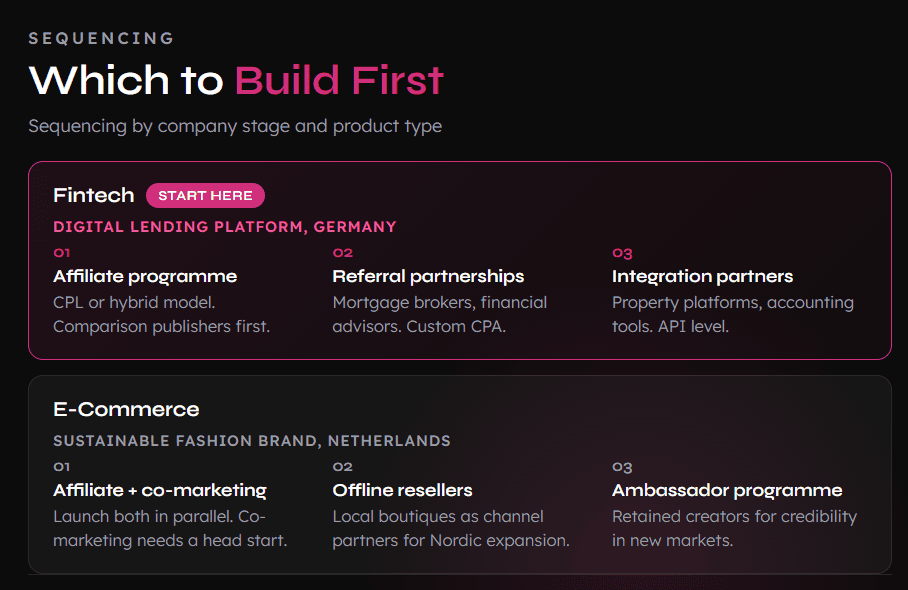
The sequencing question comes up constantly, and the answer depends on two things: company stage and product type.
Fintech scenario: A digital lending platform launching in Germany. The product has a clear conversion event (loan application), a competitive CPA market, and strong demand from comparison publishers. Build the affiliate programme first, using a CPL or hybrid (CPL + CPS) model. Once the affiliate channel is generating consistent volume, layer in referral partnerships with mortgage brokers and financial advisors, then explore integration partnerships with property platforms or accounting tools.
E-commerce scenario: A sustainable fashion brand expanding from the Netherlands into the Nordics. Affiliate works well for content publishers and cashback sites, but the brand also wants to partner with complementary lifestyle brands for co-marketing campaigns and with local boutiques as offline resellers. Here, the affiliate programme and one or two strategic partnerships should launch in parallel, because the co-marketing partnerships take longer to produce results and need a head start.
A useful rule: if your product has a simple, trackable conversion event and an established publisher market, start with affiliate. If your growth depends on integration, distribution, or co-marketing, start building those partnerships early, even if the affiliate programme launches at the same time.
Frequently Asked Questions
Is Affiliate Marketing Part of Partnership Marketing?
Yes. Affiliate marketing is one model within the broader partnership marketing channel. It covers performance-based relationships with publishers who promote products through tracked links. Partnership marketing also includes strategic alliances, technology integrations, reseller arrangements, referral programmes, and ambassador relationships, all of which operate under different commercial and measurement structures.
What Is the Difference Between a Partner and an Affiliate?
An affiliate promotes a brand’s product through tracked links and earns a commission on defined actions such as leads or sales. A partner is a broader term covering any third party that collaborates commercially with a brand. Partners might co-develop products, resell services, refer clients from their own base, or co-market to shared audiences. All affiliates are partners, but not all partners are affiliates.
What Types of Marketing Partnerships Are There?
The main categories are: affiliate and publisher partnerships, strategic and co-marketing partnerships, technology and integration partnerships, reseller and channel partnerships, referral partnerships, brand ambassador agreements, and agency or consultancy partnerships. Each type has a different commercial model, relationship structure, and measurement approach.
Do You Need Different Software for Partnership Marketing?
Usually, yes. Affiliate platforms handle tracking, attribution, and automated commission payments at scale. But strategic partnerships, integration partnerships, and reseller relationships need CRM-style tools for relationship management, deal registration, contract tracking, and bespoke reporting. Some organisations use a combination of an affiliate platform and a CRM or partner relationship management (PRM) system.
Which Should a Brand Build First?
Start with affiliate if your product has a clear, trackable conversion event and an established publisher market. The affiliate model is lower risk, faster to scale, and generates performance data quickly. Layer in other partnership types as you identify partners whose value does not fit the affiliate structure, such as integration partners, co-marketing allies, or referral networks with bespoke requirements.