Ask ten affiliates about their income and you will get ten wildly different answers. Some earn nothing after a year of effort. Others run their affiliate business as a full-time operation with a team behind it. Both are telling the truth, which is exactly why “how much do affiliate marketers make” is a harder question than most articles admit.
Having watched hundreds of publishers move through European affiliate programmes, I can tell you the honest answer up front: most affiliates earn modestly in their first year, a committed minority build a sustainable full-time income within two to four years, and a small group at the top earn more than most marketing directors. What separates them is rarely luck. It is niche choice, commission structure, traffic quality, and the calibre of the programmes they work with.
This guide walks through each of those levers, the commission models behind them, and why financial services publishers in Europe often sit at the profitable end of the spectrum.

How Do Affiliate Marketers Make Money?
Affiliate marketers earn commissions by referring customers to a brand. When someone clicks their tracked link and completes a defined action, a purchase, a registration, or a funded account, the affiliate is paid for that result.
Simple in principle. The economics underneath are anything but uniform.
A comparison site reviewing consumer electronics might earn a small percentage of each sale. A finance publisher referring verified investors to a trading platform might earn a substantial fixed fee per funded account, because that customer is worth far more to the brand over time. Same mechanic, completely different business.
This is the first thing I explain to publishers who feel stuck: your income is not just a function of your audience size. It is a function of what each referred customer is worth to the advertiser. Fintech and financial services sit near the top of that value scale, retail sits near the bottom, and everything else falls somewhere in between.
What Determines Affiliate Marketing Earnings?
Four variables explain most of the gap between struggling and thriving affiliates.
| Factor | Why it matters | What you control |
|---|---|---|
| Niche and customer value | High-value customers support high payouts | Which vertical you build in |
| Commission model | Recurring and hybrid deals compound; flat retail rates do not | Which programmes you join |
| Traffic quality | A small, trusting audience outconverts a large indifferent one | Content depth and audience fit |
| Conversion rate | Doubling conversion doubles income with zero extra traffic | Page design, intent matching, trust signals |
A pattern worth flagging: publishers obsess over traffic volume and neglect the other three. In practice, moving from a weak commission structure to a strong one, or lifting conversion from one percent to two, often does more for revenue than a year of chasing additional visitors. Traffic is the hardest lever to pull. Start with the easier ones.
Audience trust deserves a special mention for anyone working in finance. European consumers are rightly sceptical of money advice online, and regulators expect financial promotions to be fair and not misleading. Publishers who build genuine credibility, who explain risk honestly and only recommend platforms they would use themselves, convert better and keep converting. Trust is not a soft metric in this vertical. It is the conversion engine.
Common Affiliate Commission Models Explained
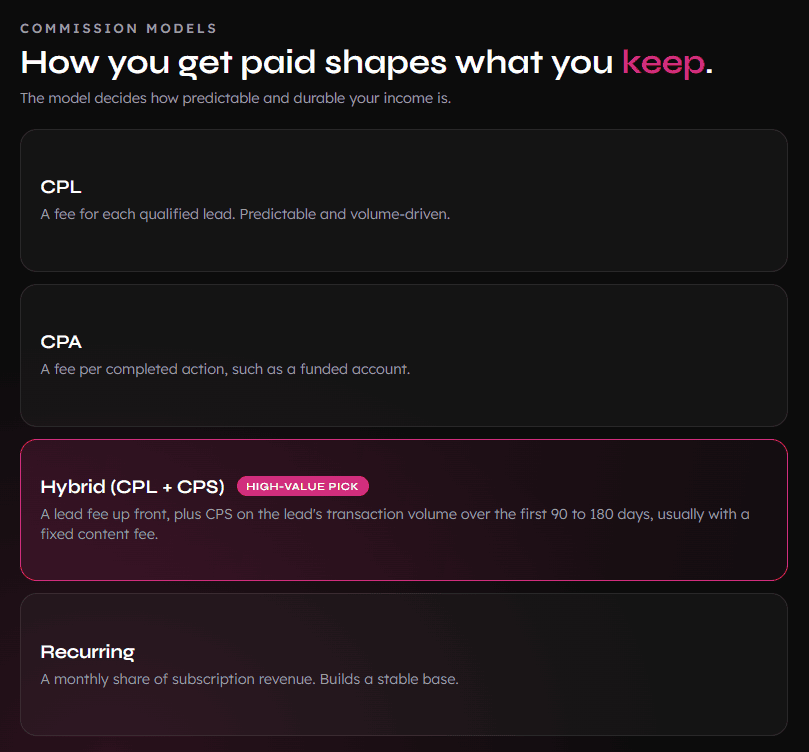
The commission model shapes not just how much you earn per conversion, but how predictable your income becomes. Here is how the main structures compare.
| Model | You are paid for | Typical vertical | Income character |
|---|---|---|---|
| CPL (cost per lead) | Each qualified lead | Lending, insurance, banking | Predictable, volume-driven |
| CPA (cost per action) | A completed action, such as a funded account | Investment platforms, trading, neobanks | High per-conversion value |
| Hybrid (CPL + CPS) | A lead fee up front, plus CPS earned on the lead’s transaction volume in the first 90 to 180 days after registration, usually plus a fixed content fee | P2P lending, investment platforms, brokers, high-value products | Front-loaded and compounding |
| Recurring | A share of subscription revenue each month | SaaS, financial software | Builds a stable base over time |
Two practical observations from managing these structures.
First, recurring and hybrid models are underrated by newer affiliates. A one-off lead fee is gone the moment it is paid. A recurring commission on a software subscription keeps earning while you sleep, and so does the CPS side of a hybrid finance deal, which pays on a referred investor’s transaction volume for months after they register. Publishers who prioritise these structures early build far more resilient businesses.
Second, CPA models in finance carry a quality expectation. Advertisers pay well per funded account precisely because they expect genuine, engaged customers. Send low-intent traffic and the partnership will not last. The affiliates who thrive on CPA treat advertiser outcomes as their own metric, not just their payout.
Average Affiliate Earnings by Experience Level

Reliable earnings data is scarce, but the largest industry survey to date, run by Authority Hacker across more than two thousand affiliates, shows a clear and consistent pattern: income tracks experience almost linearly, with the steepest jump after the first year.
| Stage | Typical experience | Earnings pattern |
|---|---|---|
| Beginner | Under one year | Little to no income; building content, traffic and trust |
| Developing | One to two years | Roughly a sevenfold increase on the first year, on average |
| Established | Three to five years | Income more than doubles again as authority compounds |
| Advanced | Six years and beyond | Full-time income and above; often multiple sites and channels |
One caveat that most earnings articles skip: averages in this industry are heavily skewed. A small group of top performers pulls the mean far above what a typical affiliate experiences, and the same survey data suggests the median annual income sits well below the headline average. Plan around the median, not the outliers.
The practical reading of this table is not “wait four years and money appears”. It is that the first year is groundwork, content, indexing, audience building, and the affiliates who quit at month eight usually quit just before the curve bends. If you cannot commit to at least twelve months of consistent output, this is probably not the channel for you.
Why Some Affiliates Earn More Than Others
Beyond the mechanical factors, the high earners I have worked with share a few habits worth copying.
They specialise. A publisher known across the Nordics or the DACH region for rigorous P2P lending reviews will outearn a generalist ten times their size, because advertisers compete for their placements and readers arrive ready to act.
They diversify programmes, not niches. Relying on one advertiser is a business risk; commission cuts and programme closures happen. Strong affiliates spread revenue across several programmes within their specialism, so no single change can sink them.
They treat partnerships as relationships. Negotiated rates, exclusive offers, and early access to campaigns go to affiliates who communicate with their account managers and deliver quality. The published commission rate is a starting point, not a ceiling.
They measure conversion, not just clicks. Anyone can report traffic. The affiliates who grow are the ones who know which pages convert, why, and what to fix.
Why Financial Services and Fintech Offer Strong Affiliate Opportunities
European fintech is one of the most attractive verticals an affiliate can build in, for reasons that come down to unit economics.
A referred customer for an investment platform, a neobank, or a lending marketplace can generate value for the brand for years. That lifetime value supports commission levels that retail simply cannot match, whether through generous fixed fees per funded account or hybrid deals that keep paying as the customer stays active. Platforms like Trade Republic, Revolut, and the wave of P2P investment marketplaces across the Baltics and Nordics all grew partly on the back of publisher partnerships built this way.
The vertical also rewards exactly the kind of publisher Europe produces in abundance: finance bloggers, comparison sites, and YouTube creators who take compliance seriously. GDPR-conscious data handling and honest risk disclosure are not obstacles here; they are the entry ticket, and they filter out the low-quality competition that plagues easier niches.
There is a catch, and it is worth stating plainly. Financial audiences are harder to win. Nobody funds an investment account because of a thin, hastily written review. The publishers who succeed in fintech affiliate marketing invest in depth: real product testing, transparent comparisons, and content that respects the reader’s scepticism. The barrier to entry is higher, which is precisely why the earnings are too.
Common Mistakes That Limit Affiliate Income
Most underperformance traces back to a handful of avoidable errors.
| Mistake | Revenue impact |
|---|---|
| Chasing the highest commission regardless of product quality | Damaged trust, falling conversion, audience churn |
| Spreading across too many niches | No authority anywhere; weak rankings and weak negotiating position |
| Ignoring conversion optimisation | Traffic wasted at the final step |
| Depending on a single traffic source | One algorithm update can erase the business |
| Working with poorly managed programmes | Unreliable tracking, delayed payouts, no support |
| Weak or missing disclosure | Regulatory risk and eroded reader trust |
That last row matters more in finance than anywhere else. European financial promotion rules and advertising standards expect clear disclosure of affiliate relationships. Publishers who treat this as a burden misread the situation: transparent disclosure, done well, actually strengthens credibility with a sceptical audience.
The programme-quality mistake is the one I would fix first, though. Industry surveys consistently show a meaningful share of affiliates citing poor support from affiliate managers as a real obstacle to growth. Your programme choices are part of your income. Reliable tracking, prompt payouts, and a responsive partner team are worth more than a marginally higher headline rate from a badly run programme.
Best Practices for Growing Affiliate Revenue
If I were advising a European publisher on where to focus this year, the list would be short:
- Pick one vertical and go deep. Authority compounds; breadth does not.
- Prioritise recurring and hybrid commission structures. Build a revenue base that survives a slow month.
- Fix conversion before chasing traffic. Audit your top pages against search intent and tighten the path to action.
- Negotiate once you have proof. Bring conversion data to your account manager and ask for improved terms.
- Add a second traffic channel deliberately. Email and video are the natural complements to search for finance publishers.
- Choose partners on infrastructure, not just rates. Tracking accuracy and payout reliability determine whether your reported earnings become actual earnings.
None of this is glamorous. It is also, in my experience, the entire difference between affiliates who plateau and affiliates who scale.
Myths About Affiliate Marketing Earnings
A few persistent claims deserve a direct response.
“Affiliate income is passive.” Partly, eventually. The build phase is active work, and even mature affiliate businesses need ongoing content updates and programme management. Semi-passive is the honest description.
“You need a huge audience.” Survey data consistently shows most working affiliates have small followings. A few thousand engaged readers in a high-value niche outearn a hundred thousand passive ones in a weak niche.
“The market is saturated.” Affiliate spend across Europe continues to grow, and advertisers in finance consistently report demand for quality publishers outstripping supply. What is saturated is thin, low-effort content. Depth still wins.
“Everyone earning well got in early.” Experience helps, but the survey data shows the income curve applies to affiliates starting today just as it did five years ago. The first year is still the hard part.
Future Trends in Affiliate Marketing
Two shifts are worth planning for.
AI answer engines are becoming a traffic source. Visitors arriving from a recommendation in ChatGPT, Perplexity, or Google’s AI Overviews tend to be further along in their decision, and early data suggests they convert unusually well. Publishers producing genuinely citable, expert content will benefit first. Thin content will become even less visible than it already is.
Advertisers are consolidating around fewer, better partnerships. Brands increasingly prefer a smaller roster of high-quality publishers they can work with closely over a long tail of anonymous traffic. For serious affiliates this is good news: it shifts leverage toward publishers who can demonstrate quality, and it makes affiliate programme management a genuine differentiator on the advertiser side rather than an afterthought.
Key Takeaways
- Affiliate earnings range from nothing to a full-time income and beyond; experience, niche, and programme quality explain most of the variance.
- The first year is groundwork. Income typically jumps sharply after it, then compounds with authority.
- Commission structure matters as much as traffic. Recurring and hybrid models build resilience.
- Financial services and fintech reward depth and trust with some of the strongest payouts available to European publishers.
- Programme quality, tracking, payouts, and partner support, quietly caps or unlocks everything else.
Conclusion
So how much do affiliate marketers make? The truthful answer is a range: little at first, a meaningful side income for the persistent, and a serious business for those who specialise, optimise conversion, and choose their partners well. The affiliates who reach the upper end are not doing anything mysterious. They picked a high-value vertical, committed to it, and treated their advertiser relationships as assets.
For European publishers, financial services remains one of the clearest paths to the profitable end of that range, provided you bring the depth and honesty the audience demands. If you are ready to work with vetted finance and fintech programmes, reliable tracking, and payouts you can plan around, joining Circlewise as a publisher is a practical place to start. And if you are a brand on the other side of the equation, wondering how to turn publishers into a dependable acquisition channel, that is exactly the problem our advertiser team solves every day.
Frequently Asked Questions
How much do affiliate marketers make per month?
It varies enormously. Most first-year affiliates earn little while they build content and traffic. Survey data shows average income rising roughly sevenfold after the first year and continuing to climb with experience, though the median sits well below the often-quoted averages.
Can beginners make money with affiliate marketing?
Yes, but rarely quickly. The realistic expectation is six to twelve months of consistent work before income becomes meaningful. Beginners who focus on one niche and one traffic channel reach that point fastest.
Which affiliate niches pay the most?
Finance, fintech, investing, insurance, SaaS, and education consistently rank among the highest-earning verticals, because each referred customer is worth a great deal to the advertiser. High payouts come with higher content standards, particularly in regulated financial markets.
How do affiliate marketers get paid?
Through commission models such as cost per lead, cost per action, hybrid deals that combine a lead fee with commission on the referred customer’s transaction volume, or recurring subscription shares. Networks handle tracking and typically pay out monthly once a minimum threshold is reached.
Why do some affiliates earn so much more than others?
Specialisation, commission structure, conversion optimisation, and programme quality. Two affiliates with identical traffic can earn vastly different amounts depending on what each referred customer is worth and how well their pages convert.
Is affiliate marketing still profitable in Europe?
Yes. Affiliate spend across European markets continues to grow, and demand from finance and fintech advertisers for quality publishers remains strong. What no longer works is thin, low-effort content.
Do I need a large audience to earn from affiliate marketing?
No. Most working affiliates have modest audiences. A small, engaged readership in a high-value niche such as investing routinely outearns much larger audiences in low-commission verticals.
What should I look for in an affiliate programme?
Reliable tracking, prompt and transparent payouts, responsive partner support, and commission structures that reward customer quality. A slightly lower rate from a well-run programme usually beats a higher rate from a poorly managed one.