Most people who look up how to start affiliate marketing are sold a version of it that doesn’t exist. The promise is passive income, a laptop on a beach, money arriving while you sleep. The reality is closer to building a small media business: it takes patience, useful content, and an audience that trusts your recommendations before a single commission lands.

That distinction matters, because beginners who understand it tend to stick around long enough to succeed. This guide walks through what affiliate marketing actually is, how the money moves, and the practical steps to build something that keeps earning. It’s written with a European audience in mind, and it pays particular attention to financial services, where some of the most durable affiliate opportunities sit.
What Is Affiliate Marketing?
Affiliate marketing is a performance-based arrangement where you earn a commission for promoting another company’s product or service. When someone follows your unique link and completes a defined action, such as opening an account or making a purchase, you get paid a share of the value you helped create.
The appeal is straightforward. You don’t build the product, hold stock, or handle customer support. Your job is to connect the right audience with the right offer and to be honest about it. The company gets a customer it might not have reached; you get a commission; the customer, ideally, finds something genuinely useful.
Three parties make the model work:
- The advertiser (or merchant) is the brand offering the product and funding the commissions. In fintech, this could be a digital bank, a payment provider, or an investment platform.
- The publisher (the affiliate) is you: the person or business recommending the product to an audience.
- The consumer is the person who clicks and converts.
Some programmes run through an affiliate network that sits in the middle and handles tracking, payments, and compliance. Others are managed directly by the advertiser through an in-house team. Both models are common across Europe, and each has trade-offs we’ll come back to.
How Affiliate Marketing Actually Works
The mechanics are simple once you see them laid out. You join a programme, receive a tracking link, share it through your content, and earn when a referred user converts within a set window.
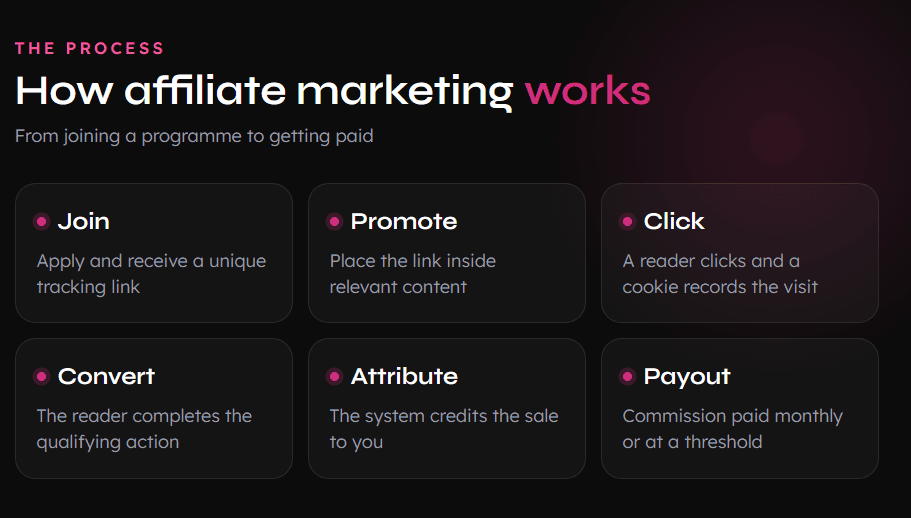
| Step | What happens | Who’s involved |
| 1. Join a programme | You apply and receive a unique tracking link | Publisher, advertiser or network |
| 2. Promote | You place the link inside relevant content | Publisher |
| 3. Click | A reader clicks and a cookie records the visit | Consumer |
| 4. Convert | The reader completes the qualifying action | Consumer, advertiser |
| 5. Attribution | The system credits the sale to you | Network or advertiser |
| 6. Payout | Commission is paid, usually monthly or at a threshold | Advertiser to publisher |
Two details trip up beginners. The first is the cookie window. Most programmes credit you if the user converts within a defined period after clicking, often 30 days, sometimes longer. If they buy on day 45 with a 30-day window, you earn nothing. The second is the qualifying action. In retail it’s usually a purchase. In financial services it might be a funded account, a completed loan application, or a verified sign-up, which changes how you should write about the offer.
Worth flagging early: attribution and consent are not afterthoughts in Europe. Because tracking relies on cookies and personal data, affiliate activity falls under GDPR and the ePrivacy rules. Programmes that take compliance seriously will have proper consent handling built in. That’s a mark of quality, not a nuisance.
Why Affiliate Marketing Works So Well in Europe
Affiliate marketing has grown into a core acquisition channel across Europe for reasons that hold up under scrutiny.
For publishers, the barriers are genuinely low. You can start with a modest budget, and content that ranks or resonates keeps working long after you’ve published it. Once you understand the model, it scales across topics and programmes without a proportional increase in effort.
For advertisers, the maths is compelling. They pay for results rather than impressions, which keeps customer acquisition costs predictable. In competitive sectors like banking and payments, where the cost of buying attention through paid media keeps climbing, a channel that only charges for outcomes is hard to argue with.
The channel has also matured. Regulators, networks, and advertisers have tightened standards, which has pushed out a lot of the low-quality behaviour that used to give affiliate marketing a poor reputation. What’s left rewards publishers who build real trust.
Step 1: Choose a Niche You Can Win
Your niche is the foundation, and getting it wrong wastes months. A niche isn’t just a subject. It’s the intersection of an audience with a problem, a set of products that solve it, and enough space for you to say something worth reading.
Broad categories are brutal to compete in. “Finance” is a category dominated by banks and established media. “Current accounts for freelancers in Germany” is a niche where a knowledgeable publisher can still win.
Three questions decide whether a niche is worth your time:
- Is there real demand? People need to be actively searching for information or products here. You can gauge this with free tools like Google Trends before committing.
- Can it be monetised well? There must be programmes that pay meaningful commissions. Financial products tend to do this because customer lifetime value is high.
- Is there room to compete? If every result on page one comes from a major brand with an unlimited budget, look for a more specific angle.
A common mistake here is chasing a niche purely because the commissions look generous. High payouts on products you don’t understand, or wouldn’t recommend to a friend, are a trap. You’ll struggle to write convincingly, and your audience will sense it. Pick something you can build genuine authority in.
Step 2: Pick the Right Affiliate Programmes
Once you know your niche, you need programmes worth promoting. Quality beats quantity every time. Two or three strong programmes will outperform a scattergun approach across a dozen.
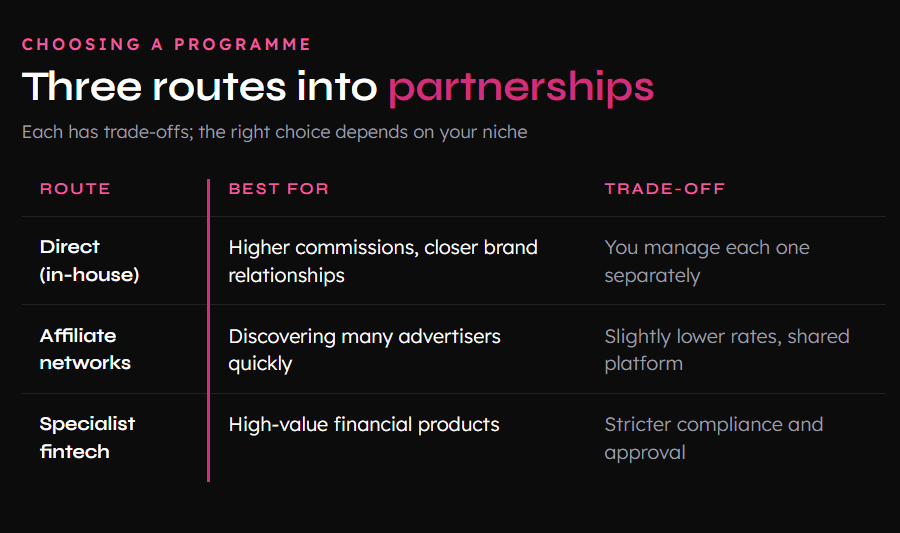
There are broadly three routes into affiliate partnerships:
| Programme type | Best for | Trade-off |
| Direct (in-house) | Higher commissions, closer relationship with the brand | You manage each one separately |
| Affiliate networks | Discovering many advertisers quickly | Slightly lower rates, shared platform |
| Specialist fintech programmes | High-value financial products | Stricter compliance and approval |
Direct programmes, run by the advertiser itself, often pay better and give you a real relationship with the brand. Networks act as marketplaces and are useful for finding offers fast. Specialist programmes in financial services sit somewhere in between, offering high-value products alongside stricter approval and compliance requirements.
Before you join anything, look past the headline commission rate and assess:
- The cookie window and attribution model
- How well the advertiser’s own landing pages convert
- Payment terms, thresholds, and reliability
- The quality of reporting and affiliate support
- The advertiser’s reputation among other publishers
One practical note from experience: a lower commission on a product that converts at eight percent will usually beat a generous rate on something that converts at one percent. Beginners fixate on the rate. The conversion rate of the offer matters just as much.
Step 3: Build a Platform You Control
Most affiliates build on a website, a video channel, or an email list. A website gives you the most control and the strongest long-term position, because you own it outright. Social platforms can change their rules overnight; your own site can’t be taken away by an algorithm update.
A functional affiliate site needs the basics done well: a domain that reflects your niche, reliable hosting, a fast and clean design, clear navigation, and a way to collect email subscribers from day one. You don’t need it to be beautiful. You need it to load quickly, work on mobile, and be easy for search engines to crawl. Google’s own Search Central documentation covers these fundamentals clearly.
WordPress remains the most common choice across Europe for good reasons: it’s flexible, well supported, and works with almost every affiliate tool you’ll want. There are solid alternatives, but the principle holds regardless of platform. Build on something you control and can adapt as you grow.

| Platform | Strengths | Consider if |
| Website / blog | Full control, strong for SEO, compounds over time | You want a durable, ownable asset |
| YouTube | Trust-building, strong for reviews and tutorials | You’re comfortable on camera |
| Newsletter | Direct audience relationship, algorithm-proof | You can write consistently |
| Social media | Fast early reach | You accept platform dependency |
Step 4: Create Content That Earns Trust
Content is what earns trust and drives clicks. The formats that convert best are the ones that help people make a decision, not the ones that push hardest.
A few reliably effective formats:
- Comparison articles (“Product A vs Product B”) reach readers who are close to choosing, which means higher intent.
- In-depth reviews work when they’re honest, including the drawbacks. Readers can tell the difference between a real assessment and a rewritten spec sheet.
- How-to guides create natural moments to recommend a tool that solves the problem you’re teaching about.
- Best-of lists rank well for informational searches and let you feature several relevant products in one place.
The single principle underneath all of it: write for the reader, not the commission. This is where most beginners go wrong. They optimise for the click and neglect the trust that makes the click worth anything. In financial services this is doubly important, because readers are making consequential decisions and can spot a thin, incentive-driven recommendation from a mile off.
Step 5: Drive the Right Traffic
Content with no audience earns nothing. There are several ways to build one, and the right mix depends on your resources and how quickly you need results.
Search remains the most valuable long-term source for affiliates. Content that ranks for the right terms can generate qualified visitors for years without ongoing spend. The fundamentals are unglamorous but effective: target keywords with genuine demand and realistic competition, answer the search intent fully, build clusters of related content that reinforce each other, and earn links from reputable sites over time.
Social platforms can accelerate early traffic before search rankings mature. The trick is to pick one platform where your audience actually spends time and commit to it, rather than spreading yourself thin. YouTube suits reviews and tutorials. LinkedIn works well if your niche touches professional or B2B financial audiences.
Email deserves its own mention because it’s the one asset you truly own. Build a list from the start with a useful lead magnet, and you have direct access to your audience no matter what happens to search rankings or social algorithms.
A word of caution on paid traffic. It can work, but many financial advertisers restrict how affiliates use paid search and social ads on their brand terms, and getting it wrong can breach programme rules or advertising regulations. If you go this route, read the terms carefully first.
Step 6: Track, Measure, and Optimise
Most programmes give you a dashboard showing clicks, conversions, and earnings. Use it properly and it will tell you where to focus.
Keep an eye on:
- Which content drives the most clicks
- Which programmes actually convert
- How much each page earns relative to its traffic
- Which pages are worth expanding or improving
Pairing this with a web analytics tool shows you where visitors come from and how they move through your site. Optimisation is continuous and often unglamorous. A clearer call to action or a better comparison on a single high-traffic page can lift earnings more than three new articles.
Common Beginner Mistakes to Avoid
Nearly everyone makes the same handful of errors early on. Knowing them in advance saves a lot of wasted effort.
| Mistake | Why it hurts | Do this instead |
| Promoting too many programmes | Dilutes focus and credibility | Start with two or three relevant ones |
| Chasing commission over quality | Erodes audience trust | Only promote what you’d recommend |
| Ignoring search intent | Traffic that never converts | Match content format to what readers want |
| Expecting quick results | Leads to quitting too early | Treat the first year as an investment |
| Skipping disclosure | Breaches advertising rules and trust | Always disclose affiliate links clearly |
That last point carries real weight in Europe. Consumer protection and advertising standards require clear disclosure of commercial relationships, and financial promotions face additional scrutiny. Being transparent isn’t just compliant; it’s what builds the trust the whole model depends on.
How to Build for Long-Term Success
The affiliates who last tend to share a few habits.
They build genuine depth in one area rather than covering everything superficially. They treat the audience relationship as the actual asset, not the traffic. They diversify their programmes and traffic sources over time so no single change can wipe them out. And they stay current, because programme terms, compliance requirements, and platform rules keep shifting, particularly in financial services.
Above all, they understand what they promote. In fintech this is non-negotiable. Readers are making decisions about their money, and shallow content doesn’t just convert badly, it can do real harm to your credibility.
Why Fintech Is One of the Strongest Niches in Europe
If you’re choosing a niche with the long game in mind, financial services deserve a serious look. Europe has one of the most active fintech ecosystems in the world, with companies like Revolut, Wise, N26, Klarna, and Trade Republic building large customer bases and competing hard for new users.
Several things make the sector attractive for affiliates:
- High customer value. Financial products often carry high lifetime value, which means advertisers can afford to pay affiliates generously for each customer they bring in.
- Considered decisions. People research financial products carefully before committing, which rewards genuinely helpful content.
- Regulatory tailwinds. Frameworks like PSD2 opened up banking and payments to more competition, creating a steady stream of new products to write about.
- Ongoing demand. Digital banking, investing, and payments continue to grow across European markets.
There’s a catch, and it’s an important one. Financial promotions are regulated, and what you can say, how you must say it, and what you have to disclose all vary by market and product. This is where working with an experienced partner pays off. Circlewise specialises in fintech affiliate marketing and helps financial brands and publishers build compliant, high-performing programmes across European markets. For businesses on the advertiser side, structured partnership marketing turns one-off affiliate relationships into a durable growth channel. And publishers looking to work with vetted financial brands can explore what a managed network offers on the publisher side.
Conclusion
Learning how to start affiliate marketing takes an afternoon. Building something that earns reliably takes a year or more of consistent, honest work. The people who succeed aren’t the ones who found a shortcut. They’re the ones who picked a niche they understood, created content that actually helped, and stayed the course long enough for search engines and audiences to trust them.
Start narrow. Choose one niche and two or three programmes you believe in. Publish on a schedule you can sustain, disclose your links, and pay attention to what your data tells you. If financial services appeal to you, the European fintech market offers real depth, and working with a specialist partner can shorten the learning curve considerably. Build for the long term, and the compounding will take care of the rest.
Frequently Asked Questions
How do I start affiliate marketing as a beginner?
Pick a specific niche, join two or three relevant programmes, build a website or content platform you control, and create content that answers the questions your audience is searching for. Focus on helping people decide rather than pushing products, and disclose your affiliate links clearly.
Do I need a website to do affiliate marketing?
No, but it’s the strongest foundation because you own it. Alternatives include YouTube, newsletters, and social media. Content on platforms you don’t own is always subject to their rules, so a website you control reduces your long-term risk.
How much does it cost to start affiliate marketing?
Very little to begin with. A domain and hosting are the main recurring costs, and most programmes are free to join. Costs rise only as you add tools for keyword research, email marketing, and analytics. You can start on a modest budget.
How long does it take to earn money from affiliate marketing?
For most beginners relying on search traffic, meaningful income typically takes between six and twelve months to build, with steadier earnings arriving in the second year as content matures. Treat the first year as an investment phase rather than expecting quick returns.
How do affiliate marketers get paid?
Payment methods vary by programme but commonly include bank transfer and other digital options, usually monthly or once you reach a minimum threshold. In financial services, commissions often trigger on a funded account or a completed application rather than a simple purchase.
Is affiliate marketing still worth it in Europe?
Yes. It remains a growing channel because advertisers value paying for results, and European fintech in particular offers high-value, long-term opportunities. The publishers who struggle are those chasing quick wins with thin content, not those building genuine trust.
Which niche is best for affiliate marketing?
The best niche combines real demand, products worth recommending, and room for you to add value. Financial services, software, and considered-purchase categories tend to reward depth. Within any of these, a specific angle beats a broad one.
What are the most common beginner mistakes?
Choosing a niche that’s too broad, promoting too many programmes, writing for commissions rather than readers, expecting fast results, and failing to disclose affiliate relationships. Relying on a single traffic source without diversifying is another frequent vulnerability.