Affiliate programs have quietly become one of the most dependable growth channels in European fintech. Plenty of finance brands launch one, onboard a handful of partners, then watch it stall. Understanding how fintech companies build high-performing affiliate programs is what separates a channel that compounds month after month from one that quietly drains budget and attention.

This guide is written for growth, partnership and marketing teams at fintechs, digital banks, lending platforms, payment providers, WealthTech and InsurTech companies across Europe. It covers the strategy, partner recruitment, commission design, tracking, compliance and day-to-day management decisions that decide whether a program scales. The aim is practical guidance you can act on, not another round of definitions.
Why affiliate programs matter for fintech growth
Affiliate programs let a fintech pay for outcomes rather than exposure. Instead of buying impressions and hoping they convert, you reward partners when they deliver a tracked result, such as a funded account, an approved loan or an active investor.
For European fintechs, three pressures make this model especially attractive.
Acquisition costs on paid channels keep climbing, and finance is one of the most competitive and expensive verticals to advertise in. Affiliates shift a chunk of that spend from fixed and speculative to variable and results-based. Trust is the second factor. People do not move their money or share financial data with a brand they have never heard of, and a recommendation from a comparison site or a respected creator does more heavy lifting here than a display ad ever will. Third, open banking under PSD2 has widened what fintechs can offer and who they can partner with, from budgeting apps to lending marketplaces, which gives affiliates more genuinely useful products to promote.
The audience is already searching too. Demand for terms like best business account, broker comparison or savings with no fees is enormous across the Germany, France, the Nordics and beyond, and specialist publishers have spent years building content that ranks for exactly those queries. That is the core logic behind fintech affiliate marketing as a channel, and it is why so many European finance brands treat it as a strategic pillar rather than a side project.
What makes a high-performing affiliate program
A high-performing affiliate program is one that reliably acquires quality customers at a predictable cost, through partners who represent the brand responsibly and stay for the long term.
That definition matters because it rules out the vanity version, a long list of sign-ups and a big partner count that produces very little funded business. Strong programs tend to share a few traits:
- A tight base of relevant partners rather than a sprawling directory of anyone who applied.
- Commissions tied to real value, usually funded or active customers, not raw registrations.
- Accurate tracking that survives long, multi-step financial sales cycles.
- Clear compliance guardrails, so partner messaging never becomes a regulatory problem.
- Active management, with someone who owns the channel and works it every week.
Miss one of these and the whole thing wobbles. Get them working together and the program starts to compound, because good partners refer more good partners and your best content keeps ranking.
How Fintech Companies Build High-Performing Affiliate Programs
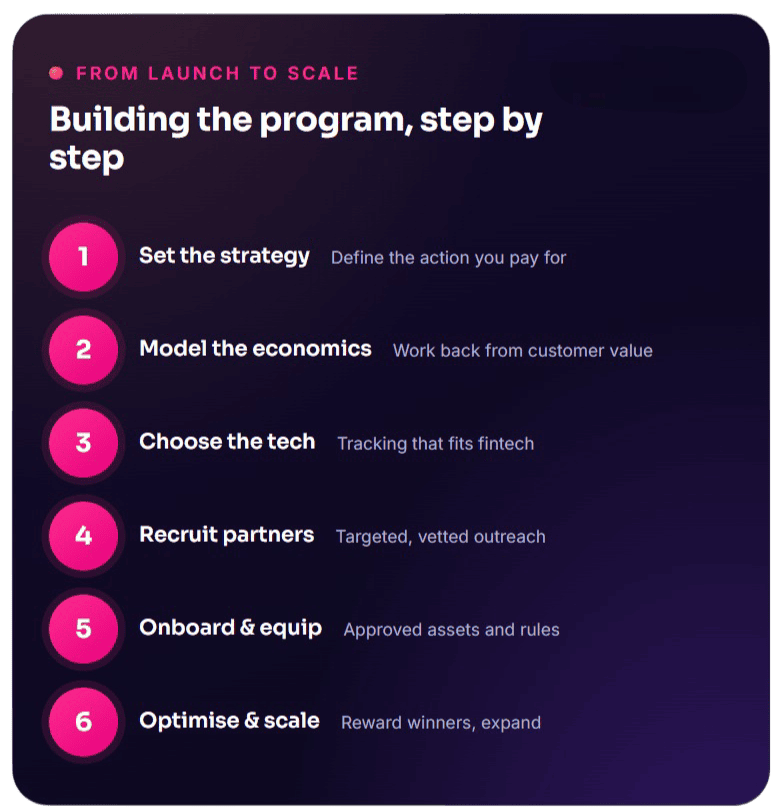
Building the channel follows a rough sequence. You can compress it, but skipping steps usually shows up later as poor tracking or the wrong partners.
| Step | What it involves | Common pitfall |
|---|---|---|
| 1. Set the strategy | Define the target customer, the action you will pay for, and how affiliate fits alongside paid and organic | Launching with no clear definition of a valuable conversion |
| 2. Model the economics | Work back from customer lifetime value to a commission you can sustain | Setting rates on gut feel, then cutting them and losing partners |
| 3. Choose the tech | Select tracking and management software that handles long sales cycles and consent | Relying on last-click cookies alone in a post-consent world |
| 4. Recruit partners | Targeted outreach to relevant publishers and creators, with vetting | Opening a public sign-up form and taking whoever arrives |
| 5. Onboard and equip | Approved assets, messaging rules, and clear terms | Handing over a link with no guidance and hoping for the best |
| 6. Optimise and scale | Review performance, reward top partners, expand into new markets | Setting it and forgetting it |
Most programs that underperform were rushed through steps one and two. Deciding what a valuable customer is, and what you can afford to pay for one, is unglamorous work that pays off for years.
Choosing the right affiliate partners
The instinct to recruit as many affiliates as possible is the wrong one in finance. A small group of credible, relevant partners will out-earn a huge mismatched list, and it keeps your brand away from the sort of promotion that attracts a regulator’s attention.
Partner types worth prioritising for European fintech include:
- Comparison and review sites that already rank for high-intent financial keywords in your target markets.
- Personal finance creators on YouTube, newsletters and podcasts with genuinely engaged audiences.
- Niche communities, such as investing forums, expat finance groups and founder networks.
- Cashback and rewards platforms, used selectively where they suit the product.
- Experienced media buyers who can run compliant paid campaigns at scale.
Vet every partner for audience fit, traffic quality and, crucially, how they talk about money. A partner who implies guaranteed returns or downplays risk is a liability whatever their reach. This is where working with a network pays off, since it gives you access to vetted publishers rather than a cold outreach list you have to qualify from scratch.
Recruitment works best as targeted outreach, not a form left to fill itself. Approach the specific sites and creators who already serve your ideal customer, and lead with why the partnership makes sense for their audience, not just your commission.
Commission models for fintech companies

Your commission structure is the biggest single lever on the kind of partners you attract and the behaviour you reward. Pay too little and strong affiliates promote a competitor. Reward the wrong action and you fill the pipeline with registrations that never fund.
Before comparing models, it helps to be precise about what each one actually pays for, because the same labels mean different things across verticals.
- CPL (cost per lead) pays for a qualified registration. In investing, that usually means a verified account, not just an email address.
- CPS (cost per sale) pays a commission linked to the transaction itself. On investment and P2P lending platforms, this is typically calculated as a percentage of the amount the referred investor actually invests, which is why it is the workhorse model in that niche.
- Fixed fee pays for content itself, independent of performance. This is a standard, not a fringe, arrangement with authoritative publishers.
| Model | You pay for | Best suited to | Watch-outs |
|---|---|---|---|
| CPL | A qualified lead or verified registration | Top-of-funnel acquisition where internal conversion is strong | Loose qualification criteria bring low-quality leads |
| CPS | A commission tied to the transaction, often a share of the amount invested | Investment platforms, P2P lending, brokers | Define exactly which transactions qualify and over what window |
| Fixed fee | Content production and placement, usually monthly | Established publishers and creators with real audience authority | Needs a commitment period and clear deliverables to be worth it |
| Hybrid | A combination, most often fixed fee plus CPL and CPS | High-value customers and top-tier partners | More complex tracking and reconciliation |
In the P2P investing and investment platform niche, the established standard is CPL and CPS together, with a fixed fee on top for content creation. That fixed fee normally covers a series of content published on a monthly basis, and deals are often structured with a minimum commitment, three months being a common starting point.
It is worth being blunt about the size of that fixed fee, because it is routinely underestimated. A fixed fee is not a token upfront payment. It is priced on the publisher’s authority, audience and editorial reach, and for top-tier affiliates in this space it can run to several thousand euros per month, commonly in the region of three to seven thousand, on top of the CPL and CPS they earn. Budget for that from the start. Teams that model a program assuming only performance payouts tend to discover, halfway through negotiations, that the publishers who actually move the needle are out of reach.
Tiered rates help too, rewarding partners who bring more, or higher-quality, customers with better terms. Whatever you choose, tie the performance element to the action that genuinely signals value, never to a metric that only looks good in a dashboard.
Selecting the right affiliate tracking platform
Accurate tracking is what lets you pay fairly and optimise sensibly. It is harder in fintech than in retail, because the journey from first click to funded customer can stretch across weeks, several devices and a verification or underwriting step in the middle.
| Feature | Why it matters for fintech |
|---|---|
| Server-side and postback tracking | Records conversions that land days after the first click |
| Flexible commission rules | Supports CPL, CPS, fixed fees and hybrids without workarounds |
| Consent-aware measurement | Keeps tracking aligned with GDPR and consent requirements |
| Fraud detection | Catches fake leads, incentivised traffic and cookie stuffing |
| Multi-touch attribution | Credits the partners who introduced a customer, not only the last click |
| Automated, compliant payouts | Handles cross-border partner payments and self-billing cleanly |
Consent is not optional here. Affiliate tracking usually relies on cookies or identifiers that count as personal data, so it sits squarely within the EU’s data protection rules. Measurement has to work alongside consent, not around it. This is one reason more fintechs lean on dedicated affiliate program management rather than stitching together spreadsheets and a basic cookie tracker.
On attribution, decide your model deliberately rather than accepting a default. Last-click is simple but over-rewards whoever closed and ignores the partners who introduced the customer earlier. For high-value finance products where several partners touch the same lead, a multi-touch view usually gives a fairer and more useful picture.
Managing and motivating affiliate partners
A program is not a dashboard you check once a month. The best-run ones treat partners like an extension of the team.
In practice that means regular communication, sharing what is converting and what is not, giving partners fresh creative and offers, and paying reliably and on time. It also means investing disproportionately in your top performers, because in most programs a small group of partners drives the majority of quality volume. Custom deals, early access to new products and a direct line to a manager keep those relationships strong.
Underperformers deserve attention too, though of a different kind. Sometimes a partner just needs a better landing page or a clearer offer. Sometimes the fit was wrong from the start, and a clean exit is healthier than letting weak traffic dilute your numbers.
Measuring affiliate program performance
Measure the channel on customer value, not activity. A rising number of clicks or sign-ups means little if those customers never fund or churn quickly.
The metrics that actually describe a healthy program include:
- Cost per funded or activated customer, compared with your other channels.
- Conversion rate from click to funded account, tracked per partner.
- Partner quality, meaning retention and value of the customers each affiliate sends.
- Average investment or transaction size per referred customer, which is what makes CPS deals work or fail.
- Share of funded customers from top partners, to understand concentration risk.
- Return on total partner cost, including fixed fees, over a sensible payback window.
Benchmarks vary too much by product and market to quote a single target honestly. A lending program and a long-horizon investment platform will look completely different. What matters is the trend: quality and efficiency improving quarter on quarter, and a widening base of partners who send customers worth keeping.
Staying compliant: the European rulebook

Compliance is where fintech affiliate programs differ most from every other vertical. When affiliates promote financial products, their content can fall under the same rules that govern the brand, and treating that lightly is a fast way to turn a growth channel into a regulatory problem.
Which framework applies depends on what you sell, so the compliance picture for a broker looks different from that of a crowdfunding platform or a crypto exchange.
MiFID II: investment firms and brokers
If you are an investment firm, Article 24(3) of MiFID II is the anchor. All information addressed to clients or potential clients, marketing communications included, must be fair, clear and not misleading, and marketing communications must be clearly identifiable as such. The detail sits in Article 44 of the MiFID II Delegated Regulation, which requires risks to be presented as prominently as benefits, not tucked below a benefit-heavy headline.
ESMA’s 2024 report on how firms apply these marketing requirements, based on a coordinated supervisory action across national authorities, made two points that matter directly for affiliate teams. Senior management and control functions are expected to be involved in the design and oversight of marketing communications. And oversight does not end at approval, because firms are expected to monitor how approved material is actually distributed. In an affiliate context, that means you are responsible for what a partner publishes, not only for the creative you signed off.
ECSPR: crowdfunding and P2P lending platforms
Crowdfunding and P2P lending platforms operate under the European Crowdfunding Service Providers Regulation (EU) 2020/1503, which dedicates a full chapter, Articles 27 and 28, to marketing communications. Requirements include that marketing communications are clearly identifiable, that information is fair, clear and not misleading, and that it is consistent with the key investment information sheet for the offer being promoted.
Two practical consequences. First, national rules still differ, since competent authorities publish their own provisions on marketing communications and notify ESMA of them, so a campaign that is fine in one member state may need adjusting in another. Second, where an offer is promoted in another member state, language requirements attach to the key investment information sheet. Affiliate campaigns that scale across borders need this checked market by market, not assumed.
MiCA: crypto-asset services
Crypto and Web3 fintechs sit under the Markets in Crypto-Assets Regulation. Marketing communications must be fair, clear and not misleading, clearly identifiable as marketing, and consistent with the white paper. Affiliates promoting crypto products need to be inside those lines, and memes and short-form video are not exempt.
GDPR: cutting across all of the above
The General Data Protection Regulation shapes how you track and target, from consent through to a user’s right to withdraw it. Every part of your affiliate measurement has to respect it, whichever product regime you sit under.
The practical takeaway across all four. Give affiliates approved messaging, spell out what they can and cannot say, review promotions during onboarding rather than after a complaint, and monitor what partners actually publish. Programs that scale safely bake compliance into partner setup instead of bolting it on later.
Common mistakes that limit growth
| Mistake | Why it hurts | Fix |
|---|---|---|
| Recruiting for volume over fit | A bloated list converts poorly and adds risk | Prioritise relevance and vetting over partner count |
| Underbudgeting for top publishers | The partners who move the needle are out of reach | Model fixed fees alongside performance payouts from the start |
| Vague payout definitions | Disputes at contract stage over what triggers a commission | Define precisely what each CPL and CPS payout is calculated on |
| Rewarding sign-ups, not value | The pipeline fills with customers who never fund | Tie payouts to funded, verified or active customers |
| Weak tracking and last-click only | You reward the wrong partners and misread performance | Use server-side tracking and considered attribution |
| Treating compliance as optional | Regulatory and reputational exposure | Build approved messaging and monitoring into onboarding |
| Setting it and forgetting it | The channel drifts and stalls | Give the program a clear owner and a weekly rhythm |
Almost all of these trace back to the same root cause: treating the program as passive. The ones that perform have an owner who works the channel like any other growth function.
Best practices for long-term success
- Start narrow with well-matched partners, then expand deliberately.
- Budget for the full partner cost, fixed fees included, not just the performance element.
- Write commission definitions precisely, so your CPL, CPS and fixed fee terms cannot be misread.
- Choose an attribution model on purpose and revisit it as you grow.
- Localise. A partner who understands German comparison culture or Baltic P2P investing communities will convert better than a one-size approach across borders.
- Give partners data, creative and support, not just a link.
- Reinvest in what works rather than endlessly chasing new partners.
Future trends in fintech affiliate programs
The channel is shifting in ways worth planning around. Compliance is tightening as regulators pay closer attention to financial promotions, which quietly favours brands that already run clean, well-documented programs. Attribution is moving server-side and multi-touch as consent rules erode older cookie methods. Creators and niche communities are gaining ground on broad directories, because trust converts better for money products, and that in turn pushes fixed-fee content deals further into the mainstream. And partnerships are broadening beyond classic affiliates into embedded finance and referral arrangements between complementary fintechs, a natural extension of open banking. None of this changes the fundamentals. It raises the bar for doing them well.
Key takeaways
- Affiliate programs let fintechs pay for outcomes and reach audiences that paid ads cannot, which is why they matter so much for European growth.
- The four pillars are relevant partners, well-defined commercial terms, accurate tracking and built-in compliance.
- In investing and P2P lending, the standard structure is CPL plus CPS, with a monthly fixed fee for content. Top publishers command several thousand euros per month on top of performance payouts.
- Compliance depends on your product: MiFID II for investment firms, ECSPR for crowdfunding and P2P platforms, MiCA for crypto and GDPR across all of them.
Conclusion
Learning how fintech companies build high-performing affiliate programs comes down to getting four things right at once: recruiting partners who fit your brand and audience, structuring commercial terms that reflect how partners in your niche actually work, tracking results accurately across long financial sales cycles, and keeping the whole operation compliant with European rules. Align those and the channel becomes one of the most efficient ways a finance brand can grow.
If you are launching or rethinking a program, start small and specific. Pick a few relevant partners, define your CPL, CPS and fixed-fee terms precisely, get tracking and disclosures right from day one, and manage it like the strategic channel it is.
This is the work Circlewise does with finance brands across Europe, from publisher recruitment and tracking to commission design and compliance. Its network spans more than 11,000 partners and has tracked over €1B in investment volume for financial companies. For teams that would rather scale with support than build everything in-house, working with a managed partner as an extension of your in-house team can turn a stalled program into a reliable acquisition engine.
Frequently asked questions
What is a fintech affiliate program?
It is a partnership where a financial company pays external partners for driving measurable results, such as a verified registration, a funded account or an investment. Payouts can be purely performance-based, or combined with a fixed fee for content, depending on the partner and the niche.
How do fintech affiliate programs work?
Each partner gets a unique tracking link. When a user clicks it and completes a defined action, the system attributes that conversion to the partner, who earns the agreed commission. Tracking, attribution rules and compliance checks sit underneath the whole process.
What commission model works best for fintech companies?
It depends on the product. In investment platforms and P2P lending, the standard is CPL and CPS together, usually with a monthly fixed fee for content creation. Lending and neobank programs lean more heavily on CPA-style payouts for funded accounts. Whatever the mix, define exactly which action triggers each payout.
How much do fintech affiliates charge in fixed fees?
It depends entirely on the publisher’s authority and audience. A fixed fee is not a token upfront payment. Top-tier affiliates in the investing niche can command several thousand euros per month, commonly around three to seven thousand, for a series of content, usually with a minimum commitment such as three months, and that sits on top of the CPL and CPS they earn.
What compliance rules apply to fintech affiliate marketing in Europe?
It depends on the product. Investment firms fall under MiFID II, where marketing communications must be fair, clear and not misleading. Crowdfunding and P2P lending platforms fall under the ECSPR, which sets specific marketing communication rules. Crypto-asset services fall under MiCA.
How do you measure whether an affiliate program is successful?
By tracking value rather than activity: cost per funded customer, click-to-funded conversion by partner, average investment size per referred customer, the retention of those customers, and return on total partner cost including fixed fees.
Should a fintech build a program in-house or work with a network?
Both can work. Building in-house gives full control but demands technology, compliance knowledge and dedicated management. A specialist network brings vetted partners, tracking and local market expertise, which usually gets a program to meaningful scale faster, especially across multiple European markets.