Ask any growth lead at a European fintech what keeps them up at night, and acquisition cost will come up fast. Paid channels that worked two years ago now cost more and convert worse. Against that backdrop, more finance teams are working out how financial brands scale growth through affiliate partnerships instead of pouring another quarter’s budget into the same crowded auctions. The appeal is simple. You pay partners for results that have already happened, not for the hope of a result.

This guide is written for the people who actually run these programmes: growth managers, partnership and affiliate managers, CMOs, and founders at banks, lenders, investment platforms, payment providers, and insurers across Europe. We will look at why acquisition has become so expensive, how affiliate partnerships differ from ordinary digital marketing, how to build a programme that scales, which metrics matter, and the mistakes that quietly drain budgets. By the end you should have a clear, practical view you can act on.
Why Growth Is Becoming More Expensive For Financial Brands
Customer acquisition in financial services has always been costly. It is getting worse. A handful of forces are compounding at once.
Auction competition keeps rising. Banking, lending, and investment keywords are among the most contested in paid search because the lifetime value of a customer is high and every competitor knows it. When a challenger bank, a broker, and three lenders all bid on the same intent, the platform wins and margins shrink.
Trust takes longer to earn in finance than in almost any other category. Nobody opens a savings account, moves their pension, or takes out credit on impulse. People research, compare, read reviews, and look for a recommendation from a source they already follow. A single cold advert rarely closes that gap on its own.
Then there is privacy. European regulation makes broad tracking harder by design. Under the EU’s data protection framework, non essential tracking generally needs clear, freely given consent, and consumers are increasingly comfortable saying no. Google reversed its plan to remove third party cookies from Chrome, so they have not vanished, but that is cold comfort. Safari and Firefox already block them by default, and consent based measurement is now the European norm. The channels that leaned hardest on broad behavioural targeting have lost precision, and they will not get it back.
Put those together and the maths changes. Paying per click for uncertain outcomes looks worse every quarter. Paying per acquired customer starts to look like the sensible option.
What Are Affiliate Partnerships?
Affiliate partnerships are performance based agreements in which a financial brand pays external partners a commission for driving a defined result, such as a new account, a qualified lead, or a funded deposit. The partner promotes the product through a tracked link, and the brand pays only when the agreed action happens.
That partner might be a price comparison site, a personal finance publisher, a fintech newsletter, a cashback platform, a content creator, or another company whose audience overlaps with the brand’s ideal customer. The unifying idea is alignment. The partner earns when the brand grows, and not before.
It helps to separate two terms people use loosely. Affiliate marketing usually refers to the transactional, commission per action relationship. Partnership marketing is the broader discipline of building and managing relationships with the partners who drive that growth, including recruitment, terms, compliance, and long term account management. In practice the strongest programmes treat affiliates as partners, not as a coupon channel, which is where the two ideas meet.
Commission Models Used In Financial Services
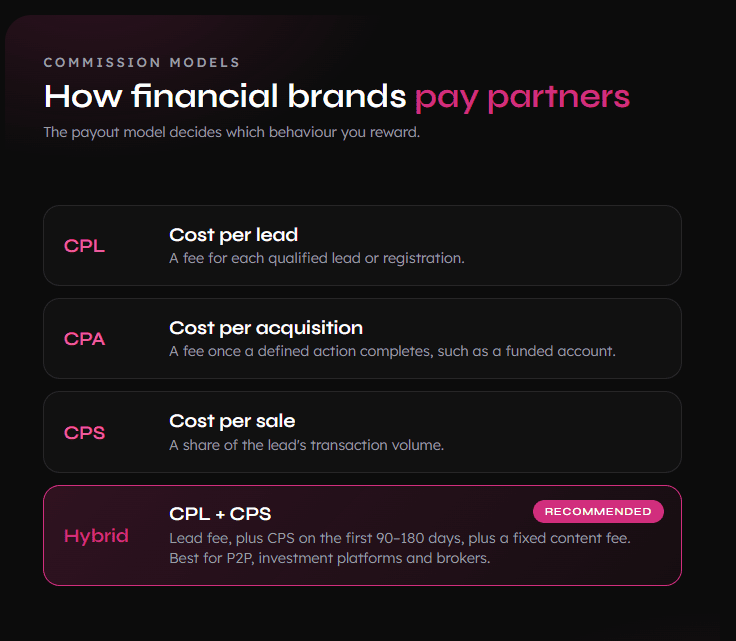
The commission model decides which behaviour you reward, and finance rarely uses a single one in isolation.
| Model | How the partner is paid | Typically used for |
|---|---|---|
| CPL (cost per lead) | A fixed fee for each qualified lead or registration | Lenders and brands that own the rest of the funnel |
| CPA (cost per acquisition) | A fixed fee once a defined action completes, such as a funded account | Banks, digital banks, straightforward account goals |
| CPS (cost per sale) | A share of the value the lead transacts, calculated on transaction volume | Products where value depends on how much the customer transacts |
| Hybrid (CPL plus CPS) | A fee per qualified lead, plus CPS earned on that lead’s transaction volume in the first 90 to 180 days after registration, usually with a fixed fee for content production | P2P lending, investment platforms, brokers, high value products |
The hybrid model is the one most European high value finance brands settle on. It works because the two halves solve different problems. The CPL element pays the partner for the work of producing content and delivering a qualified registration, which is real cost they carry upfront. The CPS element, calculated on what that lead actually transacts across the first 90 to 180 days, means the partner earns more when they send investors and borrowers who genuinely use the product. Add the fixed content production fee and you have terms serious publishers will commit to, rather than the thin, one off payout that attracts volume chasers.
Set that attribution window deliberately. Too short and you underpay partners whose audiences take time to fund and transact, which is normal behaviour in investing and lending. Too long and your finance team cannot close a period cleanly. Most brands land somewhere between 90 and 180 days for exactly that reason.
Why Affiliate Partnerships Work For Financial Services
The model suits finance for reasons that go beyond cost. Because payouts are tied to outcomes, spend maps directly to acquired customers, which is exactly the kind of predictability finance teams want. Just as important, partners sit at the decision point. A comparison site ranking current accounts or a creator explaining index investing is doing the trust building that a display advert cannot.
It also travels well across borders, which matters in a fragmented European market. Consumer habits, competitors, and regulation differ between Germany, France, the Netherlands, the Nordics, and Poland. Established local partners already understand their audience, so working with them shortcuts the learning curve that sinks so many direct expansion attempts.
Here is how the model compares with paid advertising, the channel most finance teams lean on first.
| Affiliate partnerships | Paid advertising | |
|---|---|---|
| You pay for | Completed actions (accounts, leads, deposits) | Clicks or impressions |
| Who carries risk | Mostly the partner | Mostly the advertiser |
| Cost predictability | High, tied to results | Variable, tied to auctions |
| Trust at point of decision | Borrowed from the partner | Built from scratch |
| Time to see returns | Slower to ramp, compounds over time | Fast on, fast off |
| Main risk | Partner quality and compliance | Rising costs, wasted spend |
Neither channel replaces the other. Paid media buys speed and control; partnerships buy efficiency and trust. Most mature European finance brands run both and shift budget toward whichever is producing profitable customers that month. If you want the finance specific mechanics in more depth, our guide to fintech affiliate marketing covers how these programmes are structured for regulated products.
How Financial Brands Scale Growth Through Affiliate Partnerships
Understanding how financial brands scale growth through affiliate partnerships comes down to three levers working together: lower cost per customer, wider reach through partners, and a spend model that grows with performance rather than budget.
Lower acquisition cost comes from the payout structure. Because most finance programmes pay on a CPL, CPA, or CPL plus CPS hybrid basis, you set the commission against a customer’s lifetime value and never pay more than that per conversion. There is no money lost on clicks that bounce. That gives finance teams something paid media rarely offers: a knowable, defensible cost per funded account.
Wider reach comes from the partners themselves. Each one is a distribution channel with existing trust and attention that you would otherwise have to build from nothing. A finance creator with an engaged following, a comparison platform with millions of monthly visitors, a niche investing community in a single market. You are not renting a list, you are borrowing a relationship.
Performance based growth is what makes the whole thing scale cleanly. When a partner performs, you lean in with better terms or exclusives. When one underperforms, the spend simply stops. Growth becomes a function of finding and rewarding the right partners, which is a far more controllable problem than trying to outbid everyone in an auction.
A quick reality check, though. Affiliate partnerships reward patience. Programmes take months to ramp as you recruit, onboard, and build trust with partners. Teams that expect paid media style results in week one tend to give up right before the channel starts compounding. That impatience is one of the most common reasons finance programmes fail, and it is entirely avoidable.
The Different Types Of Affiliate Partners
Not all partners do the same job, and treating them as interchangeable is a classic early mistake. A comparison site captures existing intent. A creator generates new interest. You need a mix, weighted toward the outcomes you care about.
| Partner type | What they do | Best suited to |
|---|---|---|
| Comparison and review sites | Capture high intent users actively comparing options | Banks, lenders, insurers |
| Content and finance publishers | Educate and influence during research | Investment platforms, fintechs |
| Creators and newsletters | Build trust and generate new demand | Neobanks, payment apps |
| Cashback and rewards platforms | Convert price sensitive, ready to act users | High volume consumer finance |
| Loyalty and integration partners | Embed offers into other products’ journeys | Payment providers, SaaS fintech |
A practical tip from managing these programmes: your comparison partners will often look like your best performers because they convert the intent that others created. Reward them, but do not let attribution flatter them at the expense of the creators and publishers who filled the funnel in the first place. Underpay your top of funnel partners and you will slowly starve the channel that feeds everything else.
Building A Successful Affiliate Partnership Strategy
A strong programme is designed, not switched on. The brands that scale well tend to get the same few things right early.
Start with the economics. Before recruiting anyone, map your customer’s lifetime value and decide the maximum you can pay per funded customer while staying profitable. That number sets your commissions and keeps you disciplined when a partner asks for more.
Then get the structure right:
- Match the payout to behaviour. Use cost per acquisition for straightforward account or funding goals, cost per lead where you own the rest of the funnel, and a hybrid of CPL and CPS for high value products such as P2P lending, investment platforms, and brokers, where the CPS is earned on the lead’s transaction volume in the first 90 to 180 days after registration, usually alongside a fixed content production fee.
- Recruit for fit, not volume. Ten partners whose audiences match your ideal customer will outperform a hundred random sign ups. Quality of audience beats raw reach every time.
- Make onboarding painless. Give partners clean tracking, ready creative, clear compliant messaging, and fast answers. Friction at the start kills momentum you cannot easily recover.
- Get tracking right before you scale. First party, server side tracking holds up under European consent rules far better than anything cookie dependent, and accurate attribution is what lets you pay the right partners confidently.
Sound infrastructure is usually the difference between a programme that plateaus and one that compounds. This is also where disciplined partnership marketing earns its keep, turning a loose set of affiliate links into a managed portfolio of relationships.
Measuring Partnership Success
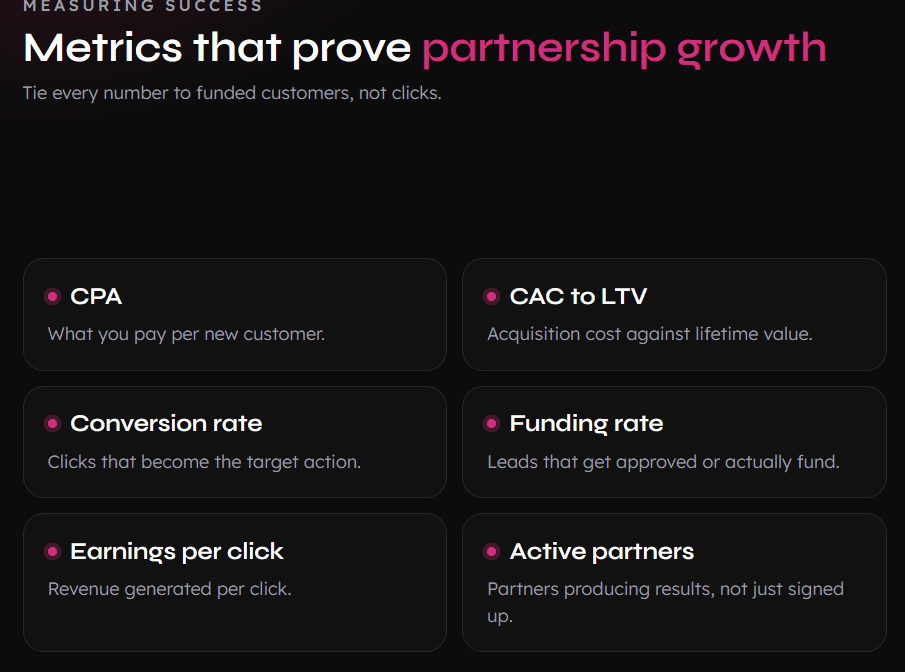
Vanity metrics will mislead you. Total clicks tell you almost nothing about whether the channel is working. Tie every number back to funded customers and revenue.
| Metric | What it tells you | Why it matters |
|---|---|---|
| Cost per acquisition | What you pay per new customer | The anchor for the whole programme |
| CAC to LTV ratio | Acquisition cost against lifetime value | Proves the channel pays off over time |
| Conversion rate | Share of clicks that become the target action | Reveals which partners send real quality |
| Approval or funding rate | Leads that get approved or actually fund | Exposes high volume, low value partners |
| Earnings per click | Revenue generated per click | Compares partner quality on a level field |
| Active partner count | Partners producing results, not just signed up | A healthy programme grows this steadily |
One number deserves special attention in finance: the approval or funding rate. A lending partner can send enormous volume that looks great until you notice almost none of it qualifies. Paying on funded loans rather than raw applications fixes the incentive at the source.
Common Mistakes And How To Avoid Them
Most struggling programmes are not unlucky. They repeat a familiar set of errors.
Chasing quantity over quality. A programme with five hundred dormant partners and ten active ones is really a programme with ten partners. Recruit deliberately and prune the rest.
Underestimating compliance. Financial promotions are regulated, and so are the people promoting them. Partners must disclose their relationship with the brand clearly, and they cannot make claims a regulated product would not stand behind. Give partners approved messaging and disclosure templates, monitor what they publish, and remove anyone who cuts corners. In finance, compliance is not a one off task.
Ignoring fraud. Where there is a payout, there is an incentive to game it. Fake leads, low quality sign ups that never fund, and bot traffic all erode budgets quietly. Lead validation and payouts tied to funded actions are your best defences.
Setting and forgetting. The single biggest waste is treating affiliates as a channel to launch rather than relationships to manage. Your top partners are courted by competitors constantly. Communicate, pay on time, and give them reasons to prioritise you.
Expecting instant results, then quitting. Worth repeating, because it kills more programmes than any technical problem. The channel compounds. Give it the runway it needs.
Best Practices For Long-term Partnership Growth
The programmes that keep paying off share a mindset: they treat partners as a portfolio to grow, not a cost to minimise.
- Pay against lifetime value, and use a CPL plus CPS hybrid on high value products so partners earn from the transaction volume their leads generate, not just the first registration.
- Segment your partners and manage the top tier like key accounts, with tailored terms and direct relationships.
- Feed the whole funnel. Reward the publishers and creators who create demand, not only the comparison sites that capture it.
- Keep compliance active and visible, so partners always know what good looks like.
- Review performance monthly, reallocate toward what works, and retire what does not.
Handling all of this well takes specialised infrastructure and time, which is why many European finance brands work with a dedicated network rather than building everything in house.
Future Trends In Affiliate Partnerships
A few shifts are worth planning for now.
First party data is becoming the foundation. Regardless of what Chrome does with cookies, European measurement is moving toward consented, direct, server side tracking, because that is what survives GDPR and the ePrivacy rules and what still works in Safari and Firefox. Brands that invest here early gain a durable advantage.
The line between affiliate and creator marketing is blurring. Finance creators on YouTube, newsletters, and community platforms are now a serious acquisition channel, increasingly paid on outcomes rather than flat fees. Expect the two disciplines to merge into one performance model.
Regulation will keep shaping the field. Frameworks such as PSD2, MiCA for crypto assets, and the Digital Services Act are changing how financial products are marketed and how partners must behave. Programmes with compliance built in will adapt more smoothly than those bolting it on later.
Automation is improving partner discovery and attribution. Better tooling is making it easier to find partners likely to convert, predict which to retain, and credit touchpoints accurately across a longer journey. The practical effect is a channel that is easier to measure and to scale.
Key Takeaways
For a busy reader, this is the short version:
- Acquisition is getting more expensive, and paying per result rather than per click is an increasingly rational response.
- Affiliate partnerships lower cost per customer, extend reach through trusted partners, and scale with performance.
- Success depends on economics first, then the right payout model, partner fit, clean tracking, and active compliance.
- Measure funded customers and lifetime value, not clicks.
- Treat partners as long term relationships, and give the channel time to compound.
Conclusion
Understanding how financial brands scale growth through affiliate partnerships is less about a clever tactic and more about a shift in mindset. Instead of buying uncertain attention, you build a network of partners who grow when you grow. For European banks, lenders, investment platforms, and fintechs facing rising acquisition costs and tighter privacy rules, that alignment is hard to beat.
The next steps are practical. Map your customer’s lifetime value, decide the payout you can afford per funded account, and recruit partners whose audiences genuinely match. Get your tracking and compliance right before you scale, and manage your best partners like the growth assets they are.
This is the work Circlewise does with financial brands across Europe: recruiting the right partners, handling tracking and compliance, and turning a basic affiliate setup into a managed programme that acquires customers efficiently. If you are building or scaling one, our team can help you put the strategy into practice through structured affiliate programme management and a partnership approach built for regulated finance.
Frequently Asked Questions
What are affiliate partnerships in financial services?
They are performance based agreements where a financial brand pays external partners a commission for driving a specific result, such as a new account, a qualified lead, or a funded deposit. Partners promote the product through tracked links and earn only when the agreed action happens, which keeps acquisition cost tied to outcomes.
How do affiliate partnerships help financial brands scale growth?
They lower the cost of each new customer, open access to audiences that already trust the partner, and tie spend to performance. Because you reward partners who deliver and stop paying those who do not, growth becomes a matter of finding and managing the right partners rather than outbidding competitors in an auction.
How are affiliate partnerships different from paid advertising?
Paid advertising charges for clicks or impressions, so the advertiser carries the risk and costs rise with competition. Affiliate partnerships charge for completed actions, so the partner carries most of the risk and cost stays tied to results. Paid media buys speed; partnerships buy efficiency and borrowed trust. Most finance brands use both.
Which commission model should financial brands use?
It depends on the product. CPL suits brands that own the rest of the funnel, and CPA suits straightforward goals such as a funded account. For high value products like P2P lending, investment platforms, and brokers, most European brands use a hybrid of CPL and CPS, where the CPS is paid on the lead’s transaction volume in the first 90 to 180 days after registration, usually with a fixed fee for content production. That structure rewards partners for leads who actually transact, not just those who register.
Which types of financial companies benefit most?
Banks, digital banks, lenders, investment and trading platforms, payment providers, and insurers all use the model. Products with high lifetime value and a strong research phase, such as investment accounts, loans, and credit products, tend to see the strongest fit, because trust and comparison play a large role in the decision.
How do you measure the success of an affiliate partnership programme?
Focus on cost per acquisition, the CAC to LTV ratio, conversion rate, approval or funding rate, earnings per click, and the number of active, productive partners. The goal is to connect partner activity to funded customers and revenue, not to celebrate clicks or sign ups that never convert.
What are the main risks, and how do you manage them?
The recurring risks are weak compliance and disclosure, fraud and low quality leads, and inaccurate attribution. Manage them with approved messaging and disclosure templates, active monitoring, first party tracking, lead validation, and payouts tied to funded actions rather than raw sign ups.
Do affiliate partnerships work under European privacy rules?
Yes, and often better than channels built on broad tracking. Programmes that use consented, first party, server side tracking align with GDPR and the ePrivacy rules and continue to work in browsers that block third party cookies. Compliance and clear disclosure are essential, but the model itself fits the European privacy environment well.