Fintech customer acquisition through affiliate marketing has become one of the more dependable answers to a problem every growth team in the sector recognises: winning new customers keeps getting harder, and the cost of doing it keeps climbing. Paid search and paid social were meant to solve distribution. In practice they turned acquisition into an auction where prices rise each quarter, and the trust a financial brand needs still has to be built somewhere else.

This guide is written for growth managers, CMOs, and partnership leads at European fintech and financial services companies who want a clearer view of how affiliate partnerships fit into a modern acquisition plan. You will find how the model works, where it beats other channels, the partner types worth pursuing, the metrics that actually matter, and the mistakes that quietly drain budgets. The aim is practical understanding, not a pitch.
Why customer acquisition is so difficult in fintech
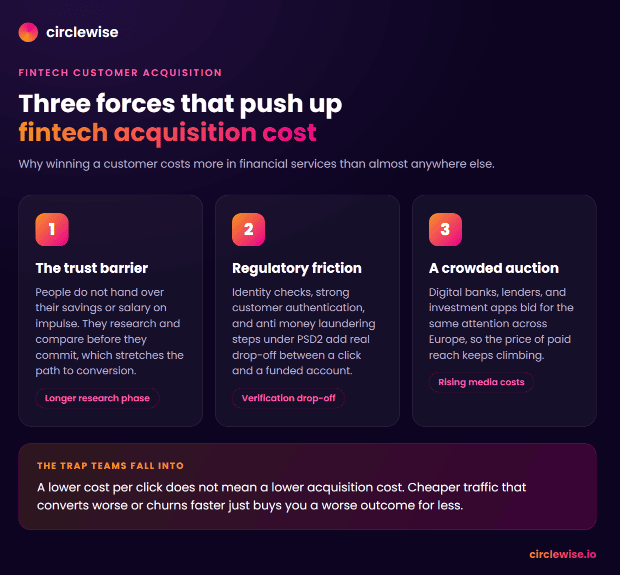
Acquiring customers in financial services carries a weight that most other industries never feel. Someone downloading a shopping app needs a reason and maybe a discount. Someone handing a new provider access to their salary, their savings, or their investments needs proof that the company is safe, regulated, and/or worth trusting before they commit anything at all.
That trust barrier sits on top of an already crowded market. Digital banks, P2P lending platforms, payment providers, and investment apps are all competing for the same attention, often bidding on the same keywords. As more players enter, the price of paid reach rises, and the effective cost of each acquired customer rises with it.
Regulation adds another layer. Under frameworks such as PSD2 and the EU’s wider payment services rules, onboarding involves identity checks, strong customer authentication, and anti money laundering steps. Every one of those adds friction between a click and a funded account. A prospect can be genuinely interested and still drop out at verification, which means you can pay for the interest without ever getting the customer. For peer-to-peer lending and investment platforms, which make up a large share of Europe’s fintech advertisers, the framework that matters most is the European Crowdfunding Service Providers Regulation (ECSPR), which unifies authorisation, risk disclosure, and anti money laundering procedures across member states. Industry bodies such as EuroCrowd track how these rules develop across the EU.
Here is the part teams often miss. Lowering your cost per click does not automatically lower your customer acquisition cost. If cheaper traffic converts worse or churns faster, you have simply paid less for a worse outcome. The number that matters is what it costs to acquire a customer who stays and generates value, and that number is stubbornly high in fintech because trust, compliance, and competition all push against you at once.
What fintech customer acquisition through affiliate marketing actually involves
Fintech customer acquisition through affiliate marketing is a performance model where a financial brand partners with publishers, creators, and media partners who promote its product, and pays them only when a defined result occurs, such as a qualified lead, a funded account, or a verified first transaction. Payment follows the outcome rather than the exposure.
That single feature changes the economics. With most paid media, you spend whether or not anyone converts. With affiliate partnerships, cost attaches to the action you actually care about, so the risk of paying for empty traffic drops sharply.
It helps to clear up a common misconception. Affiliate marketing in fintech is not a pile of discount codes scattered across coupon sites. Done well, it is a managed acquisition channel built on relevant partners, clean tracking, and careful compliance oversight. The discount-code image comes from low-value retail programmes, and applying that mental model to financial services is exactly how companies end up disappointed. This is why brands increasingly treat fintech affiliate marketing as a strategic channel with its own management discipline, not a bolt-on.
How affiliate marketing supports sustainable growth
The appeal for finance teams is that affiliate partnerships align cost with value in a way few other channels manage.
- You pay for results, not impressions. Budget moves after the lead or funded account lands, so wasted spend shrinks.
- Partners bring trust you would otherwise have to build. A respected European finance publisher or an established investing creator has already earned their audience’s confidence. Their recommendation shortens the research phase that makes fintech acquisition so slow.
- Risk shifts away from the brand. Weak partners cost you little because payout depends on performance. Strong partners earn more because they deliver more.
- Good placements compound. A well-positioned comparison page or review keeps sending qualified traffic for months, whereas paid media stops the moment the budget does.
Consider a European lending or investment marketplace. Platforms in this space, including names such as Mintos, Bondora, and PeerBerry, operate in a category where investors compare options carefully before committing funds. Comparison publishers and specialist finance content sites do a large share of that persuasion work, and a performance model means the platform pays for the investors who actually sign up rather than for the traffic that merely browses. That is what sustainable growth looks like: acquisition cost tied to genuine outcomes, supported by content that keeps working after publication.
The fintech customer acquisition journey through affiliate partnerships
A customer rarely goes from first touch to funded account in a single click. In fintech the path is longer, and understanding it changes how you value partners.
A typical journey runs like this:
- Discovery. A prospect encounters your brand through a partner’s article, video, or comparison table.
- Research. They read reviews, compare fees and features, and look for reassurance that you are legitimate.
- Referral click. They follow a tracked link to your site or app.
- Sign-up. They begin registration.
- Verification. Identity and compliance checks are completed. This is where many drop out.
- First transaction. They fund the account, make a first investment, or complete a first payment.
- Active customer. They return, and lifetime value begins to accrue.
The strategic point sits between steps five and six. Because verification can delay conversion by hours or days, a naive last-click model credits whichever partner touched the customer most recently and undervalues the publisher who created the original interest. A frequent mistake among fintech teams is rewarding only that final touch, which slowly starves the upper-funnel partners who build awareness. Stronger programmes use conversion-path or multi-touch attribution so credit is shared fairly across everyone who contributed. It is a small technical choice with a large effect on which partners stay motivated.
Types of affiliate partners for fintech companies
Not all partners do the same job. A strong programme blends several types so you reach people at each stage of the decision.
| Partner type | What they do | Where they add most value |
| Comparison and review sites | Rank providers on fees, returns, and features | Late stage, when the prospect is choosing between options |
| Finance content publishers | Explain products, strategies, and concepts in depth | Mid stage, during active research |
| Finance creators and influencers | Share first-hand experience with an engaged audience | Early stage, building trust and consideration |
| Cashback and loyalty partners | Add an incentive at the point of sign-up | Final push for hesitant prospects |
| Media buyers and performance partners | Run paid campaigns on a pay-for-results basis | Scaling volume without fixed ad risk |
In regulated finance, one principle overrides the rest: partner relevance and compliance matter more than raw reach. A single careless promoter making unsupported claims about returns, or hiding a paid relationship, can create regulatory exposure faster than they create customers. Vetting partners, setting clear promotional rules, and monitoring how your brand is represented are not optional extras. They are the difference between a programme that scales and one that becomes a liability. It is also why publisher screening matters so much, and why many brands prefer to work through an established network of vetted European publishers rather than approving applicants one at a time.
How P2P lending platforms use incentives to win investors
Cashback and loyalty partners carry particular weight in peer-to-peer lending, where platforms rely on incentives to convert cautious investors. A new investor is often welcomed with a cashback bonus on their first deposit, and platforms run regular promotions that lift interest rates or improve cashback rates for a limited period. Loyalty schemes then reward investors who stay and keep funding their accounts. For affiliates, these offers are among the most effective conversion tools available, because a well-timed cashback campaign gives a comparison site or finance creator a concrete reason for their audience to act now rather than later. Recent European examples include Loanch’s summer cashback bonus and its upgraded loyalty programme, alongside Indemo’s afterparty cashback promotion.
Affiliate marketing compared with other acquisition channels
Affiliate partnerships are not a replacement for everything else. They work best as part of a balanced mix, and knowing the trade-offs helps you allocate budget sensibly.

Paid advertising still earns its place. When you need to test a new market quickly or push volume in a short window, it is hard to beat. The honest position is that affiliate marketing improves the efficiency of your wider acquisition strategy rather than replacing paid channels outright.
It is worth separating affiliate marketing from influencer marketing too, since the terms get blurred. Influencer deals are often paid upfront as flat fees regardless of outcome, whereas affiliate arrangements pay on performance. Many European fintech brands now blend the two, giving creators an affiliate link so the relationship rewards actual sign-ups instead of views alone.
Metrics every fintech company should track
You cannot improve what you do not measure, and the right metrics keep an affiliate programme honest.
| Metric | What it measures | Why it matters |
| Customer acquisition cost (CAC) | Total spend divided by new customers | The headline efficiency number |
| Cost per action (CPA) | Cost of each defined action | Shows what you pay at each funnel step |
| Lifetime value (LTV) | Total value a customer generates over time | The ceiling that justifies your CAC |
| LTV to CAC ratio | Value created against cost to acquire | The clearest signal of sustainable growth |
| Conversion rate | Share of referred traffic that converts | Reveals partner and funnel quality |
| Return on investment (ROI) | Return against total programme spend | Confirms the channel pays off |
| Retention and churn | How many acquired customers stay | Exposes cheap acquisitions that do not last |
A widely used rule of thumb is that a healthy business wants its lifetime value to sit at roughly three times its acquisition cost. Below that, growth quietly turns into a leak.
The insight that separates good analysts from great ones is this: CAC read on its own is misleading. A partner delivering a low cost per sign-up can still be your worst partner if those sign-ups never verify or never fund. Track CAC and retention by individual partner, not just at the programme level, and you will quickly see which relationships build the business and which only inflate the top of the funnel.
Common challenges and how to overcome them
Most programmes that underperform fail for predictable reasons.
- Incentivised or low-quality traffic. Some partners chase volume with tactics that produce sign-ups who never become customers. Counter this by paying on funded accounts rather than raw registrations, and by watching cohort quality per partner.
- Fraud and misattribution. Financial products attract fraudulent activity. Reliable tracking, fraud detection, and clear validation rules protect your payouts.
- Compliance exposure. Under GDPR and EU data protection rules, how partners collect and handle prospect data is your concern as well as theirs, and disclosure of paid relationships has to be clear. Build these expectations into your partner terms from the outset.
- Neglect. Programmes decay when left alone. Partners go quiet, offers grow stale, tracking breaks. Someone has to own the relationship actively.
- Chasing volume over fit. A hundred loosely relevant partners will underperform ten whose audiences genuinely match your product.
Best practices for long-term success
Building a programme that holds up as it grows comes down to a handful of disciplined habits.
- Model your payout from lifetime value. Work backwards from what a customer is worth, so your commission plus other costs still leaves room for profit.
- Recruit for audience fit. In fintech, relevance beats reach every time. Prioritise partners whose audiences already trust them on money matters.
- Define the conversion that pays. Decide clearly whether you reward a lead, a funded account, or a verified transaction. Vague goals produce inflated payouts.
- Give partners what they need to succeed. Accurate creative, compliant talking points, and reliable tracking make your programme easy to promote well.
- Measure by partner and prune often. Reward the relationships that drive retained customers and cut the ones that do not.
- Scale what works. Once a partner type proves out, find more like it. Growth comes from repeating winners.
The teams that succeed treat affiliate programme management as an ongoing discipline rather than a one-time launch. Recruitment, activation, optimisation, and pruning never really stop.
Future trends in fintech customer acquisition
Several shifts are reshaping how European fintech brands will acquire customers over the coming years.
- Creators move to the centre. Finance creators with engaged, niche audiences are becoming primary acquisition channels rather than supplements, because their recommendations convert when trust is the deciding factor.
- First-party data grows more valuable. As third-party cookies fade and privacy rules tighten, direct partner relationships and clean consented data become a real advantage over anonymous open-auction media.
- Fairer attribution becomes standard. More programmes are adopting conversion-path models that credit every contributing partner, not just the last click, which keeps upper-funnel partners engaged.
- AI sharpens the operational work. Partner discovery, fraud detection, and performance analysis are all improving with better tooling, though the underlying logic of paying for outcomes stays the same.
The direction is consistent: away from expensive, anonymous media and towards measurable, trust-led partnerships.
Key takeaways
- Fintech acquisition is expensive because trust, regulation, and competition all raise the real cost of each customer.
- Affiliate marketing lowers that cost by paying for outcomes and borrowing partner trust.
- The customer journey is longer in fintech, so attribution should reward upper-funnel partners, not only the last click.
- A balanced partner mix reaches prospects at every stage, and relevance matters more than reach.
- Read CAC alongside retention and lifetime value, and measure performance partner by partner.
Bringing affiliate marketing into your fintech acquisition strategy
Fintech customer acquisition through affiliate marketing works because it aligns spend with results in an industry where trust is expensive and every wasted click hurts. The brands that get the most from it share a few habits: they pay on the conversion that matters, recruit partners for genuine audience fit, watch lifetime value next to acquisition cost, and treat compliance as part of the strategy rather than an afterthought.
If you are reviewing your own customer acquisition strategies, a sensible starting point is to map your true CAC by channel, then test affiliate partnerships against your most relevant European audiences. This is where a specialist partner earns its keep. Circlewise helps fintech and financial services brands build and manage in-house affiliate programmes across more than ten European markets, combining a vetted publisher network with the tracking, compliance oversight, and payment infrastructure that regulated products demand. For brands ready to launch or scale, the advertiser platform handles programme setup and partner recruitment so you keep control of the relationships that drive growth. Run well, affiliate marketing does more than reduce acquisition cost. It builds a channel that keeps paying off long after the spend stops.
Frequently asked questions
What is fintech customer acquisition through affiliate marketing?
It is a performance model where a fintech brand partners with publishers and creators who promote its product and get paid only when a defined result occurs, such as a funded account or verified transaction. Because cost attaches to outcomes rather than exposure, it reduces wasted spend and draws on the trust partners have already built with their audiences.
Why is customer acquisition so expensive for fintech companies?
Financial products require trust and regulatory checks that most other products do not. Prospects research carefully before committing money, onboarding involves identity and compliance steps that cause drop-off, and heavy competition pushes up the price of paid reach. Together these raise the real cost of acquiring a customer who stays.
What is customer acquisition cost, and how is it calculated?
Customer acquisition cost is the total amount spent to gain one new customer, calculated as total acquisition spend divided by the number of new customers in a period. It is only meaningful when read against lifetime value, with a ratio of roughly three to one generally considered healthy.
How does affiliate marketing compare with paid advertising for fintech?
Paid advertising charges for exposure whether or not it converts and stops the moment the budget does. Affiliate partnerships charge only when a result happens and keep working through evergreen content. Paid media is faster for testing and short-term scale, while affiliate marketing tends to improve overall efficiency, so most brands use both.
Which affiliate partners work best for financial services?
Comparison and review sites, in-depth finance content publishers, trusted finance creators, and cashback or loyalty partners each reach prospects at a different stage. In regulated finance, audience relevance and compliance matter far more than sheer reach.
How can fintech brands scale acquisition sustainably?
Model payouts from lifetime value, recruit partners for audience fit rather than volume, reward the conversion that genuinely matters, and measure retention and CAC partner by partner. Active, ongoing management is what separates programmes that scale from those that stall.
What metrics should a fintech company track in an affiliate programme?
Track CAC, CPA, lifetime value, the LTV to CAC ratio, conversion rate, ROI, and retention. Reading acquisition cost alongside retention is essential, since a low cost per sign-up means little if those customers never fund an account or churn quickly.
How do European data and payment rules affect affiliate acquisition?
Frameworks such as GDPR and PSD2 shape how prospect data is collected and how onboarding works, and brands remain responsible for how partners handle data and disclose paid relationships. Building these requirements into partner terms from the start protects both compliance and performance.