Every affiliate programme produces data. Clicks, impressions, leads, conversions. But when a marketing director sits down to assess whether the programme is actually working, one number matters more than most: cost per acquisition.
CPA tells you what you paid, on average, for each customer or conversion your affiliate partners delivered. It strips away vanity metrics and forces a straightforward question: can we acquire customers through this channel at a cost that makes commercial sense?

This guide breaks down how cost per acquisition works in affiliate marketing, how to calculate it properly, what a realistic target looks like, and where most advertisers go wrong when trying to improve it.
What is cost per acquisition?
Cost per acquisition is the total cost of acquiring one customer or completing one defined conversion through a marketing channel. In affiliate marketing, it typically represents the amount an advertiser pays, across commissions and programme costs, to generate a single valid acquisition.
The word “acquisition” is doing real work in that definition. What counts as an acquisition varies by business and product:
- A completed purchase
- A funded investment account
- An approved loan application
- A subscription sign-up
- A first deposit or transaction
- A qualified lead that meets predefined criteria
Getting this definition right is more important than most teams realise. A fintech company that defines acquisition as “account registration” will calculate a very different CPA from one that defines it as “first funded deposit.” Neither is wrong, but mixing the two makes performance comparisons meaningless.
Before running any CPA calculation, agree internally on what the acquisition event actually is. Then make sure your affiliate tracking is configured to measure that event, not a proxy.
Cost per acquisition formula

The formula for cost per acquisition is simple:
CPA = Total acquisition cost / Number of acquisitions
Each component matters:
- Total acquisition cost includes all spending directly attributable to generating those acquisitions. In an affiliate programme, this is primarily commissions paid, but it can also include platform fees, tracking costs, and partner management overhead.
- Number of acquisitions should reflect valid, approved conversions only, not raw leads or pending sign-ups.
Example: A European lending platform spends EUR 12,000 on affiliate commissions and programme costs in a given month and generates 240 approved loan applications. CPA = EUR 12,000 / 240 = EUR 50 per acquisition.
How to calculate cost per acquisition
Running the formula is easy. Getting accurate inputs takes more discipline. Here is a practical process:
1. Define the acquisition event. Decide what action a customer must complete before you count them as acquired. This should align with your business model, not just what is easiest to track.
2. Determine which costs to include. At minimum, include affiliate commissions. Depending on your measurement framework, you may also include platform fees, creative production costs, and partner management time. Be consistent across reporting periods.
3. Count valid acquisitions only. Use approved and validated conversions. Exclude pending conversions, duplicates, fraudulent sign-ups, and leads that failed your qualification criteria. Many advertisers inflate their numbers by counting raw conversions, which makes CPA look artificially low and leads to poor decisions.
4. Apply the formula. Divide total cost by valid acquisitions.
5. Compare against customer value. A CPA figure means nothing in isolation. Compare it to expected revenue per customer, gross margin, and lifetime value to determine whether the acquisition cost is commercially sustainable.
What costs should be included in CPA?
This depends on what you are measuring. Most advertisers use one of two approaches:
Affiliate programme CPA includes only the costs directly tied to the affiliate channel: commissions, network or platform fees, tracking costs, and any promotional incentives paid to partners. This is the most common way to evaluate affiliate performance against other channels.
Blended customer acquisition cost includes affiliate spend plus internal team costs, creative production, landing page development, and any other resources allocated to the programme. This gives a fuller picture but is harder to calculate consistently.
A common mistake is mixing the two approaches between reports or teams. If your affiliate manager reports channel CPA of EUR 40 and your finance team reports a blended CAC of EUR 85, both can be correct. The problem comes when someone compares them as if they measure the same thing.
Pick one framework for affiliate reporting and stick with it.
CPA in affiliate marketing
In an affiliate programme, the CPA model works in a specific sequence:
- The advertiser defines what counts as a qualifying acquisition and sets a commission accordingly.
- Affiliate partners promote the product to their audiences.
- A prospect clicks an affiliate link, arrives on the advertiser’s site, and completes the conversion journey.
- The tracking system records the conversion and attributes it to the referring affiliate.
- The advertiser validates the conversion against quality criteria.
- The approved commission is paid to the affiliate.
- The advertiser evaluates the resulting CPA against targets.
What makes affiliate CPA different from paid media CPA is the commission structure. In paid search or social, you pay for clicks or impressions regardless of outcome. In affiliate marketing, you typically pay for results. That means your CPA calculation is closely tied to your commission model, whether that is a flat CPA per action, a CPL for leads, or a hybrid structure combining an upfront CPL with a CPS earned on transaction volume over the first 90 to 180 days.
The commission model you choose directly shapes your CPA. A flat CPA commission gives you predictable costs but may not attract high quality partners who deliver more valuable customers. A hybrid model costs more per acquisition on paper but often produces customers with stronger lifetime value. The right structure depends on your product, your margins, and what kind of partners you want to recruit.
CPA vs CAC vs CPL
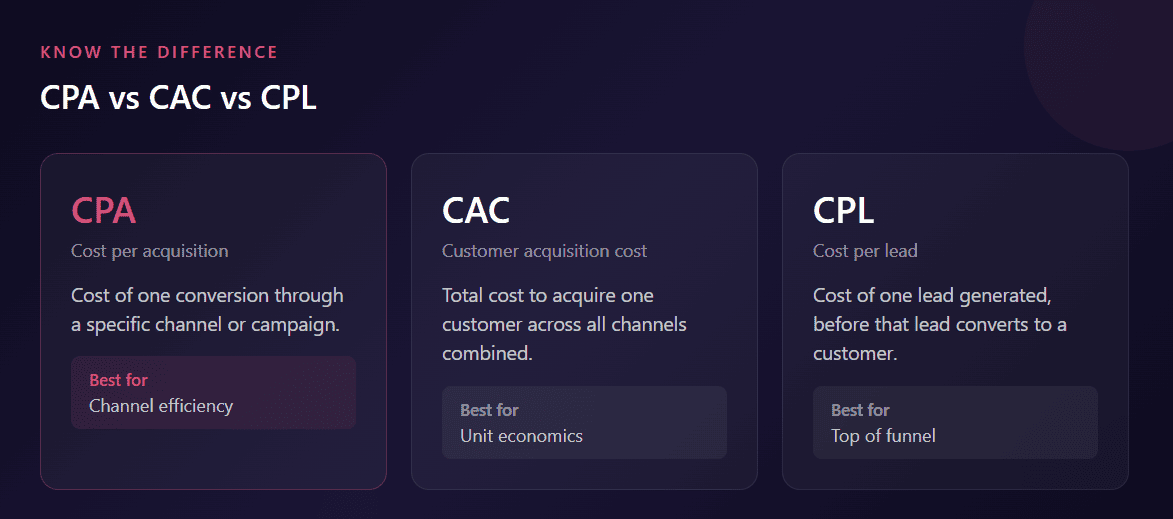
These three metrics overlap enough to cause confusion. Here is how they differ:
| Metric | What it measures | Typical scope | Best used for |
| CPA (cost per acquisition) | Cost to generate one defined conversion | Single channel or campaign | Evaluating affiliate, paid media, or campaign efficiency |
| CAC (customer acquisition cost) | Total cost to acquire one new customer | All channels combined | Assessing overall marketing efficiency and unit economics |
| CPL (cost per lead) | Cost to generate one lead | Single channel or campaign | Measuring top of funnel activity, especially in lending, insurance, and brokerage |
CPA and CAC are the pair that gets mixed up most often. CPA is usually channel specific, while CAC is company wide. A brand might have an affiliate CPA of EUR 45 but a total CAC of EUR 110 once you factor in paid search, content marketing, and internal sales costs. Both are useful numbers, but they answer different questions.
CPL sits earlier in the funnel. For a lending platform, a lead might be someone who submits an application, while an acquisition is a funded loan. The CPL will always be lower than the CPA, because not every lead converts. Tracking both helps you understand where the funnel leaks.
CPA vs other affiliate marketing metrics
CPA does not tell the whole story on its own. It works best alongside these metrics:
- Conversion rate reveals how efficiently traffic turns into acquisitions. A high CPA with a low conversion rate often points to landing page or onboarding problems, not partner quality.
- EPC (earnings per click) helps affiliates evaluate offers, but advertisers should watch it too. If your EPC is too low, good partners will deprioritise your programme.
- ROAS (return on ad spend) connects acquisition cost to revenue. CPA tells you what you paid; ROAS tells you what you got back.
- Customer lifetime value is the metric that makes CPA meaningful. A CPA of EUR 80 is expensive if your average customer generates EUR 100 in lifetime revenue. It is a bargain if they generate EUR 800.
- Average order value influences whether a CPA target is viable. Higher order values support higher acquisition costs.
For a broader view of how these metrics fit together, the guide to measuring affiliate marketing performance covers the full KPI framework.
What is a good cost per acquisition?
There is no universal answer. A “good” CPA depends on too many variables to reduce to a single benchmark:
- Product value and gross margin. A SaaS platform with 80% margins can tolerate a much higher CPA than a low margin e-commerce product.
- Customer lifetime value. If a customer stays for three years, you can afford to spend more upfront.
- Conversion event. CPA for a completed purchase will differ from CPA for a funded account or an approved application.
- Geography. Acquisition costs vary meaningfully across European markets. Acquiring a customer in Germany costs differently than in Poland or Portugal.
- Commission model. A CPA programme will produce different unit costs than a hybrid CPL plus CPS arrangement.
- Competitive landscape. Crowded verticals push CPA higher because more advertisers compete for the same partner attention and audience.
Anyone quoting you a universal “good CPA” for affiliate marketing is guessing. The right question is whether your CPA is sustainable given your specific unit economics.
How to set a target cost per acquisition
Setting a target CPA is a commercial exercise, not a marketing one. Start with what a customer is worth, then work backwards:
1. Calculate expected customer lifetime value. How much revenue does the average customer generate over their relationship with you? For subscription businesses, this is monthly revenue multiplied by average retention in months. For transaction-based products, factor in repeat purchase behaviour.
2. Determine your gross margin. Not every euro of revenue is available to fund acquisition. Subtract cost of goods, servicing costs, and operational overhead.
3. Decide your acceptable payback period. How quickly do you need to recover acquisition costs? A well funded fintech might accept a 12 month payback period. A bootstrapped SaaS company might need 3 months.
4. Factor in strategic context. Are you in a growth phase where market share matters more than short term profitability? Are you entering a new European market where higher initial CPA is expected?
5. Set the target. Your target CPA should sit below the point where acquisition becomes unprofitable, with enough margin to absorb variance between partners and campaigns.
A practical benchmark: many experienced affiliate managers aim for a CPA that allows recovery of acquisition costs within the first 25-40% of expected customer lifetime value. But this varies significantly by vertical and growth stage.
How to lower cost per acquisition in affiliate marketing
Reducing CPA without damaging customer quality requires a more surgical approach than simply cutting commissions. Here are the strategies that actually work:
Improve affiliate partner quality. The fastest way to lower CPA is to work with partners whose audiences are genuinely relevant to your product. A finance comparison site with qualified traffic will produce better CPA than a broad coupon site, even if the comparison site sends fewer clicks. Invest time in recruiting the right publishers rather than chasing volume.
Fix the conversion journey. If you are paying for clicks that do not convert, the problem is often your landing page or onboarding flow, not the affiliate. Test page load times, form length, mobile experience, and the clarity of your value proposition. Small improvements here can move CPA significantly.
Optimise commission structures. Paying the same flat rate to every partner regardless of quality is a missed opportunity. Consider tiered commissions that reward partners delivering higher value customers, or hybrid models that combine an upfront CPL with a CPS on subsequent transaction volume.
Improve attribution accuracy. Inaccurate tracking inflates CPA by either missing valid conversions or counting the wrong ones. Make sure your conversion path and attribution setup correctly identifies which partners drive real results, especially across devices and longer customer journeys.
Remove low quality traffic sources. Monitor for incentivised traffic, cookie stuffing, and partners delivering leads that never convert past the initial action. Regularly audit your partner base and remove sources that consistently produce poor quality acquisitions.
Segment and compare partner performance. Do not assess CPA as a single programme-wide number. Break it down by partner, traffic source, geography, and customer segment. You will almost certainly find that a small group of partners delivers most of your valuable acquisitions at the best CPA, while a long tail contributes volume but poor unit economics.
Test and iterate. Run controlled tests on offers, landing pages, creative assets, and commission structures. Do not change everything at once. Measure the impact of each change before moving to the next.
CPA and customer quality
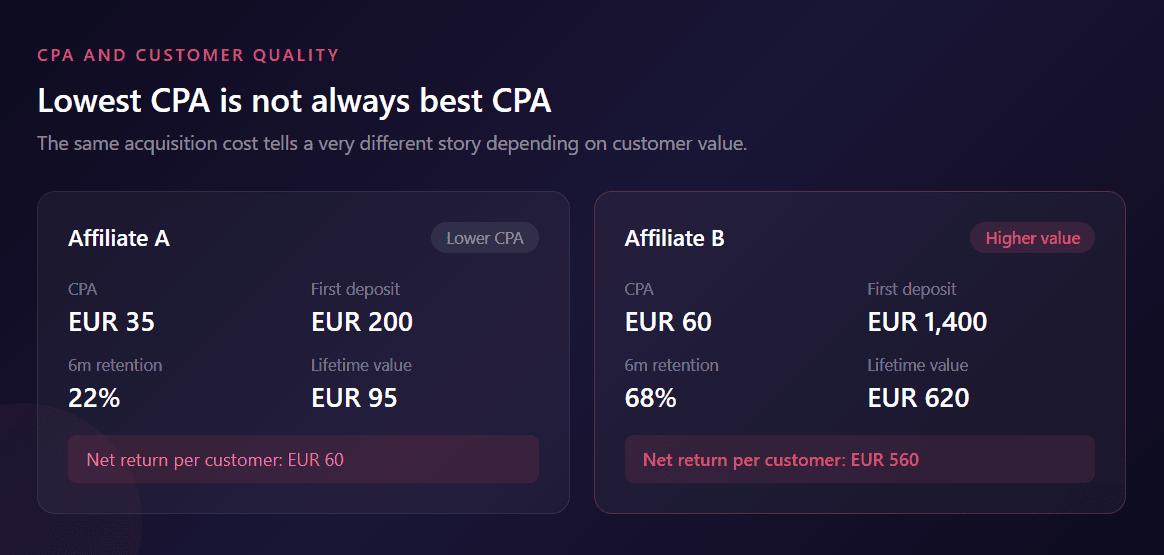
Chasing the lowest possible CPA is one of the most common mistakes in affiliate programme management. It sounds logical: pay less per customer, improve profitability. In practice, it often does the opposite.
Consider two affiliates promoting a European investment platform:
| Affiliate A | Affiliate B | |
| CPA | EUR 35 | EUR 60 |
| Average first deposit | EUR 200 | EUR 1,400 |
| 6 month retention | 22% | 68% |
| Lifetime value | EUR 95 | EUR 620 |
Affiliate A looks better on a CPA report. Affiliate B is far more valuable to the business. If you optimise purely for CPA, you would scale Affiliate A and reduce spend on Affiliate B, which would be exactly the wrong decision.
Always evaluate CPA alongside retention, lifetime value, first transaction value, repeat activity, and refund or cancellation rates. The cheapest customer to acquire is rarely the most profitable one to keep.
CPA and attribution
How you attribute conversions directly affects your CPA calculation. Two common pitfalls:
Last click attribution overstates the contribution of deal and coupon sites. A customer might discover your product through a finance blog, research it via a comparison site, and then search for a discount code before signing up. Last click gives full credit to the coupon site, making that partner’s CPA look excellent while the blog and comparison site appear expensive. The reality is that all three contributed.
Short attribution windows miss longer decision journeys. Financial products often involve consideration periods of weeks or months. If your attribution window is 7 days, you are losing conversions and inflating your apparent CPA. Most fintech programmes should test windows of 30 to 90 days, depending on the product.
Multi-touch attribution gives a more accurate picture but requires better tracking infrastructure. At minimum, understand how your attribution model affects your CPA figures and avoid making partner decisions based on a model that systematically undervalues certain types of partners.
Common CPA measurement mistakes
These errors appear repeatedly across affiliate programmes of all sizes:
- Counting clicks or leads as acquisitions. CPA measures cost per completed acquisition, not cost per click or cost per form fill. Mixing these up produces misleading numbers.
- Including unvalidated conversions. Raw conversion counts always look better than approved ones. Use approved acquisitions only.
- Ignoring refunds and cancellations. A customer who signs up and cancels within a week should not count as a valid acquisition. Adjust your CPA retroactively for reversals.
- Comparing different acquisition definitions. If your app team counts “download” as an acquisition and your web team counts “first purchase,” their CPA figures are not comparable.
- Setting unrealistic CPA targets. Targets based on what you want to pay rather than what the market and your unit economics allow lead to under-investment in quality partners.
- Looking at CPA in isolation. A low CPA paired with poor lifetime value is worse than a moderate CPA with strong retention.
- Using inconsistent attribution windows. Changing your attribution window between reporting periods makes trend analysis unreliable.
What to monitor on a CPA dashboard
A well structured affiliate dashboard should give you answers within a few seconds. The metrics that matter:
- Total acquisitions and total acquisition cost
- Programme CPA and CPA by partner
- Conversion rate from click to acquisition
- Revenue generated and ROAS
- Customer lifetime value by partner
- Top performing and underperforming partners
- CPA trend over time (weekly and monthly)
Review CPA weekly for active optimisation and monthly for strategic decisions. Quarterly reviews should assess whether your target CPA still aligns with customer value and market conditions.
What is changing in CPA measurement
A few shifts are worth watching:
Privacy regulation and browser restrictions are pushing tracking toward first party, server side models. Advertisers who invest in consented, GDPR-compliant tracking infrastructure will have more accurate CPA data than those relying on third party cookies.
Incrementality testing is gaining traction. Rather than asking “what CPA did this partner deliver,” smart programmes are asking “would these customers have converted anyway?” That is a harder question, but it produces a more honest CPA.
Customer quality measurement is getting more sophisticated. The gap between “we acquired a customer” and “we acquired a valuable customer” is where the most interesting CPA work happens now.
Key takeaways
- CPA measures what you pay for each valid acquisition through your affiliate programme. Define the acquisition event carefully before calculating.
- The formula is straightforward: total acquisition cost divided by number of approved acquisitions.
- Include only the costs that belong in your chosen measurement framework and be consistent.
- CPA benchmarks are meaningless without context. Set targets based on your own unit economics, lifetime value, and margins.
- The lowest CPA is not the goal. Acquiring valuable customers at a commercially sustainable cost is the goal.
- Attribution models shape your CPA numbers. Understand how yours works before making partner decisions.
- Segment CPA by partner, geography, and customer type. Programme averages hide the insights that drive improvement.
Conclusion
Cost per acquisition is one of the most useful metrics in affiliate marketing, but only if you measure it properly and interpret it in context. A CPA figure that is not connected to customer quality, lifetime value, and attribution accuracy is just a number on a spreadsheet.
The goal is not the lowest possible acquisition cost. The goal is to acquire customers who generate more value than they cost, through partners who deliver consistent, sustainable results.
Getting this right requires accurate tracking, thoughtful attribution, careful partner management, and a willingness to pay more for quality when the data supports it. That is exactly the kind of programme management that Circlewise helps European advertisers build, from tracking infrastructure and attribution to partner recruitment and performance optimisation across multiple markets.
Frequently asked questions
What is cost per acquisition?
Cost per acquisition is the average amount an advertiser spends to generate one completed acquisition, such as a purchase, funded account, or qualified sign-up. It is calculated by dividing total acquisition costs by the number of valid acquisitions.
What is the formula for cost per acquisition?
CPA = Total acquisition cost / Number of acquisitions. Total acquisition cost should include commissions and directly attributable programme costs. The number of acquisitions should reflect validated, approved conversions only.
How do you calculate CPA in affiliate marketing?
Define what counts as a qualifying acquisition. Add up all affiliate commissions and programme costs for the period. Count only the approved, valid acquisitions. Divide total cost by total acquisitions. Then compare the result against customer lifetime value to assess whether the CPA is sustainable.
What is a good CPA?
There is no universal benchmark. A good CPA depends on your product margins, customer lifetime value, conversion event definition, market, and commission model. The right CPA is one you can sustain while still acquiring customers who generate a positive return over their lifetime.
What is the difference between CPA and CAC?
CPA typically measures the cost of one conversion through a specific channel or campaign. CAC (customer acquisition cost) is broader, covering all marketing and sales costs across every channel divided by total new customers. An advertiser might have an affiliate CPA of EUR 50 and a total CAC of EUR 120.
How can advertisers lower CPA in affiliate marketing?
Focus on partner quality over volume, optimise your conversion journey, test commission structures, improve attribution accuracy, remove low quality traffic sources, and segment performance by partner rather than relying on programme averages.
What costs should be included in CPA?
At minimum, include affiliate commissions and platform or tracking fees. Depending on your measurement approach, you may also include partner management costs, creative production, and promotional incentives. Be consistent in what you include across reporting periods.
How does affiliate tracking affect CPA?
Inaccurate tracking leads to inaccurate CPA. Missed conversions inflate CPA artificially, while incorrectly attributed conversions deflate it. Attribution windows, cross-device tracking, and the attribution model (first click, last click, or multi-touch) all affect which partners get credit and what CPA each partner appears to deliver.