Two affiliate programmes can report the same number of conversions and be worth completely different amounts to the business. That gap is the reason to measure affiliate marketing properly rather than simply counting what the platform hands you.

Performance measurement decides where budget goes, which partners get more of it, and whether the channel earns a seat in annual planning. Programmes that report clicks and conversions get treated as a nice extra. Programmes that report acquisition cost, customer value and incremental revenue get funded.
This guide covers the key performance indicators (KPIs) worth tracking, how each one is calculated, how to structure dashboards and reporting, how attribution changes your numbers, and the mistakes that quietly distort results in European programmes.
What is affiliate marketing performance?
Affiliate marketing performance is the measurable value an affiliate programme delivers, expressed as conversions, revenue and customer quality set against the commission and management cost required to produce them.
It has two halves that get confused constantly. Output is what the programme produced. Efficiency is what that output cost. A programme can grow output every month while efficiency deteriorates, and reporting that shows only the first half will not catch it.
For European fintech, lending and investment brands there is a third consideration. The conversion that matters is rarely the registration. A sign up that never funds an account, clears identity and anti money laundering checks (KYC) or completes a policy is not performance. It is activity that looks like performance in a dashboard.
Definition to work from: performance is measured at the point where the customer becomes commercially real to your business, not at the point where the tracking pixel fires.
Why measuring affiliate performance matters
Accurate measurement changes five things that directly affect programme growth.
Campaign optimisation. You cannot fix what you cannot isolate. Partner level data shows whether a drop came from creative fatigue, a landing page change, a market specific problem or one underperforming partner.
ROI improvement. Knowing the cost of an acquired customer against their value lets you raise payouts where the maths supports it and pull back where it does not. Most programmes leave growth on the table because they cap commissions uniformly rather than by partner economics.
Rewarding the right partners. Volume leaderboards reward whoever sits closest to the conversion. Quality adjusted scoring rewards whoever brings customers who stay. These produce different lists, and the second one is the one worth paying bonuses against.
Reducing wasted spend. Duplicate tracking, unvalidated conversions, dormant partners and overlapping voucher activity all cost money without producing customers. None of them are visible in a headline conversion count.
Stronger partnerships. Publishers work harder for advertisers who share numbers. A partner who can see their own earnings per click and approval rate will optimise without being asked.
There is a compliance dimension too. Under the Unfair Commercial Practices Directive, undisclosed affiliate content is treated as misleading, and promotions for regulated products sit under frameworks such as MiFID II, the Consumer Credit Directive and MiCA depending on the product. The advertiser carries that responsibility, so monitoring what partners publish belongs inside performance reporting rather than beside it.
The most important affiliate marketing KPIs
Revenue and sales KPIs
Revenue is the value generated by affiliate referred customers. In finance this often needs a proxy, such as deposit volume, funded loan value or annualised premium, because value accrues over time rather than at checkout.
Sales counts completed transactions. Useful for trend lines and seasonality, weak as a standalone judgement.
Conversions counts completed target actions. The number is only as meaningful as the action behind it, which is why the conversion event should be agreed with compliance and product, not defined by whoever set up the tracking.
Conversion rate is the share of clicks that convert. This is the most diagnostic single metric in the channel because it sits at the join between partner quality and your own funnel. When it falls across every partner at once, the problem is almost always internal.
Traffic and efficiency KPIs
Clicks measure interest and act as the denominator for most useful ratios. Deduplicate them or every downstream metric inherits the error.
Click through rate (CTR) is clicks divided by impressions, expressed as a percentage. It shows how well a placement and a creative work together. A falling CTR on a stable placement usually means creative fatigue rather than audience decline, so the fix is a rotation rather than a renegotiation.
Earnings per click (EPC) is commission earned divided by clicks delivered. It is how publishers compare your offer against everything else available to them. An uncompetitive EPC stalls recruitment regardless of how good the product is.
Average order value (AOV) is revenue divided by orders. In finance, read it as average first deposit or average loan size. A partner with a lower conversion rate but a much higher average deposit can be the most valuable one you have, and a conversion rate ranking hides that entirely.
Revenue per affiliate shows how much value the average partner produces and exposes concentration. If a small handful of partners generate most of the revenue, that is a commercial risk sitting inside a performance channel.
Cost and return KPIs
Customer acquisition cost (CAC) is total acquisition cost divided by customers acquired. Include commissions, platform fees, management time and creative production, or the figure will flatter the channel when compared against paid media.
Cost per acquisition (CPA) is the payout side of the same question: what you pay a partner for each completed acquisition. It is the metric most often calculated inconsistently between teams, usually because scope and validation rules are never written down. Two things settle most of the arguments. Agree what counts as an acquisition, since a registration and a funded account produce very different numbers from the same traffic. Then agree which costs sit inside the calculation, because a CPA covering commission alone will always look cheaper than one that also carries platform fees, management time and creative production. CPA suits broad acquisition with a clear conversion point. Where the conversion sits further from the money, cost per lead (CPL) fits lending, insurance and brokerage, while high value products such as investment platforms usually work better on a hybrid: a CPL paid upfront plus a share of the lead’s transaction volume in the first 90 to 180 days after registration.
Return on investment (ROI) compares net return with total channel cost. Return on ad spend (ROAS) compares gross revenue with spend and suits programmes with a media buying component. Both are defensible. Mixing them inside one report is not, and it happens more often than anyone admits.
Customer value KPIs
Customer lifetime value (CLV) is the contribution a customer generates across the relationship. Financial products often have long payback periods, so an acquisition that looks expensive in month one can be comfortably profitable by month nine. Without CLV you will cut your best partners.
New versus returning customers shows whether partners are genuinely acquiring or intercepting existing users on their way to purchase. Cashback and voucher partners skew towards returning customers, which is not automatically bad, but it should be paid differently.
Programme health KPIs
Active affiliates counts partners producing at least one validated conversion in the period. Recruitment totals without activation totals are decoration.
Affiliate activation rate is the share of newly recruited partners delivering a first conversion within 30 to 60 days. It is the clearest available measure of whether onboarding, creative assets and payout terms are working.
Contribution KPIs
Assisted conversions show where partners appear in journeys they never get paid for under last click rules. Content and review partners frequently sit here, and cutting them because their last click numbers look weak is one of the more expensive mistakes in the channel.
Incremental revenue is the revenue that would not have occurred without the partner. It is the hardest metric to produce and the most persuasive one you can put in front of finance.
Affiliate marketing metrics explained
Before the formulas, a quick reference for the abbreviations used across this guide and in most affiliate platforms.
| Abbreviation | Stands for | In one line |
|---|---|---|
| KPI | Key performance indicator | A metric tied to a business goal, owned by someone and reviewed against a target |
| CTR | Click through rate | Share of impressions that produced a click |
| EPC | Earnings per click | Commission a partner earns per click they send |
| AOV | Average order value | Average value per transaction, or per funded account in finance |
| CAC | Customer acquisition cost | Full cost of acquiring one customer, across all cost lines |
| CPA | Cost per acquisition | What you pay a partner for each completed acquisition |
| CPL | Cost per lead | What you pay for a qualified lead, before conversion |
| CLV | Customer lifetime value | Total contribution a customer generates over the relationship |
| ROI | Return on investment | Net return measured against total channel cost |
| ROAS | Return on ad spend | Gross revenue measured against spend, before margin |
| KYC | Know your customer | Identity and anti money laundering checks during onboarding |
| CRM | Customer relationship management | The system holding customer records after the conversion |
| Metric | Formula | What it tells you |
|---|---|---|
| Conversion rate | Conversions / clicks x 100 | Offer and funnel effectiveness |
| Earnings per click (EPC) | Commission earned / clicks | How attractive your offer is to publishers |
| Average order value (AOV) | Revenue / number of orders | Value per transaction or per funded account |
| Revenue per affiliate | Total revenue / active affiliates | Programme depth and concentration |
| Customer acquisition cost (CAC) | Total acquisition cost / customers acquired | True cost of a customer |
| Return on investment (ROI) | (Net return – channel cost) / channel cost x 100 | Channel profitability |
| Return on ad spend (ROAS) | Gross revenue / channel spend | Efficiency of spend, before margin |
| Customer lifetime value (CLV) | Average contribution per period x expected lifespan | Long term customer worth |
| Activation rate | Activated new partners / total new partners x 100 | Onboarding effectiveness |
| Assisted conversions | Conversions with a partner touch before the final click | Upper funnel contribution |
| Incremental revenue | Revenue with partner activity – modelled baseline | Genuine channel lift |
Two practical notes. First, agree whether ratios use gross or approved conversions before you publish anything, because the two versions of the same report will differ enough to start arguments. Second, incremental revenue does not need a modelling team to begin with. A controlled partner pause of two to four weeks, with total conversions watched to see whether they fall or simply redistribute, gets you most of the way there.
Affiliate marketing KPIs versus metrics
A metric is any number you can measure. A KPI is the small set of metrics tied to a business objective that you actively manage against.
| Metrics | KPIs | |
|---|---|---|
| Purpose | Describe what happened | Measure progress towards a goal |
| Quantity | Many | Few, usually five to eight |
| Ownership | Reported | Owned by a person with a target |
| Example | Impressions, clicks, bounce rate | CAC, ROI, activation rate, retention at 90 days |
| Reaction when it moves | Noted | Triggers a decision |
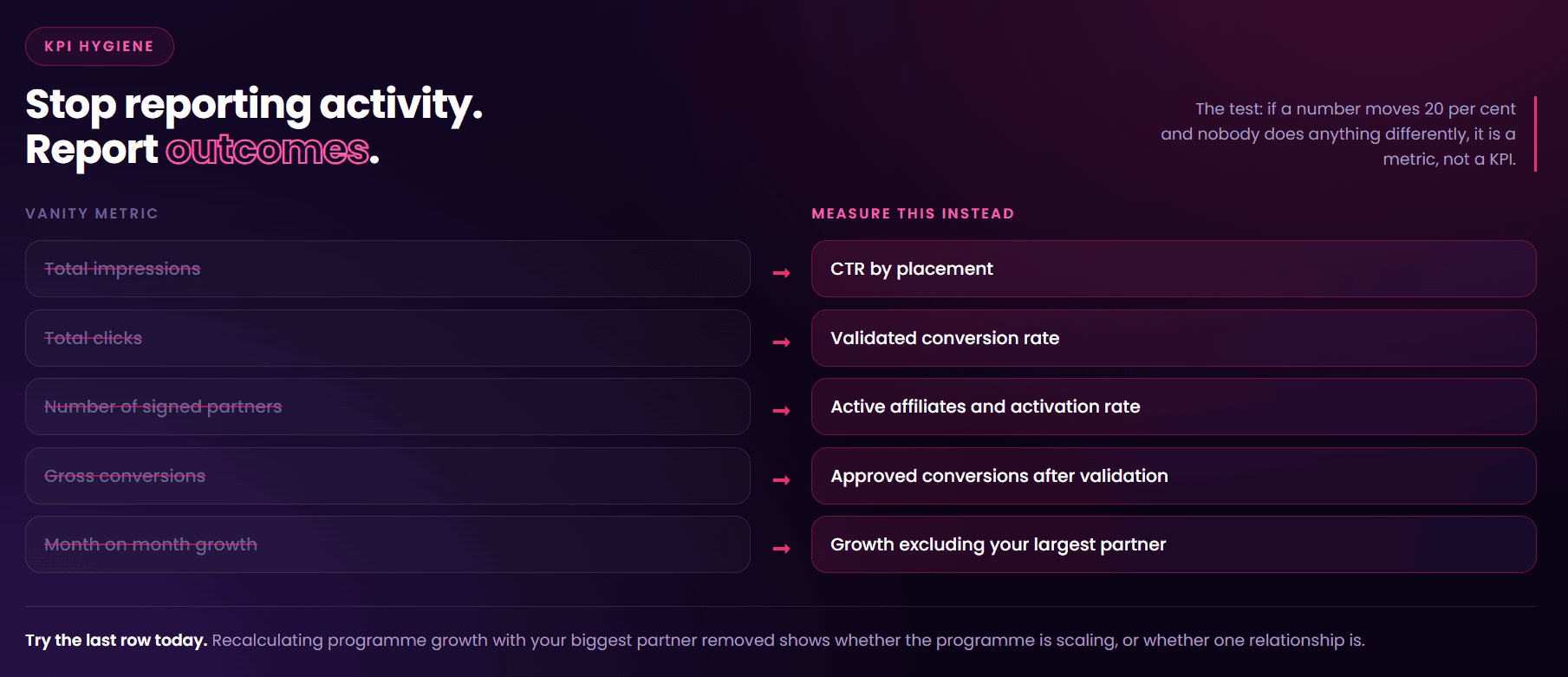
The practical test: if a number moves 20 per cent and nobody does anything differently, it is a metric, not a KPI. Most programmes track too many metrics and too few real KPIs.
Leading versus lagging indicators
| Type | What it does | Examples | Use |
|---|---|---|---|
| Leading | Signals future performance | Active affiliates, activation rate, click volume, creative refresh rate, partner pipeline | Weekly management, early warning |
| Lagging | Confirms what already happened | Revenue, ROI, CLV, retention at 90 days, incremental revenue | Monthly and quarterly evaluation |
Manage the leading indicators. Report the lagging ones. Teams that do the reverse spend their time explaining results they can no longer influence.
Building an affiliate marketing dashboard

A dashboard is not one screen. It is three review rhythms built on the same underlying data.
| Cadence | Audience | What to monitor |
|---|---|---|
| Weekly | Affiliate and partnership managers | Clicks, conversions, conversion rate, approved versus pending conversions, new partner activations, anomalies and fraud flags |
| Monthly | Growth managers, CMO | CAC, ROI or ROAS, revenue per affiliate, AOV, active affiliates, partner league table with quality columns, commission cost, market breakdown, compliance checks |
| Quarterly | Executive, finance, programme owner | CLV and payback period, retention by cohort, new versus returning split, partner concentration, incremental revenue, payout structure review |
Build it in this order:
- Confirm the conversion event and validation rules. Everything else depends on this.
- Standardise partner, campaign and market naming before connecting any data source.
- Pull platform data through an API rather than manual exports.
- Join affiliate data to customer relationship management (CRM) or core product data so you can follow the customer past the conversion.
- Add comparison periods. A number without a prior period is a fact, not an insight.
- Publish on a fixed schedule. Reporting that appears only when someone asks for it stops influencing decisions.
Visualisation matters less than most teams think, with one exception: every chart should make a comparison. Against target, against last period, or against other partners. Standalone totals fill space without informing anything.
Remove anything that has never changed a decision. If a panel has sat there for six months without prompting an action, it is diluting the panels that matter. Circlewise runs this reporting layer inside its partnership hub, which is worth reviewing if you are deciding what to build in house versus what to consolidate.
Attribution and performance measurement
Attribution decides which touchpoint receives credit. Change the model and your partner rankings change even though nothing about partner behaviour has.
| Model | How credit is assigned | Suits | Main risk |
|---|---|---|---|
| First click | All credit to the first touch | Awareness led content programmes | Ignores what actually closed the customer |
| Last click | All credit to the final touch | Most affiliate programmes, clear audit trail | Over rewards partners sitting at the end of the journey |
| Linear multi touch | Credit split evenly | Long consideration journeys | Treats a passing mention like a decisive review |
| Time decay | More credit nearer conversion | Finance products with a research phase | Still undervalues discovery |
| Position based | Weighted to first and last | Mixed partner types | Harder to explain to partners |
| Data driven | Modelled from observed paths | High volume programmes | Needs volume and clean data to be credible |
Cross device tracking matters more than it used to. Someone researches on mobile and completes an application on desktop, and without logged in or server side matching those sessions look like two people. In finance, where the application step often moves to a larger screen, unmatched journeys systematically understate content partners.
Cookie windows set how long after a click a conversion still counts. Short windows suit impulse purchases. Financial products with research phases and onboarding delays need longer ones, and a window set too short will make your best educational partners look ineffective. Consent requirements under GDPR and the ePrivacy rules also reduce what cookie based tracking can see, so expect a gap between platform reported and analytics reported conversions. Server to server tracking limits the loss but does not remove the need for a lawful basis.
Last click remains the practical payment default because it is unambiguous and auditable. Treat it as a payment rule rather than a description of reality, and run assisted conversion reporting alongside it so upper funnel partners can be rewarded through content fees or bonuses instead of a wholesale model change.
Common affiliate reporting mistakes
| Mistake | Consequence | Fix |
|---|---|---|
| Tracking vanity metrics | Activity mistaken for performance | Report CTR, conversion rate and CAC instead of impression and click totals |
| Ignoring customer quality | Volume partners scaled, quality partners cut | Add approval rate, refund rate and 90 day retention to partner scorecards |
| Judging on conversions alone | AOV and lifetime value differences invisible | Rank partners on revenue and retention, not conversion count |
| Measuring short term revenue only | Long payback products look unprofitable | Add cohort views and payback period |
| Poor attribution setup | Partner rankings that do not reflect contribution | Document the model, verify cross device matching, set an appropriate cookie window |
| No incrementality view | Paying for conversions that would have happened anyway | Run controlled partner pauses and geo tests |
| Reporting gross conversions | Overstated performance and disputed invoices | Report approved conversions with a stated validation window |
| Treating tracking as a launch task | Slow data decay nobody notices | Reconcile against CRM monthly, audit tracking quarterly |
Best practices to measure affiliate marketing accurately
- Define the conversion event around commercial value. Funded account, drawn loan, active policy, second purchase. Not the form submission.
- Segment partners by type. Content, comparison, cashback, email and media buying partners behave differently. One leaderboard for all of them produces bad decisions.
- Run cohorts, not just periods. Follow customers acquired in March through to June. Monthly snapshots hide retention problems completely.
- Fix your own funnel before renegotiating payouts. A conversion rate decline visible across all partners is internal until proven otherwise.
- Give partners their own performance data. Transparency improves output and reduces the volume of email you handle.
- Measure by market. A landing page that converts in Germany rarely performs identically in Poland or Spain. Regional averages hide both the wins and the failures.
- Test incrementality at least twice a year. Even a rough controlled pause beats assuming every tracked conversion was caused by the partner.
- Reconcile monthly. Platform conversions against CRM records. A persistent variance above a few per cent usually indicates a tracking implementation problem.
If you are also running paid channels alongside the programme, comparing them fairly requires equivalent cost scope on both sides, which is covered further in our guide to maximising ROI with performance marketing.
Affiliate performance optimisation checklist
Work through this quarterly:
- Conversion event still matches commercial reality
- Tracking verified end to end, including postbacks and parameter passing
- Cookie window appropriate to the product’s decision cycle
- Cross device and logged in matching confirmed
- Consent coverage understood and its effect on reported data documented
- Approved versus gross conversion reporting applied consistently
- Partner scorecards include quality metrics, not only volume
- Payout structures checked against current customer lifetime value
- Bottom quartile partners reactivated, restructured or removed
- Assisted conversion report reviewed for undervalued upper funnel partners
- One incrementality test scheduled
- Compliance sweep of partner content against applicable EU frameworks
- Reporting pack reviewed for panels nobody uses
KPI focus by business goal
| Business goal | Primary KPIs | Secondary KPIs | What to watch for |
|---|---|---|---|
| Awareness | Clicks, assisted conversions, new partner activations | CTR, reach by partner type | Traffic growth with no movement in conversions |
| Acquisition | Conversion rate, CAC, active affiliates | Approval rate, activation rate | Volume rising while approval rate falls |
| Revenue | Revenue, AOV, revenue per affiliate, ROI | EPC, sales volume | Growth driven entirely by one partner |
| Retention | CLV, new versus returning split, 90 day retention | Refund and cancellation rate | Low CAC paired with early churn |
Note the pattern across all four rows. The informative number usually sits after the conversion, not at it.
Key takeaways
- Measure at the point where a customer becomes commercially real, not where the pixel fires.
- Keep five to eight genuine KPIs. Everything else is a metric you report but do not manage.
- Manage leading indicators weekly. Report lagging indicators monthly and quarterly.
- Attribution is a payment rule, not a description of reality. Document your model before setting targets.
- Assisted conversions and incrementality are how content partners get valued fairly.
- Customer quality metrics, particularly approval rate and 90 day retention, catch problems months before customer acquisition cost does.
- Reconcile platform data against CRM monthly. Tracking decays quietly.
Conclusion
The teams that measure affiliate marketing well are not running more sophisticated analytics than everyone else. They have simply made a few decisions properly and stuck to them: a conversion event tied to real value, a documented attribution model, partner scorecards that include quality, and a reporting rhythm that separates weekly management from quarterly evaluation.
Start with three actions this month. Recalculate programme growth with your largest partner excluded. Pull approval rate by partner for the last 90 days and rank it against conversion volume. Check whether your acquisition cost calculation includes management and platform costs.
Circlewise manages affiliate programmes and partner analytics for financial brands across more than ten European markets, covering tracking infrastructure, attribution reporting and ongoing optimisation. For sector specific measurement considerations, including regulated product conversion events and partner compliance monitoring, see our fintech affiliate marketing work.
Frequently asked questions
How do you measure affiliate marketing performance?
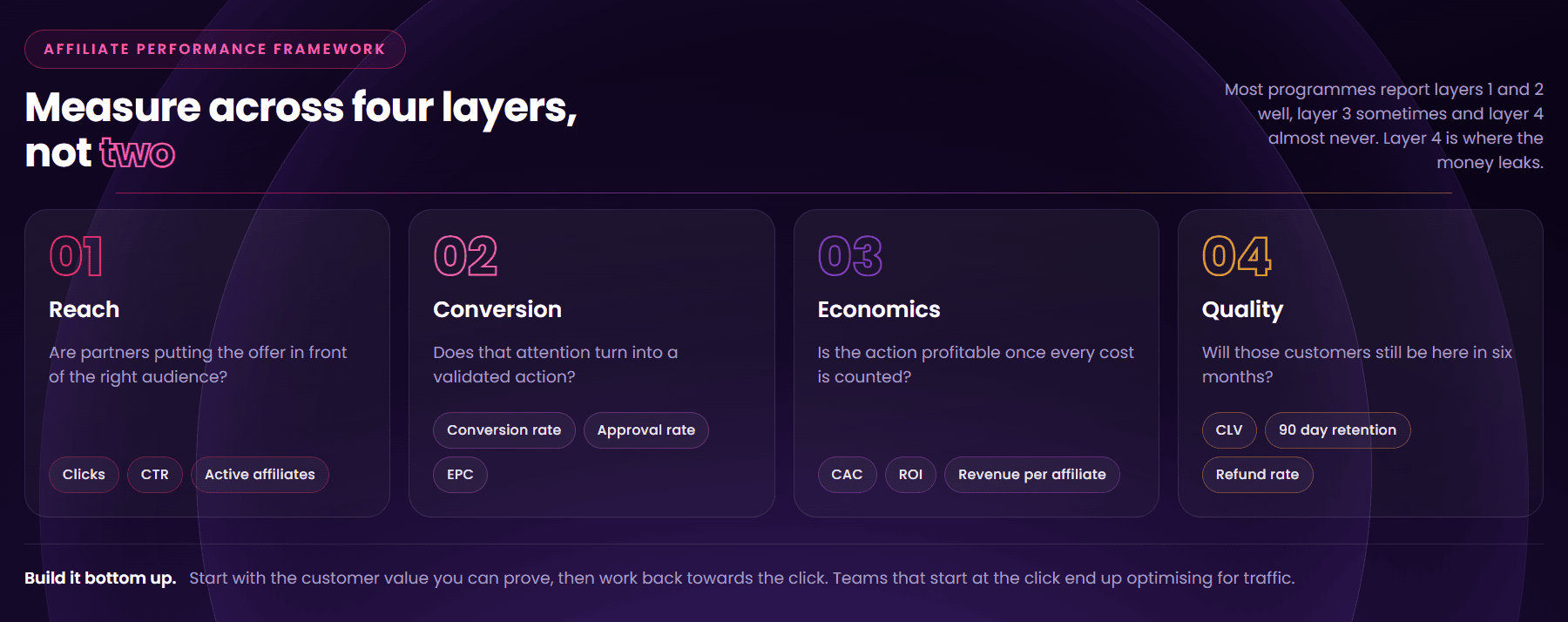
Track four layers together: reach (clicks, active affiliates), conversion (conversion rate, approval rate), economics (customer acquisition cost, return on investment, earnings per click) and customer quality (customer lifetime value, retention, refund rate). Reporting only the first two layers is the most common weakness in affiliate programmes.
What are the most important affiliate marketing KPIs?
Conversion rate, earnings per click (EPC), customer acquisition cost (CAC), return on investment (ROI), customer lifetime value (CLV), active affiliates and affiliate activation rate. Programmes selling high value or regulated products should add approval rate and 90 day retention.
What is the difference between affiliate KPIs and affiliate metrics?
A metric is any number you can measure. A KPI is a metric tied to a business objective, owned by someone, and reviewed against a target. Most programmes track dozens of metrics and only need five to eight KPIs.
How do you calculate affiliate marketing ROI?
Subtract total channel cost from the net return generated by affiliate acquired customers, divide by total channel cost, then multiply by 100. Channel cost must include commissions, platform fees, management time and creative production.
What is a good affiliate conversion rate?
There is no reliable universal figure. Published benchmarks vary too widely by vertical, market and traffic type to be useful. Benchmark against your own trailing 90 day average and compare partners of the same type against each other rather than across categories.
Which attribution model should affiliate programmes use?
Last click is the practical default because it is unambiguous to pay against and simple to audit. Run assisted conversion reporting alongside it so partners contributing earlier in the journey can be rewarded through content fees or bonuses.
How do cookie windows affect affiliate measurement?
The cookie window sets how long after a click a conversion still counts. Short windows suit impulse purchases. Financial products with research and onboarding phases need longer windows, otherwise educational and comparison partners will appear less effective than they are.
What are vanity metrics in affiliate marketing?
Impressions, total clicks, total signed partners and gross conversions before validation. They describe activity rather than outcomes. Replace them with CTR by placement, validated conversion rate, active affiliates and approved conversions.
How does GDPR affect affiliate performance tracking?
Consent requirements under GDPR and the ePrivacy rules limit cookie based tracking, creating gaps between platform reported and analytics reported conversions. Server to server tracking reduces data loss but does not remove the need for a lawful basis, and the advertiser remains responsible for how partners handle personal data.
How often should affiliate performance be reviewed?
Weekly for operational metrics and anomalies, monthly for acquisition cost, ROI and partner league tables, quarterly for lifetime value, cohort retention and payout structure. Tracking should be reconciled against CRM data monthly and audited quarterly.