Picking the wrong affiliate network costs more than a missed commission. It costs months of integration work, wasted publisher recruitment, and programmes that never gain traction. For European advertisers and publishers, the choice is made harder by the sheer number of networks claiming pan-European coverage, each with different strengths, fee structures, and market depth.
So which are the best affiliate networks for businesses operating in Europe? The honest answer is that no single network fits every situation. The right pick depends on your vertical, target countries, whether you are an advertiser or a publisher, what commission models you need, and how much programme management support you expect. This guide compares seven established European affiliate networks side by side and gives you a practical framework for making the decision yourself.
What is an affiliate network?
An affiliate network is a technology platform and marketplace that connects advertisers (brands that want to sell) with publishers (partners who promote those products to their audiences). The network provides tracking infrastructure to attribute conversions, handles commission payments, and gives both sides reporting tools to monitor performance.
Think of it as the infrastructure layer between a brand and its affiliate partners. Without a network, an advertiser would need to build its own tracking, negotiate individual publisher deals, process invoices in multiple currencies, and manage fraud prevention from scratch. A network packages all of that into one platform.
Three roles interact inside every affiliate network:
- Advertisers list their programmes, set commission structures (CPA, CPL, or hybrid models), and define terms.
- Publishers browse available programmes, apply, and promote offers using tracked links.
- The network tracks clicks, conversions, and commissions, then processes payments to publishers on a regular cycle.
One thing worth noting: the quality of a network is not just its technology. It is the quality of the publishers it attracts, the advertisers it retains, and the account management support it provides in each market. A network with impressive headline numbers but thin coverage in your target countries will not deliver results.
Best affiliate networks in Europe: comparison at a glance
Before diving into individual profiles, here is a quick overview of the seven networks compared in this article. Click any network name to jump to its full profile below.
| Network | Best for | European coverage | Key strength |
|---|---|---|---|
| Circlewise | Fintech and financial services | 10+ European markets | Financial services specialism + Partnership Hub |
| Awin | Broad multi-vertical reach | Pan-European + global | Scale: 30,000+ advertisers, 1M+ publishers |
| Adtraction | Nordic and northern Europe | 12 countries with local offices | Local market depth, Nasdaq-listed |
| Tradedoubler | Enterprise European brands | 90+ markets | 25+ years, network + SaaS + white-label |
| Daisycon | Benelux, DACH, France | Benelux, Germany, France, Nordics | Lead generation and 40,000+ publishers |
| TradeTracker | Transparent mid-market | 19 countries, 16 offices | Fee transparency and support |
| Admitad | International + emerging markets | DACH, Eastern Europe, CIS, Asia | Cross-border emerging market reach |
A more detailed comparison table with advertiser focus, publisher focus, and tracking capabilities appears after the individual profiles.
How to choose the best affiliate network in Europe

Before comparing individual networks, you need a clear evaluation framework. Too many businesses pick a network based on brand recognition alone, then discover six months later that the publisher base in their target market is thin or the tracking does not support their commission model.
Here are the factors that matter most, roughly in order of priority for European businesses.
Geographic coverage
Europe is not one market. A network that performs well in the Nordics may have minimal presence in southern or central Europe. Ask specifically about publisher density and advertiser presence in your target countries, not just the number of flags on a website.
Vertical and programme selection
Some networks are stronger in retail and e-commerce, others in finance, travel, or SaaS. If you operate in financial services, a network with deep fintech publisher relationships will outperform a generalist platform with ten times the total advertiser count.
Publisher quality
Reach matters less than relevance. A smaller pool of vetted, high converting publishers often delivers better ROI than an enormous but unfiltered marketplace. Ask how the network screens publishers and whether it actively recruits partners in your sector.
Tracking and attribution
Cookie-based last click tracking is fading. Look for server-to-server tracking, cross-device attribution, and compliance with European privacy regulations (GDPR, the ePrivacy rules). If you run multi-touch campaigns, check whether the platform supports conversion path attribution beyond last click.
Commission flexibility
European affiliate programmes increasingly use CPA (cost per action), CPL (cost per lead), or hybrid models combining CPL with CPS (cost per sale). The hybrid model is common in finance and investment: a CPL paid upfront, plus a CPS earned on the lead’s transaction volume in the first 90 to 180 days after registration, sometimes with a fixed fee for content production. Make sure the network supports the model that fits your product economics.
Reporting and optimisation
Can you see real-time performance data? Can you break down results by publisher, country, device, and campaign? Good reporting is not just about dashboards; it is about having the granularity to make optimisation decisions quickly.
Payment processes
For cross-border European programmes, payment in local currencies, automated invoicing, and reliable payout schedules matter. Ask about payment terms, minimum thresholds, and currency options before committing.
Compliance
Any network handling financial services or regulated products in Europe needs to support compliance with MiFID II, the EU Consumer Credit Directive, and GDPR at a minimum. This is not optional; weak compliance infrastructure creates regulatory risk for the advertiser.
Support and account management
A dedicated account manager who understands your market is worth more than a self-service dashboard with no local support. This is especially true when launching in new European markets where publisher relationships and cultural nuances make a real difference.
Best affiliate networks in Europe (2026)
The following seven networks are well established in European affiliate marketing. Each has different strengths, and the right choice depends on your business requirements.
Circlewise
Overview: Circlewise is a European affiliate marketing network and partnership platform. It operates across 10+ European markets with a particular specialism in fintech, financial services, and e-commerce verticals. The platform combines network services with its Partnership Hub, an affiliate tracking and management platform for businesses that want to build and control their own programmes. According to its platform data, Circlewise has tracked over 600 million events and more than one billion euros in investment volume.
Best for: Fintech companies, investment platforms, lending businesses, and e-commerce brands looking for a European-focused network with hands-on programme management and financial services expertise.
Key strengths: Deep experience in financial services verticals, with over 200 active affiliate programmes across finance and e-commerce. The network offers dedicated account management, publisher recruitment, and a marketplace of 11,000+ connected affiliate partners. Conversion path attribution is available for advertisers who need multi-touch tracking. Automated, tax-compliant self-invoicing simplifies cross-border publisher payments.
Geographic coverage: Active across 10+ European markets, with local expertise in Central and Western Europe, the Nordics, and growing presence in southern and eastern European markets.
Potential limitations: Circlewise is a smaller network than Awin or Tradedoubler, which means its total programme count is lower. Businesses seeking very broad non-European coverage may need to supplement with an additional network.
Consider as an alternative to: Awin or Tradedoubler if you want specialist financial services expertise without the overhead of a large generalist network; Adtraction if your vertical focus is finance rather than broad e-commerce.
Best fit: European fintech and financial services brands that want specialist affiliate expertise, programme management support, and the option to build their own in-house programme through a managed platform. Also strong for publishers focused on finance and investment verticals.
Awin
Overview: Awin is one of the largest global affiliate networks, formed from the merger of Affiliate Window and Zanox. Headquartered in Berlin and London, it operates across more than 180 countries with a strong European heritage. The network connects over 30,000 advertisers with more than one million approved publishers.
Best for: Advertisers and publishers looking for broad global and European coverage across retail, travel, finance, and telecoms.
Key strengths: Sheer scale across both Europe and North America makes it a strong option for cross-border programmes. The platform was recognised among G2’s best marketing and advertising software products of 2026. Awin has invested in AI-driven partner recommendations through its Ava tool.
Geographic coverage: Pan-European with dedicated local teams. Strong presence across the UK, DACH, France, Benelux, Nordics, Spain, Italy, and Poland, plus global reach into the US, Brazil, and Asia-Pacific.
Tracking and technology: Cross-device tracking, server-to-server conversion attribution, and real-time reporting. API access for enterprise advertisers.
Potential limitations: The sheer size of the network can make it harder for smaller advertisers to stand out. Some publishers report that the approval process and publisher deposit (currently required in some markets) create a barrier to entry. According to third-party analysis by Spires Digital, network fees are on the higher end at typically 25 to 30% override on publisher commissions, with setup fees in the region of EUR 3,500 to 6,000.
Consider as an alternative to: Tradedoubler if you want broader global reach; Circlewise if your priority is scale over vertical specialism.
Best fit: Established brands running multi-market European programmes who need scale and broad vertical coverage.
Sources: Awin official website; G2 Awards 2026; Spires Digital network comparison (April 2026); Awin pricing page.
Adtraction
Overview: Adtraction is a Nordic-origin partner marketing platform founded in Stockholm in 2007. Listed on Nasdaq First North Growth Market (ticker: ADTR), it has expanded through acquisitions (Connects in Switzerland, Digital Advisor and Adservice in Denmark, Affiliate Future in the UK) and now operates local offices across 12 European countries. In Q1 2026, Adtraction reported revenue of SEK 314.7 million, beating analyst forecasts, driven by strong e-commerce and finance performance.
Best for: Advertisers and publishers focused on Nordic and wider European markets, particularly in e-commerce, finance, and travel.
Key strengths: Genuine local presence in every market it operates in. Adtraction is the largest partner marketing platform by revenue in the Nordic region. Free access for publishers with payouts in local currencies. The platform hosts over 2,400 affiliate programmes, with a high proportion exclusive to the network. Its Q2 2026 results showed 19.5% sales growth year on year, with both finance and e-commerce segments expanding at double digits.
Geographic coverage: Sweden, Norway, Denmark, Finland, Germany, Netherlands, Spain, Poland, UK, Switzerland, France, and Italy.
Potential limitations: Adtraction’s strength is regional depth rather than global reach. Advertisers looking for significant presence outside Europe may need to supplement with a second network.
Consider as an alternative to: Awin if you want deeper Nordic relationships over global scale; Daisycon if your focus is Scandinavia rather than Benelux.
Best fit: Brands that prioritise Nordic and northern European markets, or those that value local account management and publisher relationships over global scale.
Sources: Adtraction official website; Nasdaq First North filings; Investing.com Q1 2026 earnings coverage; Investing.com Q2 2026 slides coverage.
Tradedoubler
Overview: Tradedoubler was one of the first affiliate networks in Europe, founded in Stockholm in 1999 by Martin Lorentzon (who later co-founded Spotify). Listed on Nasdaq Stockholm (ticker: TRAD) since 2005, it operates across more than 90 markets with approximately 365 employees. Majority-owned (53.7%) by French media group Reworld Media, the company generated more than SEK 56 billion in incremental revenue for its clients through e-commerce and m-commerce channels in 2024, according to an Edison Group research note.
Best for: Established European advertisers and publishers across retail, travel, finance, and technology who want a mature platform with a long market track record.
Key strengths: Over 25 years of European affiliate experience. Tradedoubler supports more than 3,000 brands and 180,000+ publishers. It offers both network services and SaaS/white-label solutions for businesses that want to run their own programmes. Its influencer marketing subsidiary, Metapic, operates a network of 100,000 influencers across Europe.
Geographic coverage: Pan-European with genuine depth. Largest employee concentrations in Sweden and Poland, with offices in France, Spain, the UK, Germany, and Italy. Recently expanded into the US market (Miami office opened in 2025).
Potential limitations: Some user reviews note that the platform interface can feel dated compared to newer competitors. Smaller advertisers may find the enterprise-oriented onboarding process slower than expected.
Consider as an alternative to: Awin if you prefer a European-headquartered enterprise platform with SaaS options; Circlewise if you want broad vertical coverage rather than financial services specialism.
Best fit: Enterprise-level European advertisers who need a proven platform with deep market history and flexible deployment options (managed, SaaS, or white-label).
Sources: Tradedoubler official website; Wikipedia; Edison Group research note (November 2025); Nasdaq Stockholm filings; Reworld Media/MarketScreener.
Daisycon
Overview: Daisycon has been operating in European affiliate marketing since 2000. Part of the Linehub collective of marketing agencies and headquartered in Almere, Netherlands, it is the largest Dutch affiliate network by active publisher count.
Best for: Advertisers and publishers focused on the Benelux region, Germany, France, and the Nordics, especially in e-commerce, finance, insurance, and lead generation.
Key strengths: Access to over 40,000 publishers across Europe, with more than 70,000 active websites in the Netherlands alone. Daisycon offers CPA, CPL, and CPC commission models, along with specialised lead generation and app install services. Performance-based pricing means advertisers pay only for results.
Geographic coverage: Primary focus on the Netherlands, Belgium, Germany, France, and the Nordics, with broader European reach.
Potential limitations: While Daisycon is expanding, its strongest publisher density remains concentrated in the Benelux region. Advertisers targeting southern or eastern Europe may find thinner coverage.
Consider as an alternative to: Adtraction if your primary market is Benelux rather than Scandinavia; TradeTracker if you want a Dutch network with stronger lead generation capabilities.
Best fit: Brands with strong Benelux or DACH market needs, or those looking for a mid-size network with a personal service approach and strong lead generation capabilities.
Sources: Daisycon official website; Linehub group information.
TradeTracker
Overview: TradeTracker was founded in the Netherlands in 2004 and operates across 19 countries, predominantly in Europe. It connects approximately 5,000 advertisers with publishers across retail, fashion, finance, home, and travel verticals.
Best for: European advertisers and publishers who value transparent tracking, intuitive dashboards, and responsive account management.
Key strengths: TradeTracker is praised for transparent commission reporting (visible advertiser fees, which is uncommon), low minimum payment thresholds, and strong customer support. The platform offers proprietary attribution technology (“Real Attribution”) and real-time conversion tracking.
Geographic coverage: Offices in 16 countries, primarily across Europe. Active advertiser programmes in 19 markets.
Potential limitations: A smaller advertiser catalogue compared to Awin or Tradedoubler. Payment options are more limited (primarily bank transfer). Publishers seeking a very large programme selection may find the range more focused.
Consider as an alternative to: Daisycon if you want broader European coverage from a Dutch network; Awin if you prefer transparency and personal service over scale.
Best fit: Mid-market European advertisers and publishers who prioritise transparency, direct communication, and a well-designed platform over sheer network size.
Sources: TradeTracker official website; independent network reviews.
Admitad
Overview: Admitad was founded in Germany in 2009 and is now headquartered in Dubai, with offices across Europe, Asia, and the Americas. It connects over 30,000 advertisers with more than 100,000 active publishers across 20+ markets, working with global brands including Lenovo, Nike, Adidas, and Booking.com.
Best for: Publishers and advertisers looking for broad international reach that spans Europe, CIS, Asia, and emerging markets.
Key strengths: Strong cross-border capabilities, weekly payment options for publishers, and a diverse monetisation toolkit including coupons, deals, and mobile SDK tracking. Admitad acquired Tapfiliate, expanding its offering for smaller businesses. Active fraud detection and publisher vetting processes.
Geographic coverage: Western Europe (especially the DACH region), Eastern Europe, CIS, India, South-East Asia, and North America. Particularly strong in markets that some European networks underserve.
Potential limitations: The breadth of Admitad’s geographic coverage means that European publisher depth in specific markets may not match networks with a more concentrated regional focus. Mixed publisher reviews suggest service quality can vary by market.
Consider as an alternative to: Awin if you need stronger eastern European and CIS reach; Circlewise if you want broad geographic coverage rather than vertical specialism.
Best fit: Businesses that need affiliate reach beyond western Europe, particularly into eastern Europe, CIS, or Asian markets, alongside their European programmes.
Sources: Admitad official website; Tapfiliate acquisition announcements.
Detailed comparison table
| Network | Best for | European coverage | Advertiser focus | Publisher focus | Key strength | Tracking |
|---|---|---|---|---|---|---|
| Circlewise | Fintech and financial services | 10+ European markets | Fintech, investment, lending, e-commerce | 11,000+ partners, finance-focused | Financial services specialism | Conversion path attribution, Partnership Hub |
| Awin | Broad multi-vertical reach | Pan-European + global | Retail, travel, finance, telecoms | 1M+ approved publishers | Scale and global reach | Cross-device, server-to-server, AI insights |
| Adtraction | Nordic and northern Europe | 12 countries with local offices | E-commerce, finance, travel | Local currency payouts, free access | Local market depth | Cloud-based, transparent reporting |
| Tradedoubler | Enterprise European brands | 90+ markets | Retail, travel, finance, tech | 180,000+ publishers | 25+ years of European experience | Proprietary, SaaS and white-label options |
| Daisycon | Benelux, DACH, France | Benelux, Germany, France, Nordics | E-commerce, finance, insurance, lead gen | 40,000+ across Europe | Lead generation and app installs | Real-time, custom attribution |
| TradeTracker | Transparent mid-market | 19 countries, 16 offices | Retail, fashion, finance, travel | Visible fees, low thresholds | Transparency and support | Real-time, proprietary attribution |
| Admitad | International + emerging markets | DACH, Eastern Europe, CIS, Asia | Multi-vertical, 30,000+ brands | 100,000+ active publishers | Cross-border emerging market reach | Mobile SDK, dual-channel attribution |
How much does it cost to join an affiliate network?
This is one of the most common questions, and the industry has not always been transparent about it. Here is what you can realistically expect.
Publisher costs
Most European affiliate networks do not charge publishers a membership fee. You sign up, get approved, and earn commissions on performance. Awin is a notable exception: it requires a small refundable deposit (around EUR 5) from publishers in some markets, and its tracking fee structure means a percentage of advertiser-paid commissions goes to the network before publishers are paid.
Advertiser costs
For advertisers, affiliate network pricing typically has three components:
| Cost component | Typical range | Notes |
|---|---|---|
| Setup or onboarding fee | EUR 0 to 6,000+ | Some networks waive this; enterprise setups with managed onboarding cost more. Awin’s setup fee is reported in the EUR 3,500 to 6,000 range by Spires Digital. |
| Network override (commission fee) | 2.5% to 30% of commissions or sale value | This is the network’s cut on each tracked conversion. Awin’s self-service tier charges a 2.5% tracking fee on sale value. Managed programmes at larger networks typically carry a 20 to 30% override on publisher commissions. |
| Monthly platform fee | Varies widely | Ranges from around EUR 75/month for self-service tiers up to custom enterprise pricing. Some networks bundle this into the override. |
These figures are drawn from published pricing pages (Awin) and third-party analysis (Spires Digital, Track360). Exact costs are almost always negotiated individually, especially for managed programmes, so request a detailed proposal from any network you are evaluating.
One common mistake: comparing only the network override percentage without factoring in the setup fee, monthly minimums, and contract length. A network charging a lower override but requiring a 12-month commitment with a high monthly minimum can end up costing more than one with a higher override but no lock-in.
Best affiliate networks for advertisers
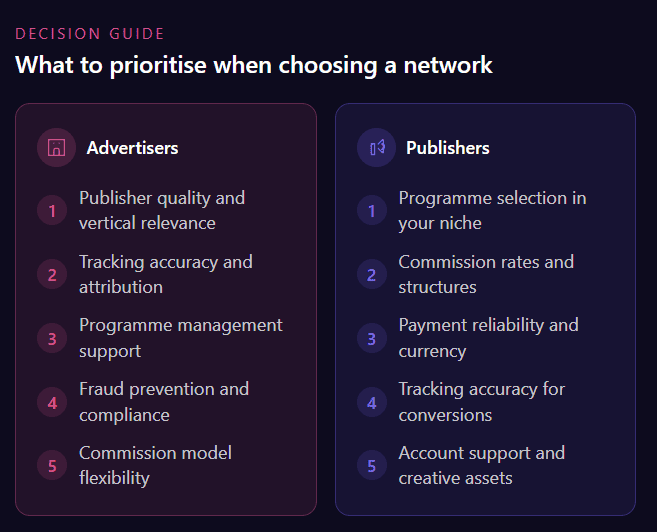
If you are an advertiser evaluating networks, your priorities are different from those of a publisher. Focus on these factors:
Publisher quality over quantity. A network with 10,000 relevant, vetted publishers in your vertical will outperform one with 500,000 unqualified partners. Ask for publisher breakdowns by country and sector before signing.
Programme management. Will you get a dedicated account manager? Will the network actively recruit publishers for your programme, or just list it and leave you to attract partners yourself? This distinction matters more than most advertisers realise.
Tracking accuracy. In regulated industries like financial services, accurate attribution is not just a reporting preference; it is a compliance requirement. Server-to-server tracking and GDPR-compliant cookie handling are non-negotiable.
Commission model support. Make sure the network supports the payout structure your product economics require. For high-value financial products, a hybrid CPL + CPS model often works better than flat CPA, but not every network handles hybrid commissions smoothly.
Fraud prevention. What vetting does the network apply to publishers? How does it detect click fraud, lead fraud, or brand bidding violations? A network that cannot answer these questions clearly is a liability.
Best affiliate networks for publishers
Publishers evaluate networks through a different lens. If you are a publisher comparing options, browse the available affiliate programmes at each network to assess whether the advertisers match your audience and content focus.
Programme availability. Does the network carry programmes in your niche and target countries? A comparison site focused on Nordic investment platforms needs a network with strong finance programmes in Scandinavia, not a generalist with 50,000 retail offers.
Commission structures and rates. Compare what you can actually earn, not just the headline CPA. Factor in approval rates, validation timescales, and whether the network offers performance bonuses or tiered commissions for top publishers.
Payment reliability. Late or inconsistent payouts erode trust quickly. Check the network’s payment cycle, minimum payout threshold, available payment methods, and whether it pays in your local currency.
Tracking accuracy. If conversions are not tracked correctly, you do not get paid. Ask about cookie duration, server-to-server tracking fallback, and how the network handles cross-device attribution.
Account support. A responsive account manager who can escalate advertiser issues, provide creative assets, and share performance insights makes a material difference to publisher earnings over time.
Affiliate network vs affiliate marketing software
This is a distinction that trips up many businesses, so it is worth clarifying.
An affiliate network provides a marketplace. It connects advertisers with an existing pool of publishers, handles tracking, and processes payments. You are joining an ecosystem.
Affiliate marketing software (sometimes called an affiliate platform or SaaS solution) provides the technology for a business to run its own affiliate programme independently. You recruit your own publishers, set your own terms, and manage the programme in-house using the software’s tracking and reporting tools.
Some businesses use both. They run their own programme through a platform for direct partnerships, while also listing on one or more networks to access a broader publisher base. Circlewise’s Partnership Hub is an example of this approach: it gives advertisers the option to manage their own partner ecosystem on a managed platform while still accessing the wider Circlewise publisher marketplace.
The decision between the two depends on your resources, scale, and how much control you want over publisher relationships.
Common mistakes when choosing an affiliate network
After seeing dozens of European businesses go through this process, certain mistakes come up repeatedly:
Choosing on network size alone. The biggest network is not always the best fit. What matters is publisher density and quality in your specific vertical and target markets.
Ignoring geographic realities. A network with 20 country flags on its website may have genuine depth in only three or four of those markets. Always ask for market-specific publisher and programme data.
Focusing only on commission rates. The cheapest network fee means nothing if the publishers do not convert. Total programme economics, including conversion rates, average order values, and validation timescales, matter more than headline commission percentages.
Skipping tracking evaluation. If you do not test the tracking before committing, you are taking the network’s word for it. Run a technical integration test, especially if you operate in a regulated sector where attribution accuracy has compliance implications.
Overlooking compliance. For financial services brands in Europe, the network’s approach to GDPR, MiFID II disclosures, and affiliate content compliance is a deal-breaker. A network that cannot demonstrate compliance infrastructure is a risk, not a partner.
Not defining success criteria upfront. Before evaluating networks, write down what a successful programme looks like in 6 and 12 months. Without clear objectives, every network will seem like a reasonable option, and you will choose based on the best sales pitch rather than the best fit.
Which affiliate network should you choose?
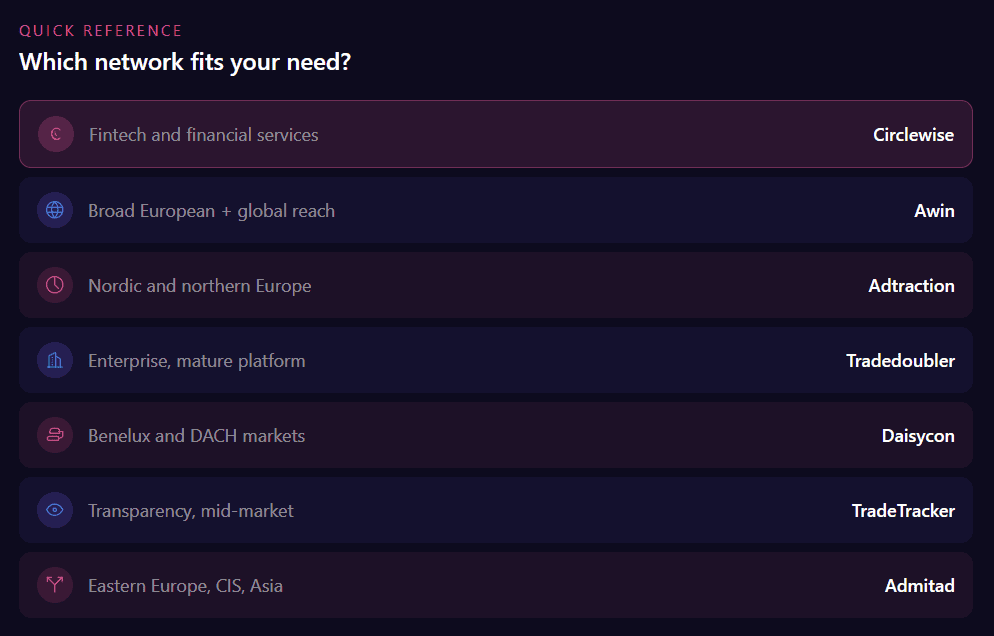
Rather than ranking networks from “best” to “worst,” use this decision framework:
If you operate in fintech, financial services, or investment: Circlewise offers specialist financial services expertise, dedicated programme management, and the option to run your own programme through its Partnership Hub, alongside access to a curated European publisher marketplace.
If you need broad European and global reach: Awin offers the widest advertiser and publisher base across the most markets.
If your priority is Nordic and northern European markets: Adtraction’s local office presence and publisher relationships in Scandinavia are hard to match.
If you are an enterprise brand wanting a mature, flexible platform: Tradedoubler brings 25+ years of European experience with network, SaaS, and white-label options.
If your focus is Benelux or DACH markets: Daisycon’s publisher density in the Netherlands, Belgium, and Germany is a genuine competitive advantage.
If you value transparency and mid-market personal service: TradeTracker offers clear fee visibility and responsive support across 19 European markets.
If you need reach into eastern Europe, CIS, or Asian markets: Admitad covers geographies that most European-focused networks do not serve well.
Most businesses serious about affiliate marketing in Europe end up working with more than one network. That is normal and often advisable. Different networks serve different markets and verticals better, and diversifying your network presence reduces dependency on any single platform.
Conclusion
The best affiliate networks in Europe are the ones that match your specific business model, target markets, and growth objectives. There is no universal answer. A fintech company launching its first European affiliate programme has very different needs from a retail brand scaling across 15 markets.
What matters is evaluating networks against clear criteria: geographic depth in your target countries, publisher quality in your vertical, tracking accuracy, commission model support, compliance infrastructure, and the quality of account management you will actually receive.
Take the time to speak with two or three networks, test their platforms, and ask for references from advertisers or publishers in your sector. The best decision is an informed one.
For businesses in financial services or fintech looking for a specialist European affiliate network with hands-on programme management, Circlewise is worth including in your evaluation. But so are the other networks on this list, depending on your priorities.
Frequently asked questions
What is the best affiliate network in Europe?
There is no single best network. The right choice depends on your industry, target countries, whether you are an advertiser or publisher, and what level of support you need. Awin offers the broadest reach, Adtraction is strongest in the Nordics, and Circlewise specialises in fintech and financial services.
Which affiliate network is best for advertisers?
Advertisers should prioritise publisher quality, programme management support, and tracking accuracy over raw network size. For regulated industries like finance, a network with compliance expertise and fraud prevention is often more effective than a generalist platform.
Which affiliate network is best for publishers?
Publishers should look at programme availability in their niche, commission rates and structures, payment reliability, and tracking accuracy. Awin and Tradedoubler offer the widest programme selection, while Adtraction and Daisycon provide strong regional depth.
Are affiliate networks free for publishers?
Most European affiliate networks do not charge publishers a membership fee. Publishers earn commissions on performance. Some networks may require a small deposit or have minimum traffic requirements for approval, but the standard model is free to join.
What is the difference between an affiliate network and affiliate software?
An affiliate network provides a marketplace connecting advertisers and publishers, along with tracking and payment infrastructure. Affiliate software provides the technology for a business to run its own programme independently. Some platforms, like Circlewise’s Partnership Hub, combine both capabilities.
Which affiliate networks operate across Europe?
Awin, Tradedoubler, Adtraction, Daisycon, TradeTracker, Admitad, and Circlewise all operate across multiple European markets. Coverage depth varies: Awin and Tradedoubler have the broadest multi-country presence, while Adtraction and Daisycon have stronger density in specific regions.
How do affiliate networks make money?
Affiliate networks typically earn revenue through a commission override (a percentage added on top of the affiliate commission paid by the advertiser), setup or onboarding fees, and monthly platform fees. Override fees typically range from 2.5% to 30% depending on the network and service level.
What should advertisers look for in an affiliate network?
Focus on publisher quality in your vertical and target markets, tracking and attribution capabilities, commission model flexibility (CPA, CPL, hybrid), compliance infrastructure, fraud prevention, programme management support, and payment processes for cross-border programmes.
How do I compare affiliate networks effectively?
Define your business objectives and success criteria first. Then evaluate each network against specific factors: geographic coverage, vertical expertise, publisher density in your target markets, tracking technology, commission flexibility, support quality, and compliance capability. Request demonstrations and speak with existing clients where possible.
Can I use more than one affiliate network?
Yes, and many European businesses do. Running programmes across multiple networks can help you access different publisher bases and reach more markets. The trade-off is additional management complexity, so weigh the benefits against your internal capacity to manage multiple network relationships.